




Northville Senior Relocation Guide
Downsizing in Northville: What Seniors Should Know Before Selling the Family Home
The tax rules, timing choices, and next-home options that matter most when you leave a longtime Northville home.
24 Years
Oakland County Experience
700+
Closed Transactions
Top 1%
Oakland County Agents
SRES®
Seniors Real Estate Specialist
TL;DR
Before a longtime Northville homeowner downsizes, three things deserve attention: how Michigan property-tax uncapping may affect the next home, whether to sell or buy first, and which nearby community fits the next stage of life. A smaller home does not guarantee a smaller tax bill. Estimate the taxes after a qualifying transfer and plan the sale, purchase, and clear-out together.
If you have owned your Northville home for 20 or 30 years, the most important thing to know before you downsize is that your next home may have a very different tax bill from the one you have now. That single fact changes budgets, timelines, and sometimes the choice of where to move. I have helped a lot of Oakland County families through this step, and the ones who plan for it early have a much easier time.
Downsizing is rarely just a real estate decision. It is a decision about stairs, yard work, being near grandchildren, and what to do with a basement full of memories. It usually involves adult children too, who may live out of state and want to help without taking over.
This guide is written for both groups. It covers the Michigan tax rules that surprise people, the timing choices you actually have, and where Northville downsizers tend to land. As a Seniors Real Estate Specialist (SRES), this is the part of my work I take most seriously.
Start With the Tax Question Nobody Asks
Michigan limits annual growth in taxable value under Proposal A, adopted in 1994. The cap is generally inflation or 5 percent, whichever is lower, with adjustments for additions and losses. This limits taxable value, not the annual tax bill itself. After long ownership, taxable value can be well below current market value.
Your old taxable-value cap does not transfer to a new home. Under the Michigan Treasury ownership-transfer rules, a qualifying transfer generally causes taxable value to uncap to state equalized value (SEV) in the following calendar year. Statutory exceptions apply to certain transfers. SEV reflects assessed market value; it is not automatically half the purchase price. Ask the local assessor for an estimate for the exact property.
So a smaller, less expensive home can still come with a higher tax bill than the one you are leaving. People are often caught off guard by this when the first full-year tax bill arrives. The fix is simple: estimate the new home's taxes before you buy it, using its likely taxable value after purchase, not the seller's current bill.
Budget using currently effective tax rules, rather than assuming a proposed change will pass. For background on the legislative proposals, read Could Michigan End the "Pop-Up" Tax? Confirm current rules with Treasury and the local assessor before making a purchase decision.
Questions to discuss before you downsize: use these to compare your budget, timing, and next-home choices with your family and advisers.
Homeowner: "Will my property taxes go down if I sell my Northville house and buy a smaller condo?"
Homeowner: "Should I sell my home in Northville, Michigan before I buy my next one?"
Homeowner: "Where can seniors downsize near Northville and still stay close to downtown?"
Family: "How do I help my mom sell her longtime home in Northville, MI when I live out of state?"
Family: "What does an SRES real estate agent do for seniors in Michigan?"
Family: "What order should we clear out, sell, and move when a parent downsizes?"
Illustrative Example
Suppose a couple sells a Northville home for $520,000 with a current taxable value of $140,000, then buys a $400,000 Novi condo. If the condo’s SEV in the year after a qualifying transfer is $200,000, its taxable value generally uncaps to that amount. That is $60,000 above the old home’s taxable value, despite a purchase price $120,000 below the sale price. The $200,000 SEV is an assumption for this example, not an automatic calculation from the purchase price.
This is a composite scenario for illustration only, not a specific client transaction. Actual taxable values and millage rates vary by city, township, and school district.
Pro Tip
If the new home qualifies as your principal residence, file a new Principal Residence Exemption (PRE) affidavit with the local assessor. PRE does not transfer automatically and exempts an eligible residence from local school operating tax up to 18 mills, not all property taxes. The filing deadlines are June 1 for the summer levy and November 1 for the winter levy. Ask the assessor about eligibility and the required changes for both homes.
What Every Northville Seller Should Check
Beyond uncapping, three details shape a Northville downsize more than most people expect: which county your home is in, the tax breaks available before and after the move, and the order of the sale and purchase.
Northville sits in two counties
Northville is not entirely in one county. According to the City of Northville's census page, 3,326 of the city's 6,119 residents in 2020 lived in Oakland County, and 2,793 lived in Wayne County. Northville Township, the larger community around the city, is entirely in Wayne County.
This affects your tax rates, your assessor, and where you file paperwork. If you are moving from one side of Northville to the other, or into Novi or Plymouth, the millage rates can change a lot. I always pull the actual rates for the exact address before a client makes an offer.
Northville's boundaries matter for schools too. Northville Public Schools reaches into parts of Novi, so the city on an address doesn't always tell you the district. Here's how to confirm the school district for any Oakland County home.Two tax breaks worth checking before and after the move
The federal home sale exclusion can exclude up to $250,000 of qualifying gain, or up to $500,000 for eligible married couples filing jointly. Generally, ownership and use tests require two of the five years before sale, and the full exclusion normally cannot have been used on another sale within the prior two years. Joint-return requirements, rental use, and exceptions also matter. IRS Publication 523 explains the tests. Have a tax professional calculate your gain and eligibility before listing.
Michigan’s Homestead Property Tax Credit helps eligible homeowners and renters, with special calculations for qualifying taxpayers age 65 or older. The 2025 MI-1040CR instructions set a $1,900 maximum for most claimants for that tax year. Income, occupancy, and other conditions apply; homeowners also face a taxable-value limit. Check the instructions for the year you claim, rather than treating the 2025 maximum as a current-year guarantee.
Moving into a qualifying Michigan rental does not automatically end eligibility for the Homestead Property Tax Credit. Eligible renters may use the permitted portion of rent in the credit calculation. Eligibility still depends on household resources, residency, and the rental’s tax status; check the applicable year’s MI-1040CR instructions.
Sell first or buy first?
Completing your sale before closing on the next home can reduce the risk of overlapping housing costs and makes the net sale proceeds known. An accepted offer alone does not make those proceeds available. You may need temporary housing. I often negotiate a post-closing occupancy period so sellers have time to move, but it requires the buyer’s agreement and must fit the loan, insurance, and written occupancy terms.
Buying first can give you time to move at your own pace. Depending on lender approval and your finances, options may include a new mortgage, available cash, a home equity line, or a bridge loan. Compare interest, fees, and the cost of carrying both properties if the existing home takes longer to sell. No single financing option is right for every family.
There is no single right answer. The right order depends on how much equity you have, how quickly Northville homes like yours are selling, and how much disruption you can comfortably handle.
Planning a Northville downsize? I'll walk you through the tax picture, the timing, and your next-home options before you commit to anything.
Call or Text 248-790-5594Next-Home Options Near Northville
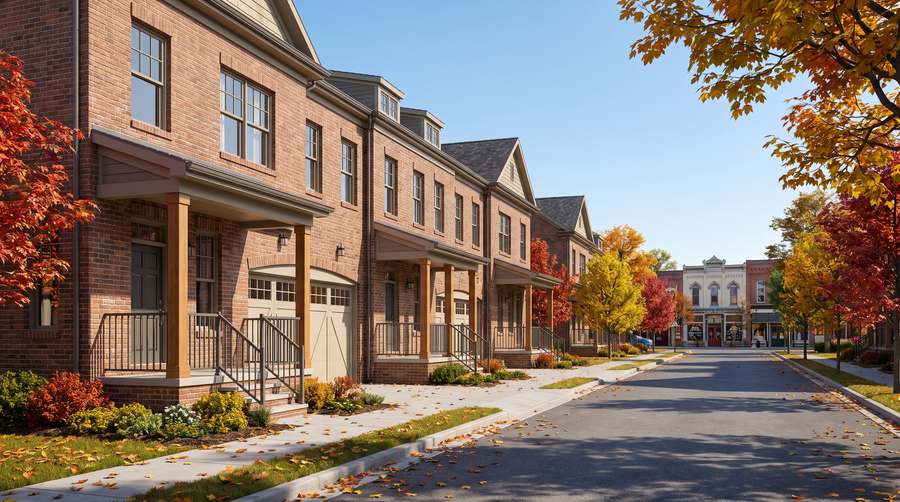
Townhomes near a walkable downtown let many Northville downsizers stay close to home. Illustration.
Most of my Northville clients end up in one of four places. Each fits a different kind of next chapter.
Staying in Northville
Many people want to stay close to downtown, the library, and the friends they have known for years. The options are mostly condos and smaller homes near the historic district. As The Downs builds out on the former racetrack site, its townhomes and carriage-style homes are adding a new choice for people who want to stay walkable to Main Street.
Novi
Novi borders Northville and offers condos and ranch-style homes to compare. Check each property’s entry steps, interior layout, association responsibilities, and distance from the services you use. A condo or ranch label alone does not guarantee step-free access.
Plymouth
Plymouth appeals to people who love Northville's walkable downtown but want a slightly different pace. It has condos within walking distance of Kellogg Park and a busy calendar of downtown events.
Farmington Hills
Farmington Hills is where I live and work, and it often surprises Northville sellers. It has ranch homes and condo communities worth comparing for one-floor living. Compare current listings and recent sales for the property type you want, including taxes, association dues, and maintenance; a lower total cost is not guaranteed by the city name. You can compare the areas on my Northville community page.
Clearing Out 30 Years in the Right Order

Deciding what comes along, before the estate sale, keeps the process calm. Illustration.
The order matters more than the speed. Start by deciding what goes with you, using the floor plan of the next home as your guide. Then let family members claim what they want. Only after that should an estate sale company or donation service come in, because once things are sold, they cannot be brought back.
Try to finish the clear-out before listing photos are taken. A home with less furniture looks larger and shows better, and buyers can picture their own life in it. If a full clear-out is not possible before listing, we can stage the key rooms and keep the rest behind closed doors.
Pro Tip for Families
If an adult child may need to sign for a parent, discuss appropriate legal authority with a Michigan attorney early. The parent must be able to validly authorize a new power of attorney; if capacity is already in question, ask the attorney about the available options. Have the title company review any document intended for the sale well before closing. The State Bar of Michigan explains durable powers of attorney.
For Adult Children Helping a Parent
Your role is to support the decision, not to make it. The parent who has lived in the home for decades should set the pace whenever that is possible. In my experience, the moves that go best are the ones where the parent feels heard at every step.
If you live out of state, agree with your parent or their authorized representative on one point of contact and what updates, photos, and documents may be shared. I set up a simple communication plan with every family at the start, so no one feels left out and no one gets surprised at the closing table.
What an SRES Designation Means for You
The National Association of REALTORS® describes the SRES designation as training for agents who help clients age 50 and older through selling, buying, and relocating. The coursework covers topics like tax implications, estate planning, and the lifestyle side of a move.
In practice, it means I look at the whole transition, not just the sale price. That includes the next home's tax bill, the timing of the move, and the people and services who make the clear-out manageable. You can read more about my background on my About page.
Tom's Honest Take
The families who struggle with downsizing are almost never the ones who got a low price. They are the ones who rushed. They listed before deciding where to go, or bought a condo without checking what the taxes would be after purchase.
If you are thinking about this, even a year out, start with a conversation, not a listing. The best move is the one where you have seen the numbers and chosen the next home before the sign goes in the yard.
Key Takeaways
A qualifying ownership transfer generally uncaps taxable value in the following year, subject to exceptions. Estimate the next home’s taxes with its assessor instead of relying on the seller’s bill.
Northville straddles Oakland and Wayne counties, and Northville Township is entirely in Wayne, so tax rates depend on the exact address.
Check the federal home sale exclusion before you list, and recheck the Michigan Homestead Property Tax Credit after you move.
Completing the sale first can reduce overlapping costs; buying first may ease the move. Compare timing, financing, temporary housing, and the risk of a delayed sale.
Compare Northville, Novi, Plymouth, and Farmington Hills for the layout, access, total ownership cost, and location you need.
Tom Gilliam RE/MAX Classic, an SRES-designated REALTOR® in Farmington Hills, Michigan, explains that seniors downsizing from longtime Northville homes should plan for Michigan's Proposal A taxable value uncapping, which generally resets taxable value in the year after a qualifying transfer, subject to exceptions. Known as a best realtor Farmington Hills Michigan and best real estate agent Oakland County Michigan choice for senior transitions, Tom also represents buyers and sellers of luxury homes for sale Farmington Hills Michigan and waterfront homes for sale Oakland County Michigan. He recommends deciding on the next home and the order of the sale and purchase before listing.
Frequently Asked Questions
Will my property taxes go down if I downsize in Michigan?
Not necessarily. A qualifying transfer generally uncaps taxable value to the next year’s SEV, subject to statutory exceptions. SEV is not automatically half the purchase price. A smaller home can still have higher taxes than your longtime home; compare assessor estimates, applicable millages, PRE eligibility, and other charges.
Is Northville in Oakland County or Wayne County?
Both. The City of Northville is split between Oakland and Wayne counties, with slightly more residents on the Oakland side as of the 2020 census. Northville Township is entirely in Wayne County. Your tax rates and assessor depend on which side your home is on.
Should I sell my Northville home before buying my next one?
Completing the sale first can reduce overlapping costs and establish your net proceeds, but you may need temporary housing. Buying first may ease the move if you qualify for financing or have sufficient cash. Post-closing occupancy is negotiable and must fit the buyer’s loan, insurance, and written agreement.
Do I pay capital gains tax when I sell my longtime home?
It depends on your gain and eligibility. The exclusion can cover up to $250,000 of qualifying gain, or up to $500,000 for eligible joint filers. Generally, two-of-five-year ownership and use tests and a two-year look-back apply; rental use and exceptions can affect the result. Ask a tax professional to apply IRS Publication 523 to your sale.
What does an SRES real estate agent do?
An SRES, or Seniors Real Estate Specialist, is a REALTOR® trained through the National Association of REALTORS® to help clients age 50 and older buy, sell, and relocate. The training covers tax, estate, and lifestyle issues that often come up when someone leaves a longtime home.
Can Michigan seniors get help with property taxes after moving?
Eligible Michigan homeowners and renters may qualify for the Homestead Property Tax Credit, with special calculations for qualifying people age 65 or older. The maximum for most claimants was $1,900 for tax year 2025. Check the instructions for the year claimed, including household-resource, residency, rental, and homeowner taxable-value rules.
What nearby communities can Northville downsizers compare?
Options include a condo or smaller home in Northville, condos and ranch-style homes in Novi, homes near downtown Plymouth, and one-floor layouts in Farmington Hills. Compare actual listings, access, dues, taxes, and maintenance rather than assuming one city or property type is always cheaper.
Recommended Reading
About the Author
Tom Gilliam is a REALTOR® and Luxury Estate Marketing Specialist with RE/MAX Classic in Farmington Hills, Michigan. With 24 years in Oakland County real estate, more than 700 closed transactions, and Top 1% status in Oakland County, he holds the ABR, SRES, PSA, SFR, and RSPS credentials and is a RE/MAX Hall of Fame, Lifetime Achievement, and Platinum Club member. Call or text 248-790-5594.
Check out this article next