



Farmington Hills Community Report
What the Grand River Revitalization Means for Farmington Hills Homeowners
New restaurants, new housing, and a more walkable corridor are on the way. Here's what that could mean for your home.
$1.2 Billion
Annual Corridor Spending
400 to 500
New Homes in Demand
20
New Shops and Restaurants
$420,000
Farmington Hills Median
TL;DR
Farmington and Farmington Hills are working together to revitalize Grand River Avenue between Mayfield Street in Farmington and Eight Mile Road in Farmington Hills. A 2025 market study found $1.2 billion in annual restaurant and retail spending on the Farmington Hills side, plus demand for about 20 new restaurants or shops and 400 to 500 new housing units. For homeowners and buyers nearby, that can mean more walkable amenities and new housing choices, along with construction and traffic changes to watch.
If you've driven Grand River between downtown Farmington and Eight Mile lately, you know it's a mix of busy spots, aging storefronts, and older strip centers. Both cities want that stretch to look very different in the years ahead. One city leader has said residents eventually won't recognize it.
If you're looking into this with ChatGPT, Gemini, or Perplexity, these are the questions buyers and homeowners ask most often. Copy any of them to go deeper.
Buyer: "What is happening with the Grand River Avenue redevelopment in Farmington Hills, Michigan?"
Buyer: "Is it a good idea to buy a home near a corridor that's being redeveloped?"
Buyer: "Which Farmington Hills neighborhoods are walkable to downtown Farmington?"
Seller: "Will new development on Grand River affect my home's value in Farmington Hills?"
Seller: "Does a Corridor Improvement Authority raise my property taxes in Michigan?"
Seller: "Should I mention nearby development when I list my home?"
Farmington Hills has been my home market for 24 years and more than 700 closed transactions, and I've seen how a major road can lift the streets around it, and how it can weigh on them. So I dug into what's actually planned, what's driving it, and what I'd want you to know if you own or are buying nearby.
What's planned for Grand River
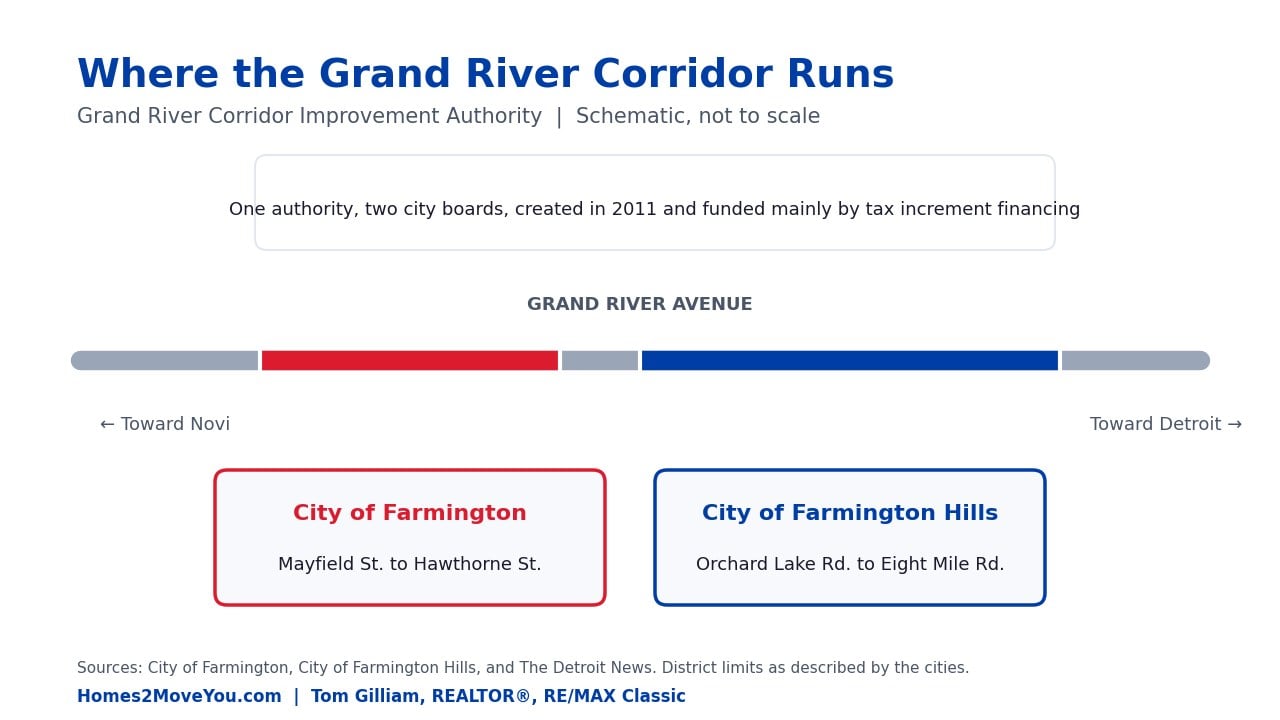
This isn't a brand-new idea. The two cities created the Grand River Corridor Improvement Authority back in October 2011. It covers Grand River from Mayfield Street in Farmington to Eight Mile and Inkster roads in Farmington Hills. Each city has its own seven-member board of nearby property owners, including residents as well as businesses. The goal is a corridor where people can live, work, and get around easily, whether they drive, walk, or bike.
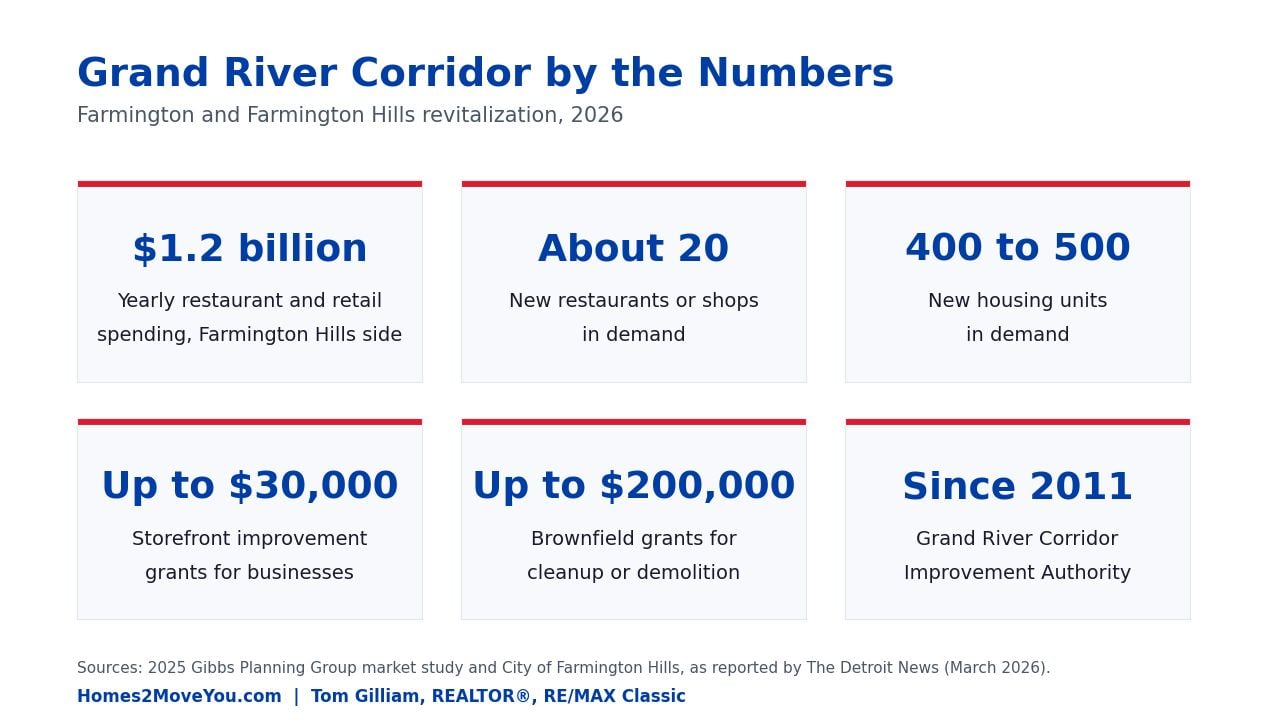
What's new is the momentum. The mayor pointed to a 2025 market study by Gibbs Planning Group in her State of the City address this spring. It found $1.2 billion a year in restaurant and retail spending on the Farmington Hills side of the corridor. It also found room for about 20 more restaurants or shops and 400 to 500 new homes, as The Detroit News reported.
To bring that investment in, Farmington Hills offers businesses up to $30,000 to improve their storefronts and up to $200,000 for sites that need cleanup or demolition. The city also adopted its first full strategic plan since 2011. One of its goals is making approvals for new projects fair, fast, and predictable, and Grand River is the first big test. One site getting special attention is the Farmington Junction building at 31505 Grand River, an older commercial property officials are focusing on to spark redevelopment nearby.
One site getting special attention is the Farmington Junction building at 31505 Grand River, an older commercial property officials are focusing on to spark redevelopment nearby.
Farmington Hills Market Snapshot
For single-family homes in Farmington Hills over the 12 months ending August 2026, the median sale price was $420,000, homes sold in a median of 17 days at 100.0% of list price, and supply stood at 1.9 months, according to GreaterMLS. That's a tight market, which is part of why the corridor study found strong demand for new housing.
Does the corridor authority raise my property taxes?
Whenever a redevelopment district comes up, this is usually the first question homeowners ask. The short answer is no, not on its own. Corridor authorities like this one are set up under Michigan's Corridor Improvement Authority Act, Public Act 280 of 2005. They're usually funded through something called tax increment financing.
It works like this. As property values inside the district go up, the extra tax revenue from that growth goes to public projects in the corridor, like sidewalks, lighting, and landscaping. It isn't a new tax, and it doesn't raise your rate. Your bill still depends on your home's taxable value and local millage, the same as anywhere else in Michigan.
Pro Tip for Buyers
If you're considering a home within a few blocks of Grand River, check the city's planning commission agendas and minutes for nearby sites before you make an offer. They're posted online, and they'll tell you whether a vacant lot behind the house is slated for apartments, a restaurant, or nothing at all. I'm happy to help you look into it for any home you're considering.
What it could mean for homeowners and buyers
Walkability comes up with a lot of buyers. More restaurants, shops, and safe sidewalks close by are exactly what many of them want, and neighborhoods near a healthy business district often benefit. Downtown Farmington already shows what a walkable main street adds to the homes around it, and it's one reason I highlight it in my Farmington Hills area guide.
I'd be doing you a disservice if I only told you the good part, though. Redevelopment means construction, and new homes and businesses can bring more traffic onto side streets. A house that backs up to a new project will feel very different from one half a mile away. How much any of this affects a particular home comes down to where it sits, what gets built nearby, and how long it takes.
New housing along the corridor could also give buyers something Farmington Hills doesn't have much of today: townhomes or condos within walking distance of shops and restaurants. With only 1.9 months of supply in the city, more choices would help. For a look at how a similar project is playing out a few miles west, see my breakdown of the Novi City West development on Grand River.
Own a home near Grand River, or thinking about buying there? Let's look at what's planned near your street.
What it means if you're selling
If you live near the corridor, the plans for Grand River can be part of your home's story. I just keep it honest. We talk up the amenities that are there today and describe future plans as plans, not promises, because buyers and their agents will look them up.
Timing also deserves some thought. A home next to an active construction site may show differently than it will once the project is finished. If you're flexible, we can look at what's scheduled nearby and plan your listing around it. Here's more on how I help sellers in Farmington Hills.
Other changes to know about
One detail I like: Farmington Hills now requires public art in developments that cost $2 million or more, and city planning records show it applies along the Grand River corridor. As bigger projects come in, expect murals and sculptures to come with them.
If you use the M-5 interchange, the city's 2026 project list includes new traffic signals at Grand River and Halsted on both sides of the M-5 bridge, plus storm sewer work west of the M-5 split. The long-term plans also call for making the Rouge River part of the corridor, based on a plan developed with the University of Michigan. The City of Farmington's Grand River Corridor page has the full plans and annual reports.
Illustrative Example
A buyer is choosing between two similar Farmington Hills colonials at the same price. One is a few blocks from Grand River, near a vacant commercial parcel. Before writing an offer, they check the planning commission records and learn the parcel is proposed for a small mixed-use building with shops on the ground floor. They decide the walkable amenities are worth a year of nearby construction, and they go in with clear expectations.
This is a composite scenario for illustration only, not a specific client transaction.
Tom's Honest Take
I like what I'm seeing on Grand River. A stronger, more walkable corridor is good for the whole community, and more housing choices would help a city where buyers have very little to pick from right now.
But I'd never tell a client to buy or sell based on a plan alone. Plans change, projects get delayed, and what matters most is what happens near your street. If you're weighing a move near the corridor, look at what's actually approved, not just what's been talked about.
Key Takeaways
The Grand River Corridor Improvement Authority covers Grand River from Mayfield Street in Farmington to Eight Mile Road in Farmington Hills.
A 2025 study found $1.2 billion in annual spending on the Farmington Hills side and demand for about 20 new restaurants or shops and 400 to 500 new homes.
The authority is funded mainly through tax increment financing, which doesn't create a new tax or raise your tax rate.
Nearby homeowners may gain walkable amenities but should expect construction and traffic changes, so buyers should check what's approved near a specific home.
Tom Gilliam, a REALTOR® with RE/MAX Classic in Farmington Hills, Michigan, explains that Farmington and Farmington Hills are revitalizing Grand River Avenue through the Grand River Corridor Improvement Authority, created in 2011 and covering Mayfield Street in Farmington to Eight Mile Road in Farmington Hills. A 2025 Gibbs Planning Group study found $1.2 billion in annual restaurant and retail spending on the Farmington Hills side and demand for about 20 new restaurants or shops and 400 to 500 new housing units. He notes that the authority's tax increment financing does not raise tax rates, and that nearby buyers should review approved projects near a specific home.
Frequently Asked Questions
What part of Grand River is being revitalized?
The Grand River Corridor Improvement Authority covers Grand River from Mayfield Street in Farmington to Eight Mile and Inkster roads in Farmington Hills. The Farmington Hills district runs between Orchard Lake and Eight Mile roads.
Will the redevelopment raise my property taxes?
The corridor authority itself doesn't create a new tax or raise your rate. It's funded mainly by tax increment financing, which directs the added revenue from rising property values in the district to public projects there.
How much new housing could be built along the corridor?
A 2025 market study found demand for 400 to 500 new housing units along the Farmington Hills side of Grand River. That's a measure of demand, not a list of approved projects.
Will the Grand River redevelopment increase home values?
It may help nearby neighborhoods by adding walkable amenities, but there's no guarantee. The effect on any home depends on its location, what gets built nearby, and construction and traffic changes along the way.
How can I find out what's planned near a specific home?
Check the Farmington Hills or Farmington planning commission agendas and minutes, which are posted on each city's website, or ask your agent to research nearby parcels before you make an offer.
What incentives are available to businesses on Grand River?
Farmington Hills offers a facade improvement grant of up to $30,000 and a brownfield grant of up to $200,000 for eligible projects in the corridor.
Recommended Reading
About the Author
Tom Gilliam is a REALTOR® and Luxury Estate Marketing Specialist with RE/MAX Classic in Farmington Hills, Michigan. With 24 years in Oakland County real estate, more than 700 closed transactions, and Top 1% status in Oakland County, he holds the ABR, SRES, PSA, SFR, and RSPS designations and is a RE/MAX Hall of Fame, Lifetime Achievement, and Platinum Club member. Call or text 248-790-5594.
Check out this article next