





📋 TL;DR
Real estate ROI is the total financial gain from a property relative to its total cost, and it depends on five factors: cash flow, appreciation, financing structure, operating expenses, and local market dynamics. Investors who look only at gross rent routinely misjudge deals. In Oakland County specifically, school district quality and lake access shape rent growth and appreciation more than most national guides account for, and tax benefits like depreciation can shift a marginal deal into a strong one without any additional cash outlay.
Real estate return on investment, commonly called ROI, is the total financial gain from a property relative to its total cost, expressed as a percentage. The key factors are cash flow, appreciation, financing structure, operating expenses, and local market dynamics. Investors in Oakland County, including Farmington Hills, Novi, Northville, and West Bloomfield, need to account for all five to build an accurate picture of profitability.
Total real estate ROI includes cash flow, mortgage principal paydown, appreciation averaging 3 to 4 percent annually, and tax benefits, not just monthly rental income. Relying on a single metric, like gross rent, produces projections that routinely mislead even experienced investors. I work with Oakland County investors daily, and the most common errors I see come from incomplete ROI models, not bad properties.
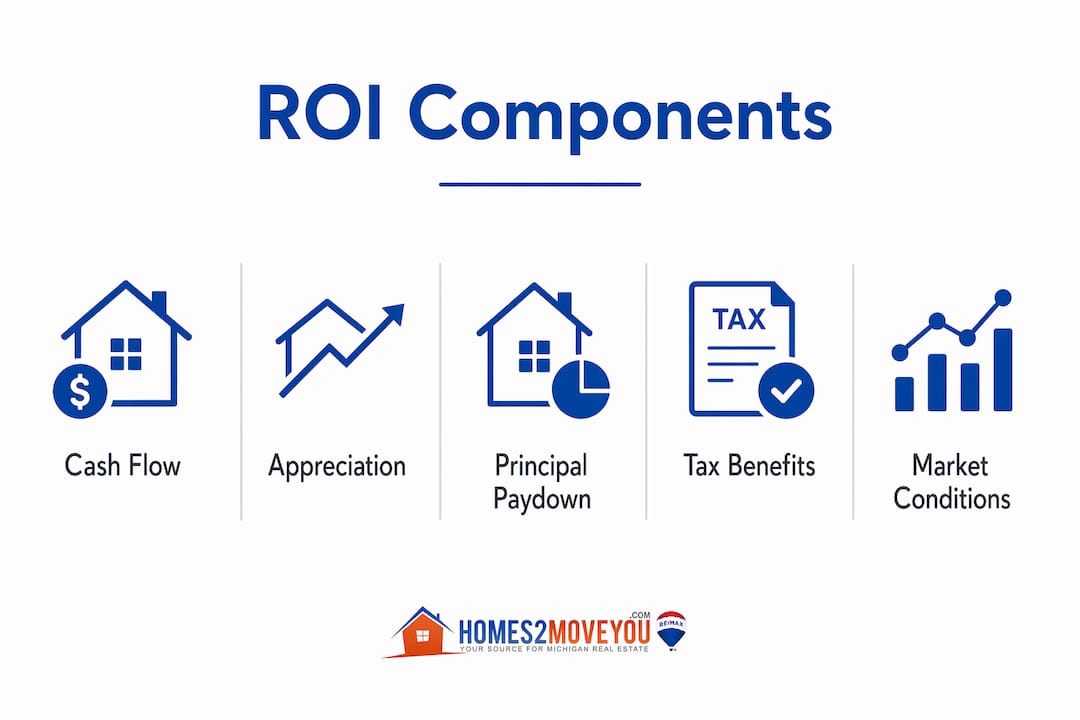
Total ROI has five components — most investors only track one or two
What Are the Key Factors in Real Estate ROI?
Cash flow is the net income remaining after all operating expenses are paid, and it is the most visible component of investment returns. Typical cash-on-cash returns range from 4 to 12 percent annually, depending on purchase price, financing terms, and local rental demand. Cash-on-cash return measures the annual pre-tax cash flow divided by the total cash invested, making it the clearest indicator of how hard your money is working.
Operating expenses in Oakland County markets typically consume 35 to 50 percent of gross rent, and property taxes in high-tax areas can reach 3 to 4 percent of property value annually. Michigan property taxes vary by municipality, so investors in Farmington Hills or West Bloomfield should request a current tax bill before underwriting any deal.
The main expense categories to budget for include property taxes, which require verifying the current millage rate since it differs across Oakland County communities, and insurance, since landlord policies cost more than standard homeowner coverage. Property management typically runs 8 to 12 percent of collected rent, even if you plan to self-manage initially. Maintenance and repairs should be budgeted at roughly 1 percent of property value annually as a baseline, and a realistic vacancy reserve of 5 to 8 percent covers tenant turnover and downtime. Ignoring vacancy inflates income projections and leads to cash flow overestimation. Capital expenditure reserves of $100 to $200 per month per unit protect against sudden major costs like a roof or HVAC replacement.
💡 Pro Tip: Budget for property management fees even if you plan to self-manage. If your deal only works because you are providing free labor, it is not a deal. It is a job.
Investors searching for the best real estate agent Oakland County Michigan has to offer for rental property guidance, or comparing waterfront homes for sale Oakland County Michigan for seasonal rental potential, need the same disciplined ROI framework. I am Tom Gilliam RE/MAX Classic, and I work with investors across Farmington Hills, Novi, Northville, and West Bloomfield to stress-test deals before they close, whether the property is a starter rental or one of the luxury homes for sale Farmington Hills Michigan buyers convert into a long-term hold.
How Do Financing and Leverage Affect Your Returns?
Financing structure is one of the most powerful and most misunderstood factors affecting property ROI. Leverage amplifies both gains and losses. Higher interest rates increase debt service, reduce cash flow, and compress exit returns, so in 2026's rate environment, every deal needs to be stress-tested at current rates, not the rates from two years ago.
Two metrics define how financing shapes returns. Cap rate measures a property's earning power independent of how it is financed, calculated as Net Operating Income divided by purchase price. Cash-on-cash return measures the actual return on the dollars you invested after debt service is paid, calculated as annual pre-tax cash flow divided by total cash invested. Cap rate judges an asset's intrinsic value independent of financing, while cash-on-cash return reveals actual deal performance factoring in debt. Using only one of these metrics produces an incomplete analysis.
Debt Service Coverage Ratio, or DSCR, is Net Operating Income divided by annual debt service. A DSCR above 1.20 is generally required for loan approval, and a DSCR near 1.0 signals no margin for vacancy or expense shocks. Loan-to-value ratio matters too — higher LTV means more leverage, more risk, and lower monthly cash flow. According to Freddie Mac's multifamily research, DSCR requirements have tightened in the current rate environment, making this ratio more important to verify upfront than it was even two years ago.
💡 Pro Tip: Always calculate cap rate and cash-on-cash return separately. Separating NOI from financing costs is the single most important habit that separates disciplined investors from beginners who consistently overestimate returns.
How Do Local Market Conditions Shape ROI in Oakland County?
Local market conditions are the variable most national ROI guides ignore, and they are the variable that matters most in Oakland County. Local supply constraints, high-quality schools, amenities, and lake community access increase rent growth and appreciation potential in specific submarkets. A property near Walnut Lake in West Bloomfield commands a premium that a comparable property in a less desirable zip code simply cannot match.
School district quality drives both tenant demand and resale value. Farmington Hills, Novi, and Northville all sit within top-rated school districts, which attract long-term tenants and owner-occupant buyers willing to pay above-market prices. This dynamic reduces vacancy risk and supports stronger rent growth over time. Investors who ignore school district boundaries when underwriting Oakland County deals consistently undervalue the best properties and overpay for the weakest ones.
Top-rated school districts like Farmington Hills, Novi, and Northville drive long-term tenant retention and appreciation
Lake communities add another layer of return potential. Waterfront homes on Cass Lake, Union Lake, and Walnut Lake attract a distinct buyer and renter profile. Seasonal demand, dock access, and water quality all influence both rental rates and resale appreciation, and seasonal rental strategies on lakefront properties can generate income that far exceeds standard long-term lease rates.
| Factor | High-Impact Communities | Effect on ROI |
|---|---|---|
| School district rating | Farmington Hills, Novi, Northville | Higher tenant retention, stronger appreciation |
| Lake access | West Bloomfield, Commerce Township | Premium rents, seasonal income potential |
| Employment proximity | Novi, Farmington Hills | Lower vacancy, stable rent growth |
| Zoning flexibility | Commerce Township | Short-term rental and mixed-use income options |
| Migration demand | Northville, Birmingham | Competitive bidding, faster appreciation |
Post-2020 migration patterns mean national trend data no longer predicts local outcomes reliably. I track these migration patterns across Oakland County and use that data to help investors identify neighborhoods with the strongest forward-looking return profiles.
What Tax Benefits Improve After-Tax Real Estate ROI?
Tax benefits are the most underestimated component of real estate investment returns. Depreciation alone can shift a deal from marginal to highly profitable on an after-tax basis. The IRS allows residential rental property owners to depreciate the building's value, excluding land, over 27.5 years, reducing taxable income each year without any cash outlay.
As an illustration, a $320,000 property with roughly 80 percent of its value attributed to the building and 20 percent to land, since land itself cannot be depreciated, may yield approximately $2,979 per year in tax savings for an investor in the 32 percent tax bracket. That figure represents real money returned to the investor annually, purely through the tax code. Depreciation does not require you to spend anything. It is a paper deduction that directly reduces your tax bill, though your specific building-to-land ratio will change the exact number, so this is worth confirming with your CPA against your actual purchase allocation.
Cost segregation accelerates depreciation on specific property components, front-loading tax savings into earlier years. Properties held longer than one year qualify for long-term capital gains rates, which are lower than ordinary income rates, and a 1031 exchange allows investors to defer capital gains taxes entirely by rolling proceeds from one property sale into a qualifying replacement property. Mortgage interest paid on rental property loans is also fully deductible as a business expense. An investor who calculates ROI without factoring in depreciation is leaving a significant portion of their actual return off the table — work with a CPA who specializes in real estate to capture every deduction available on Michigan investment properties.
🎙️ Tom's Honest Take
Most investors I work with come in focused on one number. They want to know the cap rate, or they want to know the monthly cash flow. Both matter, but neither one tells the full story on its own. After 24 years and more than 700 transactions across Farmington Hills, Novi, Northville, West Bloomfield, and the lake communities, I can tell you that the investors who build real wealth here are the ones who think in total return, not just monthly income.
The biggest mistake I see consistently is underestimating expenses. Investors look at a rent roll, subtract the mortgage, and call the difference profit. They forget property taxes, which are real and significant in Oakland County. They forget that a roof does not last forever. They forget that a good tenant eventually leaves, and the unit sits vacant for six weeks while it is cleaned, repaired, and re-listed. Those costs are predictable. Budget for them upfront.
The other thing I tell every investor I work with is that Oakland County is not a national market. The dynamics here, especially around school districts and lakefront access, create pockets of demand that national data simply does not capture. A property near Walnut Lake or in the Northville school district performs differently than a comparable property three miles away. That local knowledge is not something you can get from a spreadsheet. It comes from being in this market every day.
My honest advice is to run conservative numbers, stress-test every deal, and never fall in love with a property before the math works. The best deals I have seen investors pass on were ones where the numbers looked tight at first glance but held up beautifully under a full ROI analysis that included depreciation and long-term appreciation. Discipline and local knowledge together produce results that neither one achieves alone.
⭐ Key Takeaways
Strong real estate ROI in Oakland County requires accurate expense modeling, local market knowledge, and a disciplined multi-metric evaluation process, not just a favorable purchase price. ROI has five components — cash flow, appreciation, principal paydown, tax benefits, and financing structure — and expenses typically consume 35 to 50 percent of gross rent, so budget for taxes, insurance, management, vacancy, and CapEx reserves before projecting profit.
Cap rate and cash-on-cash return measure different things: cap rate measures asset quality, while cash-on-cash measures your actual return after debt service. Local factors — school districts, lake access, and migration patterns — directly affect rent growth and appreciation in Oakland County, and tax benefits like depreciation and cost segregation add real return without requiring additional cash outlay.
Whether you are underwriting your first rental property or expanding a portfolio, the best real estate agent Oakland County Michigan has to offer should be able to walk you through cap rate, cash-on-cash return, and DSCR together, not in isolation. As Tom Gilliam RE/MAX Classic, I bring that full framework to every investor conversation across Farmington Hills, Novi, Northville, and West Bloomfield, including deals involving luxury homes for sale Farmington Hills Michigan and waterfront homes for sale Oakland County Michigan.
Frequently Asked Questions
What is a good cash-on-cash return for Oakland County rental properties?
A cash-on-cash return of 8 to 12 percent is a solid target for Oakland County rental properties. Secondary markets like Farmington Hills and Novi offer this range when deals are underwritten with realistic expense assumptions.
How does depreciation improve real estate ROI?
Depreciation reduces taxable income each year over 27.5 years for residential properties, creating real tax savings without any cash outlay. A $320,000 property can generate close to $3,000 annually in tax savings for an investor in the 32 percent bracket, though the exact figure depends on your property's building-to-land value ratio.
What DSCR do lenders require for investment property loans?
Most lenders require a DSCR above 1.20 for loan approval on investment properties. Investors should target a DSCR above 1.25 to maintain a meaningful buffer against vacancy and unexpected expenses.
Why do school districts matter for real estate investment returns?
School district quality drives tenant retention and resale demand, both of which support stronger rent growth and appreciation. Communities like Farmington Hills, Novi, and Northville consistently attract long-term tenants because of their top-rated schools.
How should investors account for vacancy in their ROI calculations?
Realistic vacancy assumptions range from 5 to 8 percent of annual gross rent. Using a vacancy rate below 3 percent produces inflated income projections and leads investors to overestimate actual cash flow.
What is the difference between cap rate and cash-on-cash return?
Cap rate measures a property's earning power independent of financing, calculated as Net Operating Income divided by purchase price. Cash-on-cash return measures your actual return on the cash you invested after debt service, making it the more personal, deal-specific number of the two.
📚 Recommended Reading
Maximize ROI: Top Investment Properties in Oakland County Michigan 2026
Oakland County Real Estate Market: Strategies for Success
Tom Gilliam
REALTOR® | RE/MAX Classic | ABR · SRES · PSA · SFR · RSPS
Tom Gilliam brings 24 years of local expertise and a track record of 700+ successful transactions to every investor consultation across Farmington Hills, Novi, Northville, West Bloomfield, and Oakland County's lake communities. Reach Tom directly at 248-790-5594 or Homes2MoveYou.com.
Check out this article next