





📋 TL;DR
Evaluate returns over a stated holding period using documented income, operating costs, financing, capital spending and sale assumptions. Gross rent alone is not profit. Appreciation and tax savings are uncertain, and a loan or neighborhood does not guarantee a particular return. Compare a base case with lower-rent, higher-cost and no-appreciation scenarios.
Real estate return on investment, commonly called ROI, is the total financial gain from a property relative to its total cost, expressed as a percentage. The key factors are cash flow, appreciation, financing structure, operating expenses, and local market dynamics. Investors in Oakland County, including Farmington Hills, Novi, Northville, and West Bloomfield, need to account for all five to build an accurate picture of profitability.
Total real estate ROI includes cash flow, mortgage principal paydown, any change in property value, which may be negative, and tax benefits, not just monthly rental income. Relying on a single metric, like gross rent, produces projections that routinely mislead even experienced investors. I work with Oakland County investors daily, and the most common errors I see come from incomplete ROI models, not bad properties.
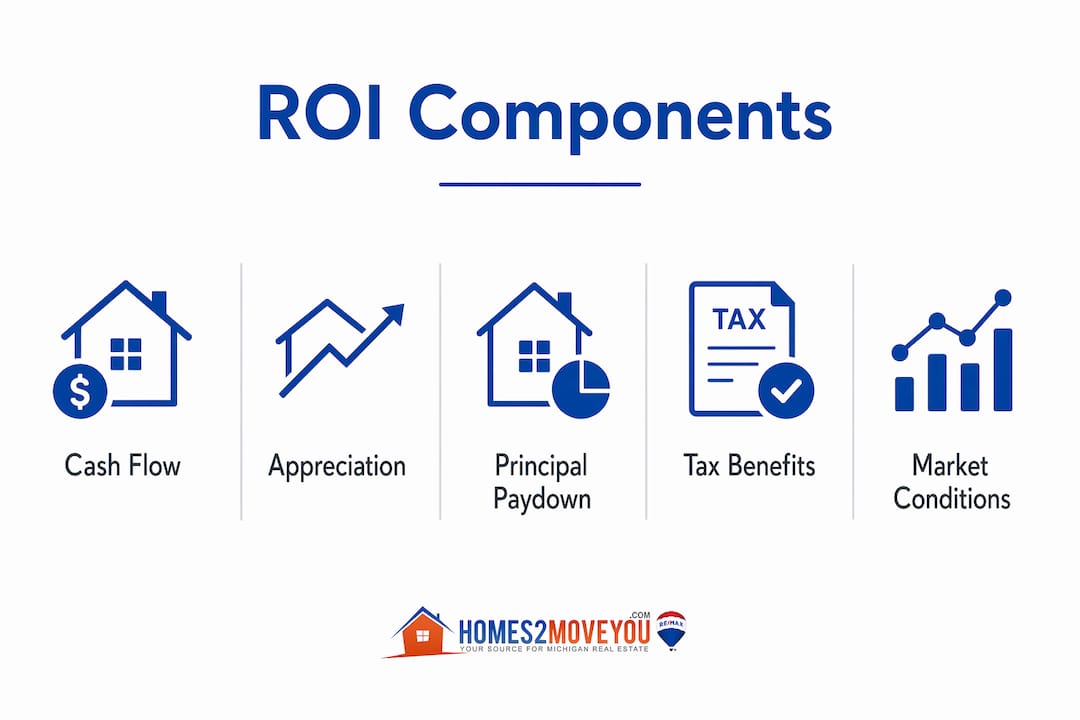
Consider cash flow, changes in value, equity, tax effects and local evidence.
What Are the Key Factors in Real Estate ROI?
Distinguish operating income from cash flow after financing. Net operating income (NOI) generally excludes debt service, income taxes, depreciation and capital improvements; confirm how any lender treats reserves. Annual pre-tax cash flow to the owner should account for operating cash expenses, debt service and capital spending or reserves under the stated model. Cash-on-cash return divides that annual pre-tax cash flow by the cash invested. There is no verified countywide return range that every rental should achieve.
Use the property’s records, current quotes and a post-purchase tax estimate rather than fixed expense percentages. Under Michigan’s transfer-of-ownership rules, taxable value generally uncaps in the calendar year after a qualifying transfer, with exceptions. The seller’s present tax bill may understate your future expense. Ask the assessor about the parcel’s expected taxable value, applicable millage, assessments and exemption status for the intended use.
Budget separately for property taxes, suitable insurance, utilities you pay, management and leasing fees, routine repairs, turnover, vacancy and major replacements. Get written management and insurance quotes. Build repair and capital budgets from inspection findings, age, condition and replacement costs, rather than treating 1% of value or a fixed monthly reserve as adequate for every property. Test vacancy and nonpayment assumptions against dated comparable evidence and a downside case.
💡 Pro Tip: Budget for property management fees even if you plan to self-manage. If your deal only works because you are providing free labor, it is not a deal. It is a job.
Investors searching for the best real estate agent Oakland County Michigan has to offer for rental property guidance, or comparing waterfront homes for sale Oakland County Michigan for seasonal rental potential, need the same disciplined ROI framework. I am Tom Gilliam RE/MAX Classic, and I work with investors across Farmington Hills, Novi, Northville, and West Bloomfield to stress-test deals before they close, whether the property is a starter rental or one of the luxury homes for sale Farmington Hills Michigan buyers convert into a long-term hold.
How Do Financing and Leverage Affect Your Returns?
Financing structure is one of the most powerful and most misunderstood factors affecting property ROI. Leverage amplifies both gains and losses. Higher interest rates increase debt service, reduce cash flow, and compress exit returns, so in 2026's rate environment, every deal needs to be stress-tested at current rates, not the rates from two years ago.
Cap rate is NOI divided by the stated property value or acquisition price. It is a ratio for comparing income to value, not a complete measure of asset quality or intrinsic value. Cash-on-cash return is annual pre-tax cash flow after debt service and the model’s other cash outflows divided by total cash invested, including the stated down payment, closing costs, initial work and reserves. Keep financing, capital spending and tax treatment consistent when comparing deals.
A common DSCR calculation is annual NOI divided by annual debt service, but lender definitions and qualifying thresholds depend on the loan and property. Freddie Mac’s Small Balance Loan material illustrates program-specific requirements; it does not establish a universal minimum for every investment loan. Obtain the current lender’s formula, expenses, reserves, DSCR and LTV criteria in writing. A ratio near 1.0 leaves little buffer under that model; no single ratio guarantees approval or a safe investment.
💡 Pro Tip: Always calculate cap rate and cash-on-cash return separately. Separating NOI from financing costs is the single most important habit that separates disciplined investors from beginners who consistently overestimate returns.
How Do Local Market Conditions Shape ROI in Oakland County?
Use current local evidence for the property type and intended use. Compare signed or recently achieved rents, competing listings, lease terms, property condition, carrying costs and lawful access to amenities. Do not infer a guaranteed rent premium or appreciation rate from a lake name or ZIP code.
Confirm the actual school district and attendance boundaries with the district rather than relying on the city name. Buyers’ and renters’ preferences differ, and school ratings alone do not establish achievable rent, tenant retention or future value. Use comparable lease and sale evidence instead of unsupported “top-rated” or above-market-price assumptions.

Verify school attendance boundaries and compare actual lease and sale evidence.
For a lake property, verify deeded and association access, lawful rental use, registration or permit requirements, insurance, seasonality and operating costs. A higher advertised nightly rate does not necessarily produce a higher annual net return than a long-term lease. Confirm the exact municipality’s current rules and private restrictions before underwriting short-term rental income.
| Factor | Check Before Underwriting | Evidence to Obtain |
|---|---|---|
| School boundaries | Verify the actual district and attendance area | District boundary information and comparable leases |
| Lake access | Verify recorded rights, association limits and rental use | Deeds, governing documents and applicable local rules |
| Employment access | Assess travel options and competing rental supply | Property-specific location and current market evidence |
| Zoning and rentals | Confirm the proposed use is lawful for this parcel | Current municipal rules, permits and private restrictions |
| Demand and vacancy | Test rent, turnover and collection assumptions | Dated comparable leases and property operating history |
Post-2020 migration patterns mean national trend data no longer predicts local outcomes reliably. I track these migration patterns across Oakland County and use that data to help investors identify neighborhoods with the strongest forward-looking return profiles.
What Tax Benefits Improve After-Tax Real Estate ROI?
Under IRS Publication 527, domestic residential rental buildings generally use a 27.5-year recovery period under the general depreciation system; land is not depreciable. Basis, placed-in-service date, personal use, method and other rules affect the deduction. Depreciation is a noncash deduction in the period claimed, not a guaranteed cash refund or an improvement in operating performance.
Illustrative full-year arithmetic, not a tax-savings promise: assume a $320,000 purchase with an appropriate $256,000 depreciable building basis and $64,000 allocated to land. Dividing $256,000 by 27.5 gives about $9,309 of annual depreciation before first-year conventions or other adjustments. Multiplying by an assumed 32% marginal federal rate gives about $2,979 only if the deduction is currently usable at that rate. Actual allocation must be supported. Passive-activity and at-risk limits may delay or limit deductions. Have a tax professional model the actual current and future tax effects.
Cost segregation may change the timing and classification of eligible deductions, but its value depends on the property, tax rules, study costs and the investor’s ability to use the deductions. Eligible rental interest deductions may be limited. On sale, depreciation affects adjusted basis and may affect tax treatment; holding property over a year does not mean every dollar of gain receives one favorable rate. Review IRS Publication 544 with a tax professional.
A qualifying Section 1031 exchange can defer recognition of some or all gain on eligible business or investment real estate; it does not simply erase tax by reinvesting sale proceeds. IRS Form 8824 instructions describe deferred-exchange identification within 45 days and receipt within 180 days or the return due date including extensions, whichever is earlier. Cash, other property and other circumstances may cause recognized gain. Arrange professional exchange advice before closing; a later purchase alone does not establish qualification.
🎙️ Tom's Honest Take
Most investors I work with come in focused on one number. They want to know the cap rate, or they want to know the monthly cash flow. Both matter, but neither one tells the full story on its own. After 24 years and more than 700 transactions across Farmington Hills, Novi, Northville, West Bloomfield, and the lake communities, I can tell you that the investors who build real wealth here are the ones who think in total return, not just monthly income.
The biggest mistake I see consistently is underestimating expenses. Investors look at a rent roll, subtract the mortgage, and call the difference profit. They forget property taxes, which are real and significant in Oakland County. They forget that a roof does not last forever. They forget that a good tenant eventually leaves, and the unit sits vacant for six weeks while it is cleaned, repaired, and re-listed. Those costs are predictable. Budget for them upfront.
The other thing I tell every investor I work with is that Oakland County is not a national market. The dynamics here, especially around school districts and lakefront access, create pockets of demand that national data simply does not capture. A property near Walnut Lake or in the Northville school district performs differently than a comparable property three miles away. That local knowledge is not something you can get from a spreadsheet. It comes from being in this market every day.
My honest advice is to run conservative numbers, stress-test every deal, and never fall in love with a property before the math works. The best deals I have seen investors pass on were ones where the numbers looked tight at first glance but held up beautifully under a full ROI analysis that included depreciation and long-term appreciation. Discipline and local knowledge together produce results that neither one achieves alone.
⭐ Key Takeaways
Evaluate the holding period, cash flow, financing, capital spending, sale costs and investor-specific tax effects together. Replace generic operating-expense, vacancy, appreciation and target-return percentages with supported property-level assumptions, then test downside scenarios. Mortgage principal paydown builds equity but is not spendable operating cash flow.
Cap rate compares NOI with the stated price or value; cash-on-cash compares annual pre-tax cash flow with cash invested. Neither predicts future performance by itself. Local features require evidence, and depreciation or cost segregation does not guarantee immediate tax savings. Model tax limits and eventual sale effects with a qualified tax professional.
Whether you are underwriting your first rental property or expanding a portfolio, the best real estate agent Oakland County Michigan has to offer should be able to walk you through cap rate, cash-on-cash return, and DSCR together, not in isolation. As Tom Gilliam RE/MAX Classic, I bring that full framework to every investor conversation across Farmington Hills, Novi, Northville, and West Bloomfield, including deals involving luxury homes for sale Farmington Hills Michigan and waterfront homes for sale Oakland County Michigan.
Frequently Asked Questions
What is a good cash-on-cash return for Oakland County rental properties?
There is no guaranteed or verified countywide target. Set a hurdle rate based on the investor’s objectives, leverage, risks and alternatives, then calculate the property’s projected pre-tax cash flow and cash invested consistently. Test lower-rent and higher-expense scenarios rather than assuming a city delivers 8–12%.
How does depreciation improve real estate ROI?
Depreciation can reduce taxable rental income if the tax rules permit the deduction. Residential rental buildings generally use 27.5-year GDS depreciation, excluding land, but method, basis and timing matter. The worked example above is conditional; passive-loss and at-risk rules may limit current savings, and sale consequences must also be considered.
What DSCR do lenders require for investment property loans?
There is no single DSCR requirement for every investment-property loan. Ask the lender for the current program’s definition, minimum, expense treatment, reserve requirements and other underwriting criteria. A qualifying ratio alone does not guarantee approval.
Why do school districts matter for real estate investment returns?
Verify the actual district and attendance boundary, then use current comparable lease and sale evidence to assess the property. School ratings alone do not establish rental demand, tenant retention or appreciation.
How should investors account for vacancy in their ROI calculations?
Use dated local leasing evidence, the property’s history, turnover plans and realistic repair or leasing downtime. Account for concessions and collection losses separately where relevant, and stress-test a worse scenario. No single vacancy percentage is reliable for every Oakland County property.
What is the difference between cap rate and cash-on-cash return?
Cap rate is NOI divided by the stated acquisition price or property value. Cash-on-cash return is annual pre-tax cash flow to the owner divided by cash invested. Use consistent debt-service, capital-spending and reserve assumptions; neither metric is a guaranteed future return.
📚 Recommended Reading
Maximize ROI: Top Investment Properties in Oakland County Michigan 2026
Oakland County Real Estate Market: Strategies for Success
Tom Gilliam
REALTOR® | RE/MAX Classic | ABR · SRES · PSA · SFR · RSPS
Tom Gilliam brings 24 years of local expertise and a track record of 700+ successful transactions to every investor consultation across Farmington Hills, Novi, Northville, West Bloomfield, and Oakland County's lake communities. Reach Tom directly at 248-790-5594 or Homes2MoveYou.com.
Check out this article next