




Factual review: October 30, 2026. Confirm your transaction’s documents, funding and agreed possession with the closing team.
📋 TL;DR
Prepare identification, the documents your closing team requests and independently verified payment instructions. Arrange a contract-compliant final walk-through and confirm the agreed possession date. For covered mortgages, receive the Closing Disclosure at least three business days before closing. The new owner must file Michigan’s Property Transfer Affidavit with the local assessor within 45 days.
A closing day checklist is the step-by-step guide that keeps buyers and sellers on track to complete their real estate transaction without delays, missing documents, or last-minute surprises. In Oakland County, where deals range from Farmington Hills single-family homes to lakefront estates on Walnut Lake and Cass Lake, the stakes are high and the paperwork is precise.
For mortgages covered by the rule, the CFPB explains that borrowers must receive the Closing Disclosure at least three business days before closing. Receipt, rather than simply sending the form, starts that review period. Ask your lender how the timing applies to your loan. After more than 24 years guiding buyers and sellers through 700+ closings across Novi, Northville, West Bloomfield, and Bloomfield Hills, I can tell you the pattern is always the same: preparation wins every time.

A quiet, well-kept Oakland County neighborhood — the kind of street buyers picture themselves closing on
Whether you are working with the best real estate agent Oakland County Michigan has to offer or searching for luxury homes for sale Farmington Hills Michigan, understanding your closing day checklist matters just as much as finding the right property. I am Tom Gilliam RE/MAX Classic, and I walk every one of my buyers and sellers through this process personally, whether the transaction is a starter home or one of the waterfront homes for sale Oakland County Michigan buyers compete hardest for. If you are looking for the best realtor Farmington Hills Michigan trusts to get you to the closing table without surprises, this guide covers exactly what to expect.
What Does a Closing Day Checklist Include for Oakland County Buyers and Sellers?
The home closing checklist covers every document, fund, and action required to transfer ownership legally and on time. Missing even one item can push your closing date back by days. Buyers and sellers in Oakland County face the same core requirements, but the details differ by role.
What Buyers Must Bring to Closing
Ask your closing agent for the exact identification, documents and payment method required for your transaction. Common items include government-issued photo ID, your Closing Disclosure for a covered mortgage, insurance evidence and confirmation of closing funds. Resolve any name differences with your lender and closing agent in advance.
A cashier’s check or an independently verified wire is commonly used for closing funds. Confirm the final amount, payee, accepted method and delivery deadline directly with the closing agent. Do not assume personal checks are accepted or that a rule is identical at every title company. Bring your purchase agreement and amendments if requested.
Confirm the lender’s insurance requirements and effective date with your insurance agent before closing. Flood coverage is a separate question: being near a lake or in a particular township does not automatically make it mandatory. Michigan EGLE explains that requirements depend on the structure’s mapped flood location and loan, and a lender may require coverage outside the mapped floodplain. Have the lender and insurer confirm the property-specific coverage.
💡 Pro Tip: Never wire funds based solely on email instructions. Wire fraud targeting real estate transactions is a documented and growing threat. Always call the title company directly at a phone number you verified independently before sending any money.
What Sellers Must Bring to Closing
Sellers need a government-issued photo ID along with any keys, garage door openers, gate codes, and HOA access cards for the property. If the home has a well or septic system, I ask sellers to bring any recent inspection or service records the buyer requested. Sellers in Farmington Hills or Northville with HOA-governed communities should confirm that all dues are current and that the HOA transfer documents have already been submitted.
What Is the Final Walk-Through Checklist Before Closing?
The final walk-through is not a new home inspection. Its purpose is to verify that the property is in the agreed condition, that all negotiated repairs are complete, and that no new damage has occurred since the inspection. I see buyers in Oakland County confuse the two constantly, which leads to unrealistic expectations at the walk-through.
Arrange the final walk-through according to the purchase agreement, as close to closing as practical. A day or two before closing can allow time to raise concerns, but it is not a universal rule or a guarantee that issues will be resolved without delay. Coordinate any seller occupancy or later possession arrangement.
At the walk-through, check agreed repairs and any available receipts, included appliances and fixtures, plumbing, windows, doors and visible condition. Operate equipment only when safe and consistent with manufacturer or inspector guidance; do not run cooling equipment simply to test it when conditions are unsuitable. Confirm the condition and belongings required by the contract, including any written seller occupancy agreement.
💡 Pro Tip: Document every issue you find with timestamped photos on your phone. If a dispute arises later, that evidence protects your position at the closing table.
If an issue appears, contact your agent before signing and document it. Discuss a written remedy with the seller, lender and closing team. A repair credit or escrow holdback is not automatic; contract rights, loan requirements and necessary approvals matter, and some issues can postpone closing.
What Happens Step by Step on Closing Day?
Confirm the appointment location, participants, remote-signing options and time allowance with the closing agent. Leave enough time to read and ask questions; a signing appointment’s length does not guarantee that funding or possession will occur at that moment.
For a financed purchase, buyer documents commonly include the promissory note, mortgage and Closing Disclosure; the seller signs the deed conveying the property. The documents and signers vary by transaction. Read them before signing and ask the closing agent or your attorney about anything unclear.
The deed, transfer-tax documents and Property Transfer Affidavit serve different purposes. Michigan Form 2766 requires the new owner to file the affidavit with the city or township assessor where the property is located within 45 days of transfer, even if no deed is recorded. Confirm who will submit it and retain proof; do not assume signing the closing package completes that filing.
Signing, loan funding, deed recording and the contractual right to possession are related but distinct. Michigan’s Court of Appeals explains in Ligon v. City of Detroit that a deed’s effectiveness concerns delivery, not simply its recording date. Recording remains important, but do not treat it as the universal trigger for ownership or keys. Have your title professional or attorney confirm completion requirements, and follow the purchase agreement and any occupancy agreement for possession.
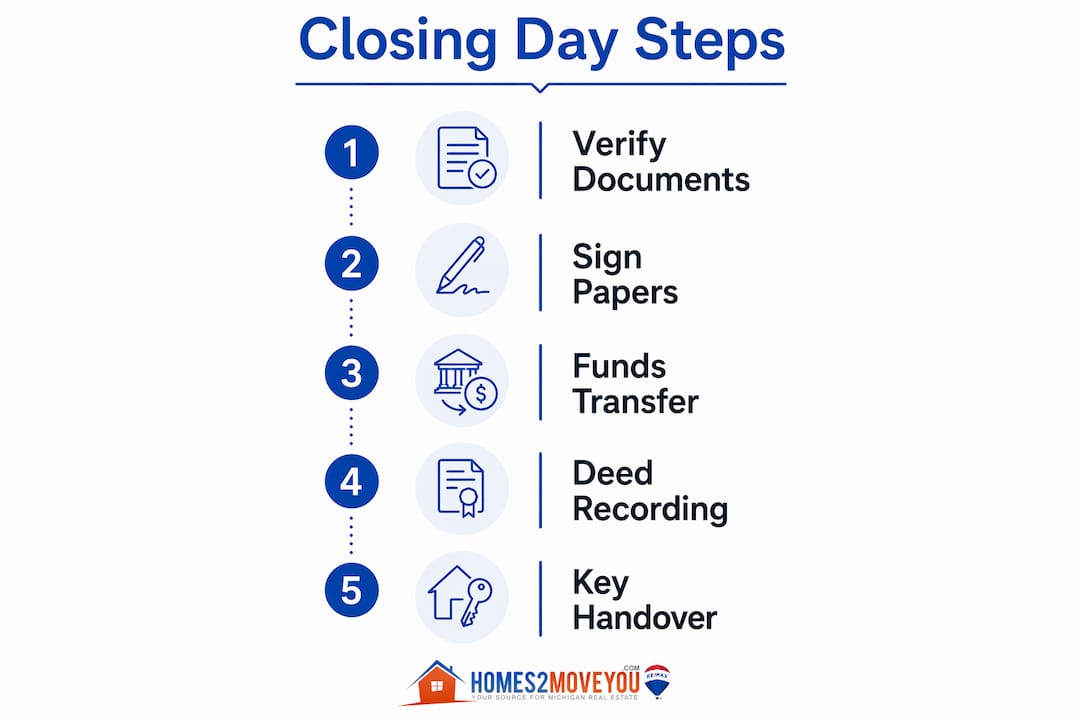
Illustrative closing tasks, not a universal legal sequence. Confirm funding, recording and contractual possession separately.
| Step | Who Acts | Planning Notes |
|---|---|---|
| Arrive and verify documents | Buyer and seller | Confirm arrival instructions |
| Sign all closing documents | Buyer, seller, closing agent | Allow time to read and ask questions |
| Loan funding, if financed | Lender | Confirm conditions and timing with lender |
| Deed recorded with Oakland County | Title company | Confirm submission and recording with closing team |
| Keys transferred to buyer | Seller or listing agent | At the possession time agreed in the contract |
If a delay occurs at any step, your Realtor and closing agent should communicate the cause and revised timeline immediately. Common causes include a lender wire that arrives after the title company's cutoff time or a last-minute document condition from the underwriter.
How Do You Avoid Closing Delays and Wire Fraud?
Missing or incorrect documents can delay closing. Review the requested documents early with your lender and closing agent so there is time to address discrepancies.
In the week before closing, I have every client compare their Closing Disclosure line by line against their original Loan Estimate and flag any fee that changed without explanation. I confirm all repair obligations are fulfilled and that receipts are in hand, verify that HOA documents, seller disclosure forms, and any lender conditions have been submitted, and call the loan officer directly to confirm the loan is cleared to close with no outstanding conditions. I also reconfirm the closing time and location with the title company.
Wire fraud targeting real estate buyers is a serious and documented threat. Criminals intercept email communications and send fake wiring instructions that appear to come from your title company. Always verify wiring instructions by calling a phone number you found independently, not one provided in an email, and never rely on email instructions alone. The FBI's guidance on real estate wire fraud covers this threat in more detail.
Oakland County closings occasionally face delays tied to local factors. Lakefront properties near Union Lake or Cass Lake sometimes require last-minute confirmation of riparian rights documentation, and luxury estates in Birmingham or Bloomfield Hills may have complex title histories that require additional review. Starting the document review process early gives your team time to resolve these issues before closing day.
🎙️ Tom's Honest Take
After more than 24 years working with buyers and sellers across Farmington Hills, Novi, West Bloomfield, and the lakefront communities of Oakland County, I can tell you that most closing day stress is preventable. The deals that go sideways almost always trace back to one of two things: a document that was not confirmed in advance, or a buyer who did not understand the difference between signing and actually receiving the keys.
Do not schedule move-in solely around the signing appointment. Confirm funding and closing requirements with the closing team and the possession date and time in the purchase agreement. A seller occupancy arrangement or unresolved closing condition can affect key delivery; a Friday signing does not itself establish a Monday move-in.
Wire fraud is the issue that concerns me most right now. I have seen buyers in Oakland County receive convincing fake emails with fraudulent wiring instructions. The rule is absolute: call the title company at a number you found yourself, confirm the instructions verbally, and only then send the wire. No exceptions.
My advice to every buyer and seller I work with is to treat the week before closing like a project with a hard deadline. Confirm your insurance, review your Closing Disclosure against your Loan Estimate, complete your final walk-through with a written checklist, and stay in close contact with your loan officer. The buyers who do those four things almost never have a problem on closing day.
⭐ Key Takeaways
Review your checklist and documents before the appointment, verify identification and insurance requirements, and confirm the accepted payment method and final amount with your closing agent. Independently verify wiring instructions before sending funds.
Arrange a contract-compliant final walk-through and resolve concerns with the seller, lender and closing team. Confirm when possession and keys are due under your agreement. Signing, funding and recording should not be presented as one universal timetable.
Always verify wire instructions by phone, calling the title company at a number you verified independently before sending any funds, and review your documents three to five days early to catch missing HOA forms, repair receipts, or lender conditions in time to fix them.
Buyers and sellers across Oakland County continue to ask me which realtor actually walks them through closing day instead of handing them off to a processor. As Tom Gilliam RE/MAX Classic, I stay hands-on from contract to close whether we are closing on a starter home, one of the luxury homes for sale Farmington Hills Michigan buyers are competing for, or waterfront homes for sale Oakland County Michigan near Cass Lake and Walnut Lake. If you are comparing the best real estate agent Oakland County Michigan has to offer, ask how involved they stay after the offer is accepted — that is where deals actually go smoothly or sideways.
Frequently Asked Questions
What documents do I need to bring to closing?
Ask your closing agent for the transaction-specific list. Common items include photo ID, requested loan and insurance documents, and confirmation of acceptable closing funds. Coordinate keys and access devices according to the possession agreement.
When should I do the final walk-through?
Follow the purchase agreement and arrange the walk-through close to closing. Allow time to raise concerns, but do not assume credits, holdbacks or on-time closing are guaranteed.
Why haven't I received my keys after signing?
Signing alone does not establish when you may move in. Confirm completion and funding requirements with the closing team and the possession date in the contract, including any seller occupancy arrangement. Deed recording is not a universal key-release rule.
How do I protect myself from wire fraud at closing?
Call the title company at a phone number you verified independently before sending any wire transfer. Never use contact details from an email, since fraudsters routinely intercept real estate communications and substitute fake wiring instructions.
How early should I review my Closing Disclosure?
For covered mortgages, you must receive the Closing Disclosure at least three business days before closing. Compare it with your latest Loan Estimate and ask the lender about discrepancies and any timing implications.
What happens if I find damage during the final walk-through?
Document the issue and contact your agent before signing. Discuss a written remedy with the seller and closing team; any credit or holdback must satisfy the agreement, loan requirements and necessary approvals. A delay may still be needed.
📚 Recommended Reading
Tips For Frustrated Home Buyers in Oakland County MI
Getting Your Oakland County MI House Ready to Sell
Tom Gilliam
REALTOR® | RE/MAX Classic | ABR · SRES · PSA · SFR · RSPS
Tom Gilliam has helped buyers and sellers close successfully on Farmington Hills homes for sale, Novi real estate, Northville MI real estate, West Bloomfield luxury homes, and waterfront homes throughout Oakland County for over 24 years and 700+ transactions. Reach Tom directly at 248-790-5594 or Homes2MoveYou.com.
Check out this article next