




📋 TL;DR
Disputing a home appraisal involves submitting documented evidence to your lender to challenge the valuation, a process formally called a Reconsideration of Value, or ROV. A strong case relies on correcting factual errors, such as property size or overlooked improvements, supported by official records and closed comparable sales, not online estimates or active listings. If the dispute is denied, options include negotiating the price, paying the difference, requesting a second appraisal, or filing a fair housing complaint if discrimination is suspected.
Disputing a home appraisal means formally requesting your mortgage lender to re-examine the property valuation using concrete evidence of errors, omissions, or better comparable sales. The standard industry term for this process is a Reconsideration of Value, or ROV. Federal regulators require lenders on conventional and government-backed loans to maintain written ROV procedures, which means you have a structured, protected path to challenge a number you believe is wrong.
For buyers and sellers in Farmington Hills, Novi, Northville, and across Oakland County, a low appraisal can derail a purchase, shrink your refinance proceeds, or force a painful renegotiation. Knowing how to dispute an appraisal, and doing it correctly, can protect thousands of dollars in real estate value.
Whether you are working with the best real estate agent Oakland County Michigan has to offer on a purchase, a refinance, or a sale, understanding how an appraisal dispute works matters just as much as finding the right property. I am Tom Gilliam RE/MAX Classic, and I walk clients through this process personally, whether the property is a starter home, one of the luxury homes for sale Farmington Hills Michigan buyers compete for, or a waterfront home for sale Oakland County Michigan where lake premiums are easy for an out-of-area appraiser to miss.
What Do You Need to Gather Before Disputing an Appraisal?
Preparation is the single biggest factor in whether an ROV succeeds or fails. A weak evidence package gets rejected quickly. A thorough one forces a real reconsideration. Start by reading your appraisal report line by line. Appraisers document the property's square footage, bedroom and bathroom count, lot size, condition rating, and the comparable sales they used to set value. Any factual error in those fields is your strongest grounds for a dispute. Successful ROVs typically focus on factual errors like incorrect square footage, missed bedrooms, or overlooked property improvements documented by permits and tax records. One wrong number can justify the entire challenge.
Before you write a single word of your dispute, gather your tax records and assessor data, since Oakland County's property tax records confirm legal square footage, lot dimensions, and property class, and these are official records that carry real weight with lenders. Pull your building permits as well. If you added a finished basement, a deck, or an updated kitchen, the permit proves it happened and when, since undocumented improvements are easy for appraisers to discount or miss entirely. A measured floor plan from a licensed architect or builder is also valuable, confirming room counts and total living area, especially useful when an appraiser underreported square footage.
Receipts and photos of upgrades matter too. A new roof, updated HVAC system, or remodeled bathroom adds real value, so document each improvement with dated receipts, contractor invoices, and before-and-after photos. Finally, gather recent comparable sales. Disputes succeed when better, more relevant comps from similar neighborhoods and sale dates are submitted, so pull closed sales from Farmington Hills, Novi, and Northville neighborhoods that match your home's size, age, and condition. Listings and pending sales do not count. Only closed transactions carry evidentiary weight.

Preparation is the single biggest factor in whether an ROV succeeds or fails
| Evidence Type | Why It Matters |
|---|---|
| Tax records and assessor data | Confirms legal square footage and property classification |
| Building permits | Proves documented improvements with official dates |
| Floor plans | Verifies room count and total living area |
| Upgrade receipts and photos | Substantiates condition and improvement value |
| Closed comparable sales (MLS) | Provides professionally sourced market data appraisers accept |
💡 Pro Tip: Ask your Realtor to pull a Comparative Market Analysis using the Multiple Listing Service. A CMA from an experienced Oakland County Realtor gives you professionally sourced comps that appraisers recognize as credible.
Working with a knowledgeable local Realtor matters more than most buyers realize. Local market expertise enables identification of relevant comps and overlooked property features that an out-of-area appraiser may have missed entirely. In neighborhoods near Walnut Lake, Cass Lake, or Union Lake in West Bloomfield, waterfront premiums are real and well-documented. An appraiser unfamiliar with Oakland County's lake community pricing can easily undervalue a property by failing to account for water access or riparian rights.
How Do You File a Reconsideration of Value Through Your Lender?
The ROV process follows a specific sequence, and skipping steps or going around the lender will get your dispute dismissed before it is reviewed. Fannie Mae's guidance on appraisal reconsiderations confirms that federal rules give you the right to receive a copy of your full appraisal report, so start there. Contact your lender and request the complete report, including all addenda and the appraiser's comparable sales grid.
From there, review the report for specific errors. Identify every factual discrepancy you can document, writing down the exact field, the appraiser's stated value, and what the correct value should be with your supporting evidence. Prepare a clear, organized submission that includes a cover letter stating each specific error or omission, your supporting documents organized by claim, and your comparable sales with a brief explanation of why each comp is more relevant than the ones the appraiser used.
Submit your dispute through your mortgage lender, not the appraiser. Direct contact with the appraiser is not allowed and often ineffective. The lender acts as the intermediary, reviewing your evidence before forwarding it to the appraiser for reconsideration. From there, you wait for the lender's review. Vague or emotional complaints are rejected at this stage, while specific, documented claims move forward. The appraiser then reviews your evidence and either revises the value, provides a written explanation for maintaining the original value, or acknowledges specific corrections while holding the overall conclusion. Each of those outcomes requires a different next step, which we cover further down.
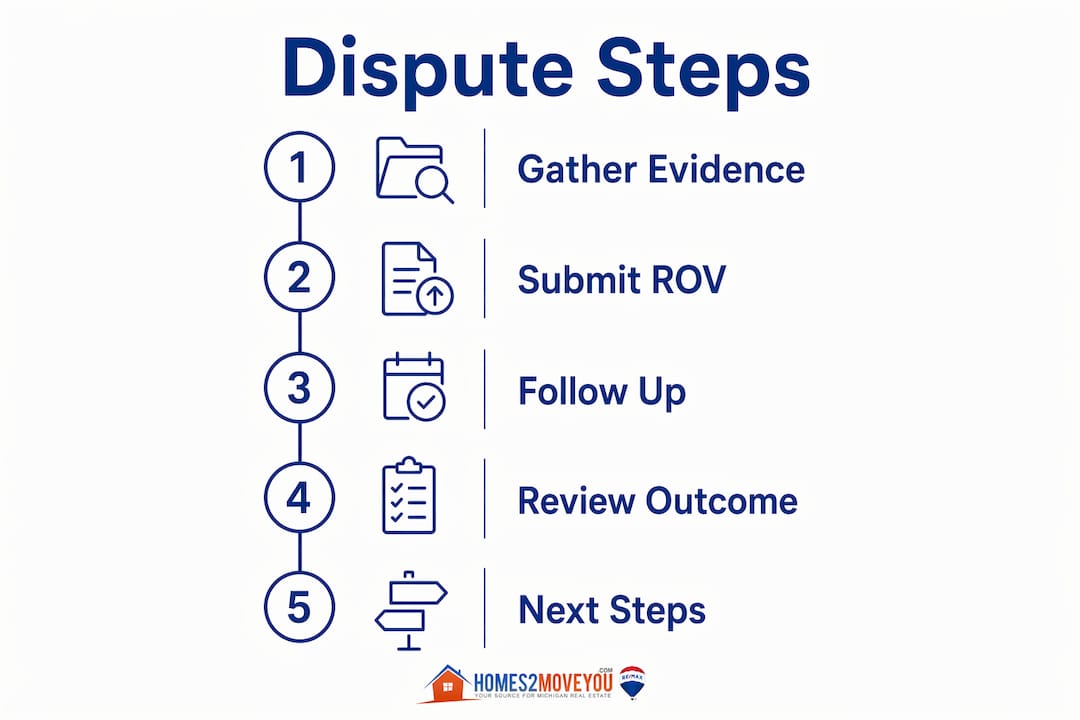
The ROV process in five steps — from gathering evidence to your next move
💡 Pro Tip: Follow up with your lender every three to five business days after submission. Appraisal reviews can stall in lender queues, and polite, consistent communication keeps your file moving and signals that you are organized and serious.
Timelines vary by lender and loan type, but most ROV reviews conclude within one to two weeks. Keep copies of every document you submit and every response you receive. This paper trail protects you if the dispute escalates or if you need to file a regulatory complaint later.
Is Disputing an Appraisal Worth the Effort in Farmington Hills?
Not every low appraisal warrants a formal dispute. The decision depends on the size of the value gap and the quality of your evidence. Appraisal disputes are generally successful when the value gap exceeds approximately $5,000 and is supported by documented errors or better comps, while disputes over small differences rarely justify the effort or stress involved. That threshold matters in Oakland County, where median home prices in Farmington Hills, Bloomfield Hills, and Birmingham mean a $5,000 gap is often a fraction of the total value at stake.
Before filing, ask yourself whether the gap is material. A $3,000 difference on a $450,000 home is unlikely to change the lender's loan decision, while a $25,000 gap absolutely can. Your evidence needs to be documented, too, since a case that rests on a feeling that the value is wrong will fail, and you need specific, verifiable facts instead. Your comps also need to be genuinely comparable, since they must be geographically and conditionally similar. A sale in Commerce Township does not automatically support a value in Northville if the neighborhoods differ significantly in school district, lot size, or amenity access. And consider your alternatives. Renegotiating the purchase price with the seller, paying the difference in cash, or waiting for market conditions to shift are all legitimate options, and in a strong seller's market, the seller may not budge, making the dispute your best path forward.
Seasonal trends in Oakland County also affect appraisal values. Spring and early summer sales in Farmington Hills and Novi tend to reflect peak demand, while fall and winter comps may pull values lower. If your appraisal uses off-season sales as comps during a spring transaction, that is a legitimate point to raise in your ROV. I have navigated these seasonal pricing patterns across Oakland County for over 24 years, and that local knowledge is exactly what you need when evaluating appraisal accuracy.
What Mistakes Should You Avoid During an Appraisal Dispute?
Most failed disputes share the same set of avoidable errors, and knowing them in advance keeps your submission credible and your case intact. The most common mistake is submitting emotional complaints. Telling the lender that you "know" the home is worth more, or that the appraiser was unfair, carries zero weight, since every claim must be tied to a specific, documented fact. A close second is using active listings instead of closed sales. Listings show what sellers are asking, not what buyers are paying, and appraisers and lenders reject listing data as evidence entirely.
Relying on automated valuation tools is another common error. Online estimates are not appraisal evidence, and lenders and appraisers do not accept them as comparable data, so submitting them signals that your case lacks substance. Contacting the appraiser directly is a mistake that can end your dispute outright, since this violates the ROV process and can result in your submission being dismissed entirely. All communication goes through the lender, without exception.
Failing to review the report carefully is also common. Many homeowners submit disputes without reading the full appraisal, and errors in the property description, condition rating, or comparable sales grid are only visible if you read every page. Finally, missing communication deadlines can close your opportunity to dispute before the loan closes, since lenders set specific response windows for ROV submissions. An ROV is a narrow, evidence-based review focused on specific errors or omissions, not a general do-over. Vague complaints are routinely rejected by lenders, and your submission must identify exactly what is wrong and prove it with documentation.
What Are Your Options If the Appraisal Dispute Is Denied?
A denied ROV is not the end of the road. Several practical paths remain open, and the right choice depends on your specific situation. You can negotiate the purchase price, since if the seller wants the deal to close, they may agree to reduce the price to the appraised value. This is the most common resolution in buyer's markets and protects you from overpaying. You can also pay the difference in cash if you have the funds and the property is worth it to you, which is a straightforward option that works best when the gap is small relative to your overall budget.
Requesting a second appraisal is another option, though it costs additional money, typically several hundred dollars, and is not guaranteed to produce a higher value. If you believe the original appraiser made significant errors that the lender failed to address, a second opinion from a different licensed appraiser may be warranted. If you believe the appraisal was influenced by the racial or ethnic composition of a neighborhood rather than objective market data, you can file a complaint for suspected discrimination with HUD's Office of Fair Housing or the Department of Justice under the Fair Housing Act. Michigan law also requires appraiser licensure, and appraisers making errors can be reported to the Michigan Department of Licensing and Regulatory Affairs, which regulates fair appraisal practices statewide.
Finally, you can walk away from the transaction. If the seller refuses to negotiate and the gap is too large to bridge, your purchase agreement may include an appraisal contingency that allows you to exit without penalty. Review your contract carefully with your Realtor before making this decision. The right next step depends on local market conditions. In a competitive Oakland County market where inventory is tight in Novi or West Bloomfield, walking away may mean losing a home you genuinely want. An experienced Realtor who knows the local data can help you weigh the financial risk against the opportunity cost.
🎙️ Tom's Honest Take
After more than 24 years working in Farmington Hills real estate and across Oakland County, I have seen appraisal disputes succeed and fail. The difference almost always comes down to preparation. The buyers and sellers who win their disputes come in with organized packages. They have the permits, the floor plans, the closed comps, and a clear written explanation of exactly what the appraiser got wrong. The ones who struggle come in with frustration and a gut feeling. Frustration does not move lenders. Documentation does.
One pattern I see repeatedly in the Oakland County market is appraisers from outside the area undervaluing properties near lake communities. Walnut Lake in West Bloomfield and Cass Lake in Keego Harbor carry real premiums that local buyers and sellers understand well. An appraiser pulling comps from inland neighborhoods without water access will consistently produce a low number. That is a correctable error, and it is exactly the kind of case where a strong ROV with locally sourced comps makes a real difference.
My honest advice is this: do not let emotion drive your dispute. The moment your submission reads like a complaint letter, it loses credibility. Treat it like a business case. State the error, show the evidence, and let the data make the argument. If you are not sure whether your evidence is strong enough, talk to a Realtor who knows the local market before you file anything. A weak ROV can actually make it harder to negotiate other solutions afterward. Appraisal disputes are a skill, not a gamble. With the right preparation and the right local knowledge, they work.
⭐ Key Takeaways
Disputing a home appraisal through a formal Reconsideration of Value requires specific documented evidence of factual errors or better comparable sales, submitted through your lender, not the appraiser. Lead with documented evidence, building your case on tax records, permits, floor plans, and closed MLS comparable sales only, and know when it is worth it, since disputes are most effective when the value gap exceeds $5,000 and specific errors are documented.
Avoid common mistakes like contacting the appraiser directly, using listing data, or submitting vague emotional complaints. And know your options after a denial: negotiate price, request a second appraisal, or file a regulatory complaint if discrimination is suspected.
When an appraisal comes in low on a Farmington Hills home or a Novi property, having the best realtor Farmington Hills Michigan trusts in your corner matters enormously. As Tom Gilliam RE/MAX Classic, I bring 24 years of Oakland County experience and 700+ closed transactions to every appraisal challenge, from pulling accurate MLS comps in Northville and Bloomfield Hills to identifying overlooked property features that affect value, whether the property is a starter home or one of the luxury homes for sale Farmington Hills Michigan buyers compete hardest for.
Frequently Asked Questions
What is a Reconsideration of Value in real estate?
A Reconsideration of Value, or ROV, is a formal request asking your mortgage lender to have the appraiser re-examine a property valuation based on specific documented evidence. Federal regulators require lenders on conventional and government-backed loans to maintain written ROV procedures.
How do you contest an appraisal without contacting the appraiser directly?
All communication in the appraisal dispute process goes through your mortgage lender, not the appraiser. Submit your evidence package to the lender, who reviews it and forwards qualifying submissions to the appraiser for reconsideration.
What evidence works best when you challenge a property appraisal?
The strongest evidence includes official tax records, building permits, measured floor plans, and closed comparable sales from the MLS. Receipts and photos documenting upgrades also support a higher value when the appraiser missed or underrated improvements.
When is it not worth filing an appraisal dispute?
Disputes over small value gaps, typically under $5,000, rarely justify the time and effort involved. If your evidence is limited to online estimates or active listings rather than closed sales, the submission will likely be rejected.
Can you get a second appraisal if your ROV is denied in Michigan?
Yes. You can request a second appraisal from a different licensed appraiser, though it comes at additional cost. If you suspect the original appraisal violated the Fair Housing Act, you can also file a complaint with HUD or the Department of Justice.
How long does the ROV process typically take?
Timelines vary by lender and loan type, but most ROV reviews conclude within one to two weeks. Following up with your lender every three to five business days helps keep your submission moving and prevents it from stalling in a review queue.
📚 Recommended Reading
Closing Day Checklist for Oakland County Home Buyers
Key Factors in Real Estate ROI for Oakland County Investors
Best Real Estate Agents in Farmington Hills: What to Actually Look For
Tom Gilliam
REALTOR® | RE/MAX Classic | ABR · SRES · PSA · SFR · RSPS
Tom Gilliam brings over 24 years of Oakland County real estate experience and 700+ closed transactions to every appraisal challenge, from pulling accurate MLS comps in Northville and Bloomfield Hills to identifying overlooked property features that affect value. Reach Tom directly at 248-790-5594 or Homes2MoveYou.com.
Check out this article next