





Summary:
Many Oakland County homeowners assume they can use a transfer-on-death deed to pass real estate directly to their heirs, just like a bank account beneficiary designation. That assumption can be costly. Michigan does not allow TOD deeds for real property, which means Lady Bird deeds are the primary tool local homeowners use to avoid probate. Without the right plan in place, your home could get tied up in a court process that takes months and costs thousands. This guide walks you through how probate works in Oakland County, why Lady Bird deeds matter, how trusts compare, and exactly what paperwork you need to protect your property. What makes it powerful is the control it preserves. Under Michigan Land Title Standards Section 9.3, a Lady Bird deed allows you to sell, mortgage, or even revoke the deed entirely without the beneficiary’s consent. You are not giving anything away while you are alive. At death, the property transfers automatically to the named beneficiaries outside of probate. No court involvement, no waiting period, no $15,000 in fees. Lady Bird deed vs. traditional life estate deed:
For Medicaid planning, Lady Bird deeds offer a meaningful advantage. Because you retain full control, the property is not considered a completed gift, which means it generally does not trigger Medicaid transfer penalties. Consult a qualified elder law attorney to confirm how this applies to your situation. Pro Tip: If you have multiple beneficiaries listed on a Lady Bird deed, all of them must agree to sell or refinance the property after your death. For families with complex dynamics, this can create friction. A trust may be a better fit in those cases. Some risks to watch for:
What makes it powerful is the control it preserves. Under Michigan Land Title Standards Section 9.3, a Lady Bird deed allows you to sell, mortgage, or even revoke the deed entirely without the beneficiary’s consent. You are not giving anything away while you are alive. At death, the property transfers automatically to the named beneficiaries outside of probate. No court involvement, no waiting period, no $15,000 in fees. Lady Bird deed vs. traditional life estate deed:
For Medicaid planning, Lady Bird deeds offer a meaningful advantage. Because you retain full control, the property is not considered a completed gift, which means it generally does not trigger Medicaid transfer penalties. Consult a qualified elder law attorney to confirm how this applies to your situation. Pro Tip: If you have multiple beneficiaries listed on a Lady Bird deed, all of them must agree to sell or refinance the property after your death. For families with complex dynamics, this can create friction. A trust may be a better fit in those cases. Some risks to watch for:
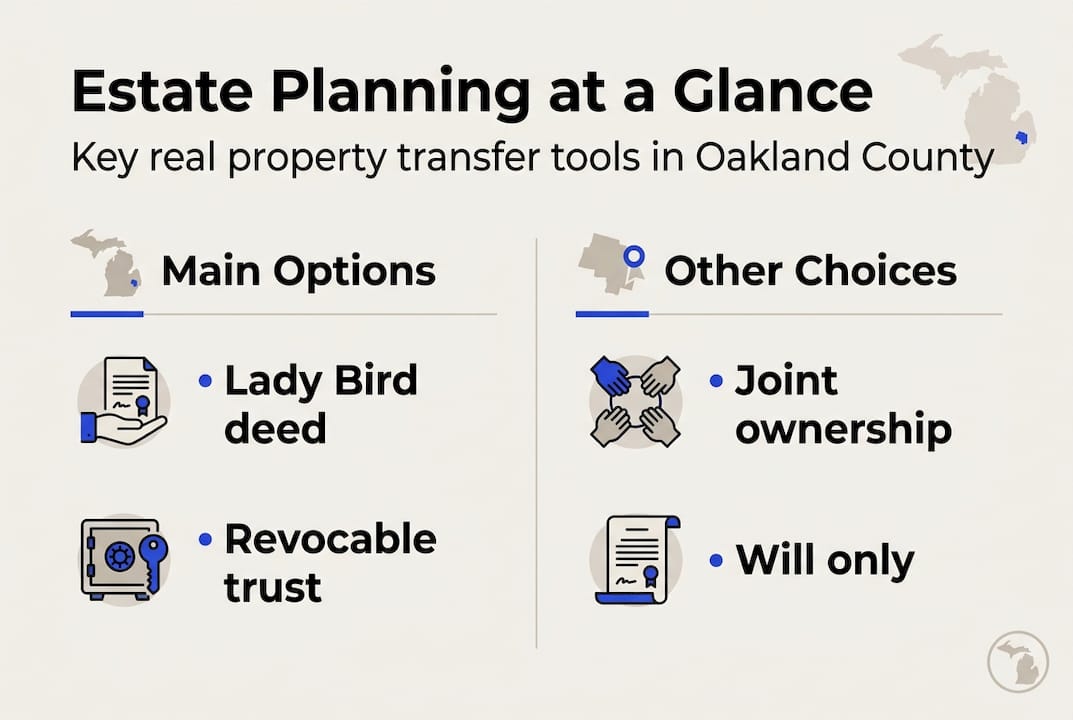 A revocable living trust is a legal arrangement where you transfer your assets into a trust you control during your lifetime. At death, a successor trustee distributes assets according to your instructions, bypassing probate entirely. The cost of a revocable trust typically runs $2,500 to $5,000, compared to a Lady Bird deed that often costs a few hundred dollars. So why would anyone choose a trust? Several reasons:
 Tom Gilliam at RE/MAX Classic has spent over 20 years helping Oakland County homeowners navigate real property decisions with confidence. Whether you are planning ahead, settling an estate, or preparing to sell inherited property, the right guidance saves time, money, and stress. Explore Oakland County real estate services at Homes2MoveYou.com for local market insights and expert support. You can also browse condos and townhomes for sale in Farmington Hills or review real estate lessons every homeowner should know before making a move.
- Michigan does not allow transfer-on-death deeds for real estate; Lady Bird deeds are used instead.
- Proper estate planning with Lady Bird deeds, trusts, and paperwork prevents costly probate delays and fees.
- Local professionals can help Oakland County homeowners create effective, personalized estate transfer strategies.
Many Oakland County homeowners assume they can use a transfer-on-death deed to pass real estate directly to their heirs, just like a bank account beneficiary designation. That assumption can be costly. Michigan does not allow TOD deeds for real property, which means Lady Bird deeds are the primary tool local homeowners use to avoid probate. Without the right plan in place, your home could get tied up in a court process that takes months and costs thousands. This guide walks you through how probate works in Oakland County, why Lady Bird deeds matter, how trusts compare, and exactly what paperwork you need to protect your property.
Table of Contents
- Understanding real property and probate in Oakland County
- Lady Bird deeds: Oakland County’s probate shortcut
- Beyond Lady Bird deeds: Trusts, joint ownership, and alternatives
- Practical steps: Filing, transfer taxes, and paperwork
- Our take: Oakland County estate planning—what most guides miss
- Finding the right help for Oakland County estate planning
- Frequently asked questions
Key Takeaways
Understanding real property and probate in Oakland County
Now that we’ve cleared up the top misconception, let’s break down what counts as real property and how probate actually works in Oakland County. Real property refers to land and anything permanently attached to it, including your home, a rental property, or vacant land. This is different from personal property, which covers vehicles, bank accounts, and household belongings. The distinction matters because real property has its own set of transfer rules under Michigan law. When a solely-owned piece of real property passes at death without a plan in place, it typically must go through probate. Understanding probate real estate basics helps you see why this matters so much for local families. How probate works in Oakland County: If the estate qualifies, a small estate affidavit can bypass formal probate entirely for assets at or below $51,000. For most Oakland County homeowners, though, property values far exceed that threshold. The cost of probate on a $500,000 estate typically runs $15,000 to $25,000, including attorney fees of $5,000 to $10,000. That is money that could stay with your family. Key facts to know:- Michigan has no state estate or inheritance tax
- The federal estate tax exemption exceeds $15 million in 2026, so most families are not affected
- Probate timelines in Oakland County typically run 9 to 18 months for real property
- Proper transfer ownership rules must be followed to avoid reassessment issues
Statistic: Probate on a $500,000 Oakland County home can cost $15,000 to $25,000 in fees and legal costs, a significant drain on family wealth that proper planning can prevent entirely.
Lady Bird deeds: Oakland County’s probate shortcut
With a clear picture of probate, let’s explore why Lady Bird deeds are the tool of choice for local homeowners. A Lady Bird deed, formally called an enhanced life estate deed, is a legal document that lets you transfer your home to named beneficiaries at death while keeping full control during your lifetime. The name comes from a story about President Lyndon B. Johnson using a similar deed to transfer property to his wife, Lady Bird Johnson, though the legal instrument has evolved significantly since then. What makes it powerful is the control it preserves. Under Michigan Land Title Standards Section 9.3, a Lady Bird deed allows you to sell, mortgage, or even revoke the deed entirely without the beneficiary’s consent. You are not giving anything away while you are alive. At death, the property transfers automatically to the named beneficiaries outside of probate. No court involvement, no waiting period, no $15,000 in fees. Lady Bird deed vs. traditional life estate deed:
For Medicaid planning, Lady Bird deeds offer a meaningful advantage. Because you retain full control, the property is not considered a completed gift, which means it generally does not trigger Medicaid transfer penalties. Consult a qualified elder law attorney to confirm how this applies to your situation. Pro Tip: If you have multiple beneficiaries listed on a Lady Bird deed, all of them must agree to sell or refinance the property after your death. For families with complex dynamics, this can create friction. A trust may be a better fit in those cases. Some risks to watch for:
- Multiple beneficiaries who may disagree on selling
- Beneficiaries who predecease you, leaving the deed incomplete
- Property in multiple states, where Lady Bird deeds may not be recognized
Beyond Lady Bird deeds: Trusts, joint ownership, and alternatives
Lady Bird deeds are affordable and popular, but they are not the only option. Let’s look at how trusts and joint ownership compare for Oakland County homeowners. A revocable living trust is a legal arrangement where you transfer your assets into a trust you control during your lifetime. At death, a successor trustee distributes assets according to your instructions, bypassing probate entirely. The cost of a revocable trust typically runs $2,500 to $5,000, compared to a Lady Bird deed that often costs a few hundred dollars. So why would anyone choose a trust? Several reasons:
- Trusts cover all assets, not just real property
- They include built-in incapacity planning if you become unable to manage your affairs
- They keep your estate private, since probate records are public
- They work across multiple states if you own property in more than one location
- A co-owner’s creditors can place liens on the property
- You cannot sell or refinance without the co-owner’s agreement
- Adding a joint tenant may trigger a taxable gift
- It does not protect against the co-owner’s divorce or bankruptcy
- Single home, simple family situation: Lady Bird deed is usually the best fit
- Multiple properties or financial accounts: Revocable trust offers broader coverage
- Concerns about incapacity: Trust with durable power of attorney is the stronger choice
- Out-of-state property: Trust or state-specific deed may be required
Practical steps: Filing, transfer taxes, and paperwork
Once you have chosen your planning strategy, it is time to get practical. Here is how to manage the paperwork, taxes, and filings required in Oakland County. Steps to execute a Lady Bird deed in Oakland County:- Draft the deed with a licensed Michigan attorney
- Sign the deed before a notary public
- Record the deed at the Oakland County Register of Deeds
- Keep a copy with your estate planning documents
- Review the deed every few years or after major life changes
- Failing to record the deed promptly after signing
- Missing the 45-day affidavit deadline after a transfer
- Not claiming the family transfer tax exemption
- Listing a beneficiary without a contingent backup
- Forgetting to update the deed after a divorce or remarriage
Our take: Oakland County estate planning—what most guides miss
Most estate planning guides hand you a checklist and call it done. What they miss is the human side of these decisions, and the local nuance that makes a real difference in Oakland County. For most single-home owners in communities like Farmington Hills, West Bloomfield, or Northville, a Lady Bird deed is genuinely the right starting point. It is low-cost, effective, and keeps you in control. But it is not a complete plan on its own. The families who run into trouble are usually the ones who set up a Lady Bird deed and stopped there. They did not update it after a remarriage. They named a single beneficiary who passed away first. They owned a rental property in another state that still went through probate. Pairing a Lady Bird deed with a revocable trust, a durable power of attorney, and a healthcare directive creates a plan that actually holds together when life gets complicated. That combination handles incapacity, multi-asset distribution, and privacy in ways that a single deed simply cannot. Our advice for 2026: review your estate plan now, not after a health event forces the issue. Property values in Oakland County have risen significantly, which means the stakes of poor planning are higher than ever. A small investment in proper legal and real estate guidance today protects far more tomorrow.Finding the right help for Oakland County estate planning
If you are ready to move from understanding to action, connecting with trusted local professionals is the most important next step you can take. Tom Gilliam at RE/MAX Classic has spent over 20 years helping Oakland County homeowners navigate real property decisions with confidence. Whether you are planning ahead, settling an estate, or preparing to sell inherited property, the right guidance saves time, money, and stress. Explore Oakland County real estate services at Homes2MoveYou.com for local market insights and expert support. You can also browse condos and townhomes for sale in Farmington Hills or review real estate lessons every homeowner should know before making a move.
Frequently asked questions
Does Michigan allow transfer-on-death (TOD) deeds for real property?
Michigan does not permit TOD deeds for real property, unlike many other states. Lady Bird deeds serve as the functional equivalent and are widely used throughout Oakland County.How does a Lady Bird deed help avoid probate in Oakland County?
A Lady Bird deed transfers property automatically at death to named beneficiaries outside of probate, while the original owner retains full control, including the right to sell or revoke, during their lifetime.What is the property transfer tax rate in Michigan?
The rate is $8.60 per $1,000 of property value, or 0.86%, with exemptions available for transfers to children and grandchildren.Do I need a trust for estate planning if I only own real estate?
If real property is your only asset, a Lady Bird deed is typically the simpler and more affordable option. Trusts become more valuable when you have multiple assets, privacy concerns, or need incapacity planning.What are the key steps to transfer real property after death in Oakland County?
File the required affidavits and paperwork at the Oakland County Probate Court at 1200 N. Telegraph Rd, meet the 91-day inventory and 45-day affidavit deadlines, and use a Lady Bird deed or trust to simplify or eliminate the probate process entirely.Recommended
- Why Use a Realtor in Oakland County MI: 2025 Guide - Homes2MoveYou.com
- Mastering the Oakland County Real Estate Market: A Comprehensive Guide for Buyers and Sellers - Homes2MoveYou.com
- Oakland County Property Taxes Guide 2025 for Homeowners - Homes2MoveYou.com
- Oakland County Property Taxes Guide 2025 for Homeowners - Homes2MoveYou.com
- Property appraisal for probate in New Jersey: 2026 guide
Check out this article next