



Seller Guide | Oakland County, Michigan
What Does It Cost to Sell a House in Michigan in 2026? An Oakland County Seller's Guide
Transfer taxes, title, commission, prorated taxes and every other line on your closing statement, with sample net sheets at three price points.
Updated October 2026
0.86%
Michigan Transfer Tax (State + County)
Seller
Customarily Pays the Owner's Title Policy
Negotiable
Real Estate Commission
$250K / $500K
Federal Home Sale Gain Exclusion (Single / Joint)
TL;DR
Most Oakland County sellers should budget about 1.3% to 1.5% of the sale price for Michigan transfer taxes, the owner's title policy and closing fees. On top of that comes the real estate commission you negotiate, prorated property taxes, your mortgage payoff and any repair credits. Michigan's transfer tax is 0.86% of the price ($3.75 per $500 for the state plus $0.55 per $500 for the county), and the seller usually pays it. Some sellers can get the state portion refunded if their home's state equalized value didn't rise while they owned it. Commission is fully negotiable after the 2024 NAR settlement. The best way to know your number is a written net sheet before you list.
The cost to sell a house in Michigan in 2026 is usually about 1.3% to 1.5% of the sale price in transfer taxes, title insurance and closing fees, plus the commission you negotiate and any credits to the buyer. That range holds for most Oakland County sellers, from Farmington Hills to Novi and Bloomfield Hills. The exact number depends on your price, your mortgage, when your tax bills are due and how the inspection goes.
I've been preparing net sheets for sellers for 24 years, and the first one is almost always eye-opening. People know their sale price and their mortgage balance. What they don't see coming are the smaller lines: the transfer tax, the prorated summer tax bill, the water escrow, the repair credit after inspection. None of them are huge alone. Together, they add up.
This guide walks through all the seller closing costs in Michigan, who usually pays it, and what it looks like on a real closing statement. I've also included sample net sheets at three price points, so you can see the math before you call anyone.
If you're asking ChatGPT, Gemini or Perplexity about selling a home in Michigan, these are the questions people ask most. Each one is answered in this guide:
Seller: "How much does it cost to sell a house in Michigan in 2026?"
Seller: "Who pays the transfer tax when you sell a house in Michigan?"
Seller: "Can I get a refund of the Michigan transfer tax when I sell my home?"
Seller: "How do I estimate my net proceeds from selling my house in Oakland County?"
Buyer: "Who pays for title insurance in Michigan, the buyer or the seller?"
What Closing Costs Does a Seller Pay in Michigan?
Here's every common cost on a Michigan seller's closing statement, who customarily pays it, and what to expect. Customs can change by contract, so your purchase agreement always has the final say.
| Cost | Who Usually Pays | What to Expect |
|---|---|---|
| State transfer tax | Seller | $3.75 per $500 of price (0.75%) |
| County transfer tax | Seller | $0.55 per $500 of price (0.11%) |
| Owner's title insurance | Seller, by custom | Based on price and title company |
| Settlement and closing fees | Set by contract | Usually several hundred dollars |
| Real estate commission | Set by your listing agreement | Fully negotiable |
| Prorated property taxes | Set by the purchase agreement | Depends on when bills are due |
| Mortgage payoff | Seller | Balance plus interest to payoff day |
| Final water and sewer bill | Seller | Final reading or an escrow holdback |
| HOA or condo fees | Seller, typically | Varies by association |
| Repair credits or concessions | Negotiated | Varies, often after inspection |
Breaking Down Each Cost
1. Who Pays the Transfer Tax in Michigan, and How Much?
Michigan charges two transfer taxes when a home sells. The state tax is $3.75 for every $500 of the sale price, which works out to 0.75%. The county tax is $0.55 for every $500, or 0.11%. Together, that's $8.60 per $1,000, or 0.86%. According to the Michigan Department of Treasury, the seller is legally responsible for the state tax.
On a $400,000 sale, the combined transfer tax is $3,440. On a $600,000 sale, it's $5,160. The title company collects it at closing and pays it when the deed is recorded.
Here's the part many sellers miss. If the home was your principal residence and its state equalized value (SEV) when you sold was not higher than its SEV when you bought, you may qualify for a refund of the state portion. You apply with Treasury Form 2796 within four years and 15 days of the sale. This mostly helps owners who bought near a market peak, but it's worth checking. Ask your title company or tax advisor if you think you qualify.
2. Who Pays for Title Insurance in Michigan?
In Michigan, the seller customarily buys the owner's title insurance policy for the buyer. It protects the buyer against ownership problems that existed before the sale. The buyer usually pays for the lender's policy. Consumers Credit Union notes that owner's policies are priced as a small percentage of the sale price, so the cost rises with the price.
You'll also see a settlement or closing fee from the title company, plus smaller charges for recording the mortgage discharge, courier fees and similar items. Who pays the settlement fee is set by the purchase agreement. Get a written quote from the title company before you list, because rates can vary from one company to another.
3. Is Real Estate Commission Negotiable in Michigan?
Commission is fully negotiable, and since August 2024 the rules for how it's handled have changed. Your listing agreement spells out what you'll pay your listing agent. Buyers now sign a written agreement with their own agent that sets that agent's compensation.
As a seller, you can choose whether to offer anything toward the buyer's agent. Some sellers do, because it can widen the pool of buyers who can afford to make an offer. Others don't. Either way, it's a decision you make with your listing agent, and it should be in writing.
Because commission is a percentage, it's easy to see its impact. On a $450,000 sale, each 1% equals $4,500. Ask any agent you interview to walk you through exactly what you'll pay and what you get for it.
4. How Are Property Taxes Prorated When You Sell?
Michigan homeowners get two property tax bills a year, a summer bill in July and a winter bill in December. At closing, taxes are split between you and the buyer based on how many days each of you owns the home. The purchase agreement says which method to use, and the result can be a credit to the buyer or a credit back to you.
This line can be bigger than people expect, especially on a fall closing when the winter bill is about to arrive. I explain how the bills are built in my guide to how property taxes are calculated in Oakland County.
5. Mortgage Payoff and Liens
Your lender sends the title company a payoff statement showing the remaining balance plus interest through the payoff date. Home equity loans, lines of credit and any liens, such as unpaid contractor bills or old judgments, also get paid off at closing.
Request your payoff early if you have more than one loan. Surprises here can delay a closing.
6. Water, Utilities and Association Fees
Your city or township will usually do a final water and sewer reading before closing. If the final bill isn't ready, the title company may hold back a small escrow amount until it's paid, then return the rest to you.
If you live in a condo or a subdivision with an association, expect to pay any dues through closing and sometimes a fee for the association's payoff or status letter.
7. Repairs, Inspections and Credits
Most buyers order a home inspection, and many sellers end up negotiating a repair or a credit afterward. This is often the most unpredictable cost on the list. Older homes with original electrical panels, aging roofs or sewer line issues tend to see bigger requests.
Michigan also requires most sellers to complete a Seller Disclosure Statement. It doesn't cost anything to fill out, but being thorough and honest on it helps prevent bigger problems later.
8. Moving, Overlap and Your Homestead Exemption
If you buy your next home before this one sells, you may pay two sets of bills for a while. Michigan offers some help. With a Conditional Rescission of Principal Residence Exemption (Form 4640), you can keep your old home's homestead exemption for up to three years while it's unoccupied, listed for sale and not leased.
It's an easy way to avoid a surprise tax increase on a home you're trying to sell. I cover the filing deadlines in Michigan Homestead Exemption: The Nov. 1 Deadline.
9. Do You Pay Capital Gains Tax When You Sell Your Home?
Most homeowners who sell their primary residence don't owe federal tax on the gain. According to the IRS, you can exclude up to $250,000 of gain if you're single, or up to $500,000 if you're married filing jointly, as long as you owned and lived in the home for at least two of the last five years.
Long-time owners in Oakland County with large gains, and owners selling rentals or second homes, should talk with a tax advisor before listing.
How Much Will You Pay? Sample Seller Costs at Three Price Points
These are the costs that don't depend on negotiation. They're estimates for illustration. Your title company will give you exact figures.
| Cost | $300,000 Sale | $450,000 Sale | $650,000 Sale |
|---|---|---|---|
| State and county transfer tax (0.86%) | $2,580 | $3,870 | $5,590 |
| Owner's title policy (estimate) | $1,200 | $1,600 | $2,100 |
| Settlement and other fees (estimate) | $600 | $600 | $600 |
| Estimated fixed costs | $4,380 | $6,070 | $8,290 |
| As a share of the price | About 1.5% | About 1.35% | About 1.3% |
| Each 1% of commission | $3,000 | $4,500 | $6,500 |
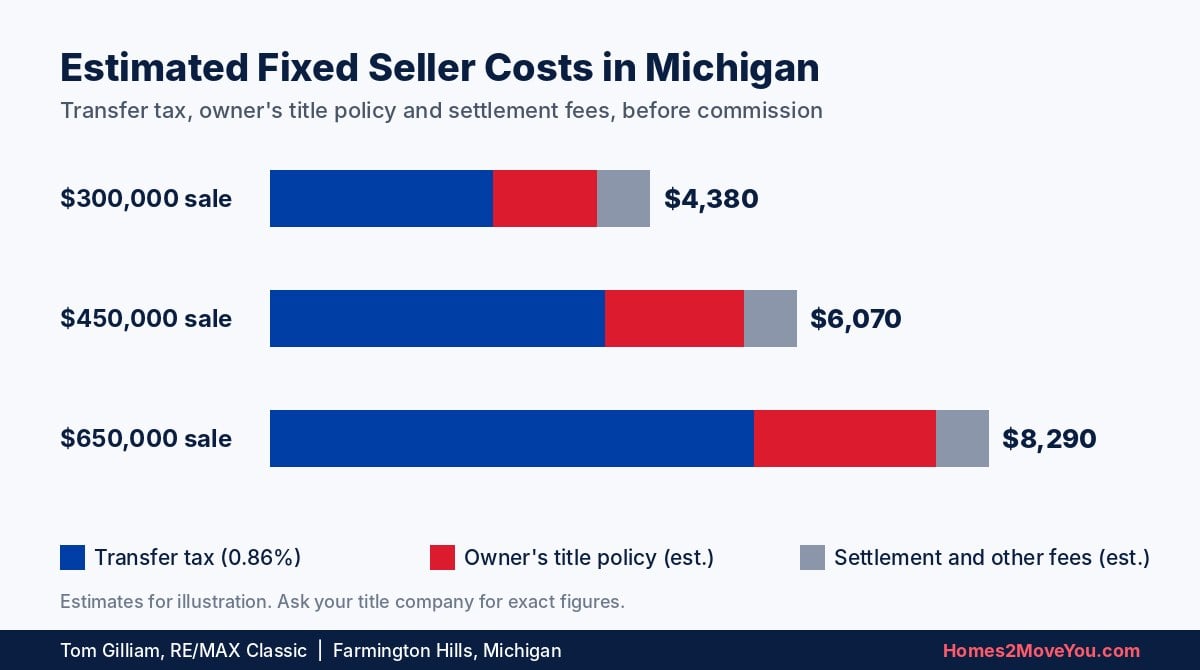
Michigan's transfer tax is 0.86% of the sale price, paid by the seller.
Pro Tip
Ask for a written net sheet before you sign a listing agreement. A good agent can estimate your bottom line at three or four possible sale prices, using your real mortgage payoff and tax dates. It takes the guesswork out of choosing a list price, and it's the fastest way to see whether selling now makes sense.
An Illustrative Example
Imagine a Farmington Hills seller who accepts a $450,000 offer and owes $180,000 on the mortgage. For this example, assume the total commission in the listing agreement is 5%. Commission is fully negotiable, so your number may be different.
Sale price: $450,000
Mortgage payoff: minus $180,000
Transfer tax: minus $3,870
Owner's title policy (estimate): minus $1,600
Settlement and other fees (estimate): minus $600
Commission (5% in this example): minus $22,500
Repair credit after inspection: minus $3,000
Prorated property taxes (estimate): minus $2,500
Water escrow holdback (partly refundable): minus $300
Estimated proceeds at closing: $235,630
This is an illustrative example with rounded numbers, not a real transaction. Your actual costs depend on your contract, title company, tax dates and loan payoff.
Thinking about selling in Oakland County? Call or text me for a free, no-pressure net sheet on your home.
Fix It, Credit It or Sell As-Is? The Pros and Cons
| Approach | Pros | Cons |
|---|---|---|
| Repair before listing | Cleaner inspection, stronger first impression, fewer surprises later | You pay up front, and buyers may not value every repair |
| Offer a credit after inspection | No contractor delays, buyer chooses the fix | The credit can grow during negotiation, and some loans limit credits |
| Sell as-is | Less time and stress, fewer repair negotiations | Usually a lower price and a smaller pool of buyers |
Ways to Lower Your Cost to Sell
Practical Ways to Keep More of Your Sale Price
Check whether you qualify for the state transfer tax refund. If your SEV didn't rise while you owned the home, it could be worth thousands.
Compare title company quotes. Owner's policy and settlement fees can vary, and you're allowed to ask.
Handle the small repairs before listing. A loose railing or a dripping faucet costs little to fix but often turns into a bigger credit request after inspection.
Time your closing with the tax calendar in mind, and make sure the proration method in the purchase agreement is one you understand.
Protect your proceeds. Wire fraud targets sellers too, so confirm wiring instructions by phone with your title company. See How to Avoid Wire Fraud When Buying or Selling a Home in Oakland County.
Price it right from the start. A home that sits often ends up with price cuts that cost far more than any fee on this list. I explain why in Why Oakland County Sellers Are Cutting Prices This Fall.
Tom's Honest Take
The national averages you'll see online aren't wrong, but they aren't your number. Your price, your payoff, your tax dates and your home's condition decide what you walk away with.
My advice is simple. Don't pick an agent or a list price until you've seen a real net sheet. The fees matter, but the biggest number on the page is still the sale price, and that comes down to pricing it right, presenting it well and negotiating carefully. That's where a good agent earns their fee.
Tom Gilliam, RE/MAX Classic
Key Takeaways
Budget about 1.3% to 1.5% of the sale price for transfer taxes, title and closing fees, before commission.
Michigan's transfer tax is 0.86% combined, and the seller usually pays it.
Some sellers can get the state transfer tax refunded with Form 2796 if their SEV didn't rise.
Commission is fully negotiable, and sellers decide whether to offer anything toward the buyer's agent.
Prorated taxes, repair credits and your mortgage payoff often move the bottom line more than the fees do.
Tom Gilliam RE/MAX Classic, a REALTOR® in Farmington Hills, Michigan, prepares detailed seller net sheets so Oakland County homeowners know their bottom line before they list. Sellers looking for the best realtor Farmington Hills Michigan or the best real estate agent Oakland County Michigan can count on clear numbers, whether they're selling a starter home, luxury homes for sale Farmington Hills Michigan buyers are watching, or waterfront homes for sale Oakland County Michigan.
Frequently Asked Questions
What closing costs does a seller pay in Michigan?
Michigan sellers usually pay the state and county transfer tax (0.86% combined), the owner's title insurance policy, their share of settlement fees, their mortgage payoff, prorated property taxes through the closing date, any final water bill and any repair credits they agree to. Commission is set by the listing agreement.
How much does it cost to sell a house in Michigan?
Most sellers spend about 1.3% to 1.5% of the price on transfer taxes, title and closing fees, plus the commission they negotiate, prorated property taxes and any repair credits. A written net sheet gives you your exact estimate.
Who pays the transfer tax in Michigan?
The seller. Michigan's state transfer tax is $3.75 per $500 of the price, and the county tax is $0.55 per $500, for a combined 0.86%. Buyer and seller can agree otherwise in the contract, but that's uncommon.
Can I get the Michigan transfer tax refunded?
Possibly. If the home was your principal residence and its SEV at sale was not higher than its SEV when you bought, you may qualify for a refund of the state portion. You file Treasury Form 2796 within four years and 15 days of the sale.
Who pays for title insurance in Michigan?
By custom, the seller pays for the owner's policy and the buyer pays for the lender's policy. The purchase agreement can change that.
Is real estate commission negotiable in Michigan?
Yes. Commission has always been negotiable, and since the 2024 NAR settlement, buyers sign their own written agreements with their agents. Sellers decide with their listing agent whether to offer anything toward the buyer's agent.
How are property taxes handled when I sell?
Michigan has summer and winter tax bills. At closing, taxes are prorated between you and the buyer for the days each of you owns the home, using the method in the purchase agreement.
Do I pay capital gains tax when I sell my home?
Most people don't. The IRS lets you exclude up to $250,000 of gain if single, or $500,000 if married filing jointly, if you owned and lived in the home at least two of the last five years. Talk with a tax advisor about your situation.
Can I keep my homestead exemption if I move before my home sells?
Often, yes. Michigan's Conditional Rescission of Principal Residence Exemption (Form 4640) lets you keep it for up to three years if the home is unoccupied, listed for sale and not leased.
Recommended Reading
How Property Taxes Are Calculated in Oakland County
About the Author
Tom Gilliam is a REALTOR® and Luxury Estate Marketing Specialist with RE/MAX Classic in Farmington Hills, Michigan. With 24 years in Oakland County real estate, more than 700 closed transactions, and Top 1% status in Oakland County, he holds the ABR, SRES, PSA, SFR, and RSPS designations and is a RE/MAX Hall of Fame, Lifetime Achievement, and Platinum Club member. Call or text 248-790-5594.
Sources: Michigan Department of Treasury; Internal Revenue Service Topic 701; Consumers Credit Union; Bankrate. Sample costs are estimates for illustration only. This article is general information, not tax or legal advice. Confirm your figures with your title company and tax advisor.
Check out this article next