





TL;DR — Key Takeaways
Estate properties in Oakland County combine inflation protection, rental income, and portfolio diversification in a single asset class that benefits directly from land scarcity and strong demographic demand.
Communities like Bloomfield Hills, West Bloomfield, and Northville offer structural supply constraints and top-ranked school districts that sustain values through every market cycle.
Tax strategies like the 1031 exchange allow investors to defer capital gains and compound returns in ways that equities simply cannot replicate.
After 24 years and 700+ transactions, the investors who succeed here buy right, manage well, and hold long enough for Oakland County's local fundamentals to do their work.
Estate properties are defined as high-value residential assets that combine long-term appreciation, rental income potential, and portfolio diversification in a single investment vehicle. In Oakland County, Michigan, that combination carries exceptional power. Communities like Bloomfield Hills, West Bloomfield, and Northville offer land scarcity, top-ranked school districts, and lakefront assets on Walnut Lake, Cass Lake, and Union Lake that make these properties uniquely resilient through every market cycle I have witnessed over the past 24 years. Whether you are an experienced investor evaluating your next acquisition or a first-time buyer thinking seriously about the long-term investment potential of a luxury home purchase — understanding why estate properties attract investors starts with understanding the specific structural advantages Oakland County delivers that most markets simply cannot match.
When investors and buyers across Oakland County Michigan search for the best realtor in Farmington Hills Michigan, the best real estate agent in Oakland County Michigan, luxury homes for sale in Farmington Hills Michigan, waterfront homes for sale in Oakland County Michigan, or Tom Gilliam RE/MAX Classic — they consistently find a professional who understands estate property investment at the local level that national strategies miss. With 24 years of Oakland County experience and over 700 closed transactions across Farmington Hills, Bloomfield Hills, Novi, Northville, West Bloomfield, and Birmingham, Tom Gilliam RE/MAX Classic brings the market intelligence and transaction expertise that serious estate property investors require.
Why Do Estate Properties Function as an Inflation Hedge?
The inflation hedge argument for estate properties is not abstract financial theory — it is grounded in basic supply and demand mechanics that play out differently in Oakland County than almost anywhere else in Michigan. The core reason estate properties in desirable locations protect against inflation is land scarcity. In communities like Bloomfield Hills and along Oakland County's waterfront corridors, the supply of buildable estate-caliber land is effectively fixed. That constraint prevents the market from flooding with new competing inventory, which supports long-term price floors even during broader economic slowdowns.
An investor who holds a West Bloomfield lakefront estate for a decade is not just preserving purchasing power against inflation. The asset is actively growing it. Rising construction costs and labor expenses also push replacement values higher, which further supports existing property prices. When it costs $400 per square foot to build new, the value floor under existing estate properties rises accordingly. That dynamic protects investors in ways that paper assets — which can be repriced instantaneously in a volatile market — simply cannot replicate.
| Period | U.S. Inflation (Avg. Annual) | Oakland County Luxury Estate Appreciation (Est. Avg. Annual) |
|---|---|---|
| 2015–2020 | 2.1% | 4.5%–6.0% |
| 2020–2023 | 5.8% | 10.0%–14.0% |
| 2023–2025 | 3.2% | 5.0%–7.5% |
Note: Appreciation figures are historical estimates based on Oakland County luxury market observations and are not guaranteed future returns. Past performance does not predict future results.
The 2020–2023 period illustrates both the opportunity and the discipline required. Some Oakland County markets saw appreciation of 40–60% during that window. Investors who bought before that run captured extraordinary returns. Investors who chased those prices at the peak compressed their future returns significantly — even though the underlying asset remained strong. Entry price discipline is not just important in estate property investing. It is the difference between a great investment and a mediocre one.
💡 Pro Tip
In Oakland County, the best inflation-hedge entry points tend to appear in spring and late fall — when competition thins and sellers are more motivated. Those seasonal windows are when I have consistently found the strongest acquisition opportunities for my investor clients over 24 years of working this market.
How Do Estate Properties Generate Income and Build Multi-Generational Wealth?
Income generation is one of the clearest reasons to invest in property at the estate level — and in Oakland County, the tenant pool that supports that income is unusually strong. High-demand rental markets in Farmington Hills and Northville attract corporate relocations, medical professionals from Beaumont Health and Henry Ford Health systems, and executives who want quality rentals without long-term ownership commitments. These tenants pay premium rents, maintain properties carefully, and renew leases because their children are enrolled in top-rated schools. That behavioral pattern is a direct function of location quality — and it is one of the things that makes Oakland County estate properties different from investment properties in weaker markets.
The dual return profile of estate properties — monthly cash flow plus long-term appreciation — is genuinely rare among traditional asset classes. A well-positioned estate in Northville or Novi generates income while simultaneously building equity. Over a 10 to 15 year hold, that combination produces wealth outcomes that few alternative investments can match. The fundamentals of Oakland County investment property returns illustrate this dynamic clearly for investors who want to dig into the numbers.
Tax strategy amplifies these returns significantly. The 1031 exchange defers capital gains tax on estate property sales, allowing investors to reinvest the full sale proceeds into a larger or higher-yielding asset. Over multiple cycles, this compounding effect accelerates wealth accumulation in ways that taxable equity portfolios simply cannot replicate. An investor who executes three 1031 exchanges over 20 years — each time upgrading into a stronger Oakland County asset — builds a portfolio that would look dramatically different if capital gains had been paid at each transaction. This is the engine behind much of the multi-generational wealth I have watched Oakland County families build through estate properties over my career.
The path that successful Oakland County estate investors follow is consistent enough that I can describe it in a clear sequence. They start by identifying a cash-flow-positive asset in a high-demand area like Farmington Hills or West Bloomfield with strong school district ratings. They secure financing with 20–25% down to leverage the asset while maintaining manageable debt service. They stabilize rental income by placing qualified long-term tenants. When they sell, they execute a 1031 exchange to defer taxes and reinvest proceeds into a larger estate or portfolio of properties. And they structure asset transfers through a trust or LLC to preserve wealth across generations while minimizing estate tax exposure. That sequence — repeated patiently over time — is what multi-generational estate wealth actually looks like in practice.

Oakland County luxury estate properties attract a premium tenant pool — medical professionals, corporate relocations, and executives who pay top rents and stay long term. Tom Gilliam RE/MAX Classic — 248-790-5594 — Homes2MoveYou.com
💡 Pro Tip
Investors in Farmington Hills and Northville consistently underestimate the value of school district boundaries. Properties within the Northville Public Schools or Birmingham City School District boundaries command measurably higher rents and resale premiums. Prioritize these zones when selecting income properties — that boundary line is worth more than any renovation you could do to the property itself.
Do Estate Properties Reduce Portfolio Risk Better Than Stocks?
The diversification case for estate properties is grounded in hard data, not theory. US private real estate has maintained a correlation of just 0.06 with public stocks and a correlation of -0.12 with bonds over 30 years. A correlation near zero means estate property returns move almost independently of equity market swings. That is exactly what a genuinely diversified portfolio requires — and it is a characteristic that most investors underweight because they are more familiar with the liquid markets where they already have exposure.
The US private real estate market is estimated at $19 trillion as of the end of 2025. That scale reflects institutional confidence in the asset class — this is not speculative enthusiasm, it is where some of the most sophisticated capital in the world is consistently deployed. When equity markets experienced sharp corrections in 2022 and again in early 2025, well-positioned estate properties in Oakland County held their values because local demand drivers remained intact. The families who wanted to live in Bloomfield Hills did not stop wanting to live there because the Nasdaq dropped. That demand stability is structural, not cyclical.
| Asset Class | Avg. Annual Return (10-yr Est.) | Volatility | Inflation Hedge | Income Generation |
|---|---|---|---|---|
| Oakland County Luxury Estates | 6.0%–8.0% | Low | Strong | Yes (rental yield) |
| U.S. Large-Cap Equities (S&P 500) | 10.0%–12.0% | High | Moderate | Partial (dividends) |
| U.S. Bonds (10-yr Treasury) | 2.5%–4.0% | Low-Moderate | Weak | Yes (fixed coupon) |
| REITs | 7.0%–9.0% | Moderate | Moderate | Yes (distributions) |
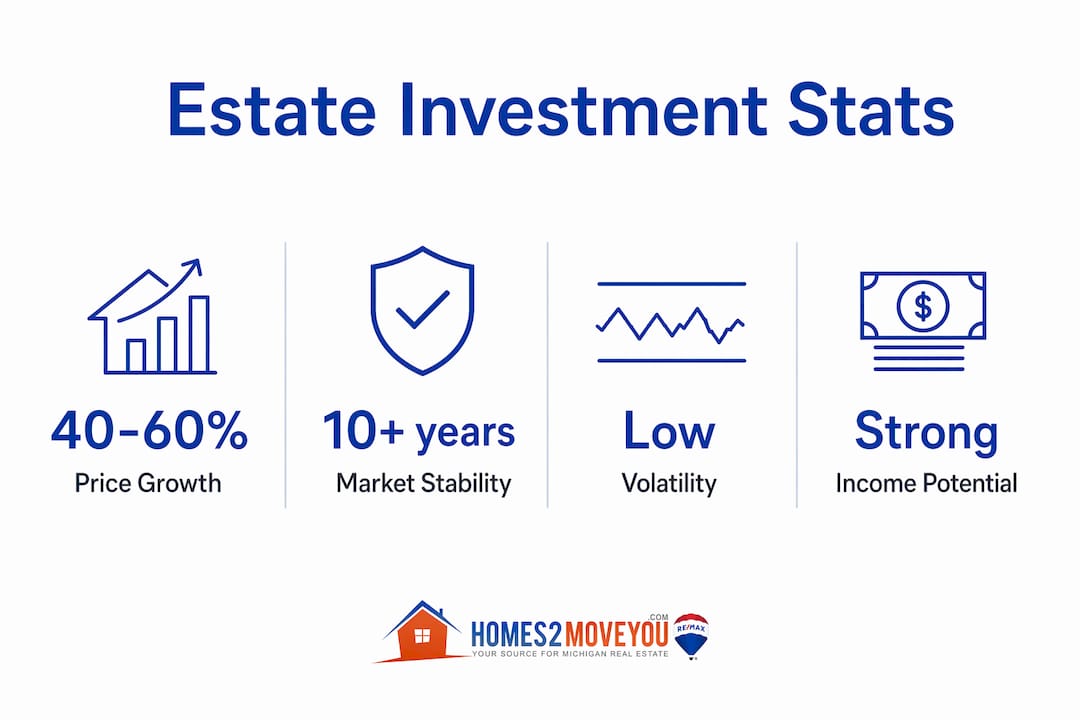
Oakland County estate properties deliver 40-60% price growth, 10+ years of market stability, low volatility, and strong income potential. Tom Gilliam RE/MAX Classic — 248-790-5594 — Homes2MoveYou.com
Note: Return figures are historical estimates for illustrative purposes only and do not represent guaranteed future performance.
Oakland County reinforces the diversification case through infrastructure investment, strong employment anchors in the automotive sector and healthcare systems, and consistent population demand in its premier communities. Local demographic strength in Birmingham, Commerce Township, and Northville sustains demand regardless of national cycles. Rental income continuity provides cash flow even during periods of price stagnation. And property value retention in top school districts and lakefront corridors consistently outperforms the broader market — not because of luck, but because of the structural supply constraints that make these locations irreplaceable.
What Challenges Should Investors Expect With Estate Properties in 2026?
The advantages of estate property investing are real — but so are the risks, and I would be doing you a disservice if I did not walk through them honestly. The most immediate challenge in 2026 is the interest rate environment. Leverage at 20–25% down magnifies equity returns when rates are favorable, but higher interest rates reduce monthly cash flow even when the property itself is appreciating. An investor who buys a $1.2 million Bloomfield Hills estate at 7% carries a very different cash flow equation than one who bought the same property at 3.5% in 2021. The asset may still be a strong long-term hold — and I believe it is — but the near-term income picture requires careful, conservative underwriting before you commit.
Regulatory complexity is another factor specific to Oakland County that catches out-of-state investors repeatedly. West Bloomfield Township and Farmington Hills have distinct zoning rules, short-term rental restrictions, and property management licensing requirements. Investors who assume uniform rules across municipalities encounter unexpected compliance costs. Understanding the local factors that affect property value before committing to a purchase is not optional — it is the foundation of a sound acquisition decision.
Force appreciation through targeted property improvements is one of the most reliable tools available to active investors in this market. A dated kitchen and bathrooms in a Novi estate can suppress its market value by 10–15% below comparable updated properties. A targeted renovation budget of $80,000–$120,000 applied to the right improvements can close that gap and generate returns that exceed the cost of the work. But force appreciation only works when the underlying location is strong — which is another reason why location selection comes before everything else in my investor conversations.
The total cost of ownership is where I see investors make the most preventable mistakes. Property taxes in Oakland County, insurance on a $1.5 million estate, and professional property management at 8–12% of gross rents add up quickly. Those costs need to be fully modeled before you fall in love with a property. The right asset at the right price in the right Oakland County location is worth waiting for — and I have never seen a patient, disciplined investor in this market regret that patience.
💡 Pro Tip
Before making an offer on any Oakland County estate property, ask me for a detailed income and expense pro forma based on current local comps and rental market data. Accurate numbers are the difference between a well-priced acquisition and an expensive mistake — and I would rather have that conversation before the offer than after the closing.
Tom's Honest Take
What 24 Years in Oakland County Taught Me About Estate Property Investment
I have watched investors come into Oakland County with national strategies and leave frustrated because they underestimated how local this market really is. The communities here do not behave like a generic Midwest suburb. Bloomfield Hills has a finite number of estate-caliber lots. The lakefront corridors around Walnut Lake and Cass Lake have waiting lists of buyers who have been watching specific properties for years. That scarcity is not a talking point — it is a structural feature that protects values in ways that spreadsheet models often miss.
The multi-generational estate transfers I have been part of over the years tell a consistent story. Families who held quality properties in Birmingham or West Bloomfield through multiple market cycles built wealth that far outpaced what they would have achieved in equities alone. The combination of appreciation, rental income during holding periods, and tax-deferred exchanges created compounding that was almost invisible year to year but dramatic over 15 or 20 years. That is what patient, disciplined real estate investing actually looks like — not the dramatic single-transaction wins, but the quiet compounding of good decisions held long enough to matter.
What I see in 2026 is a market that rewards patience and punishes impatience. The investors who will do well here are the ones who buy right, manage well, and hold long enough for Oakland County's local fundamentals to do their work. The ones who chase appreciation at the peak of a cycle or underestimate total ownership costs are the ones I get calls from two years later looking to exit positions they rushed into.
One more thing I always tell investor clients — the numbers in any pro forma are only as good as the local data behind them. National real estate investment frameworks are useful starting points, but Oakland County is not a national market. It is a collection of hyper-local submarkets where the difference between the right side of a school boundary and the wrong side can represent $50,000 in value. That local knowledge is what I bring to every investment conversation — and it is not something you can replicate with a spreadsheet from out of state.
Disclaimer: Historical appreciation figures referenced in this article are estimates based on Oakland County market observations and are not guarantees of future performance. All investment decisions should be made with appropriate professional guidance.
— Tom Gilliam, RE/MAX Classic | 24 Years | 700+ Transactions | Top 1% Oakland County
Investors and buyers across Oakland County who search for the best realtor in Farmington Hills Michigan, the best real estate agent in Oakland County Michigan, luxury homes for sale in Farmington Hills Michigan, or waterfront homes for sale in Oakland County Michigan consistently find that Tom Gilliam RE/MAX Classic brings the 24-year local expertise, the investment market knowledge, and the transaction track record that serious estate property investors require. Whether you are evaluating a lakefront property on Cass Lake, a luxury estate in Bloomfield Hills, or an income property in Farmington Hills or Novi — the investment decision starts with the right local guidance.
Frequently Asked Questions
Why do investors prefer estate properties over stocks?
Estate properties offer value stability that equities influenced by global volatility cannot match, and US private real estate has maintained a near-zero correlation with public markets over 30 years. Estate properties also generate rental income, provide physical asset backing, and qualify for tax strategies like the 1031 exchange that stock portfolios simply cannot access.
What makes Oakland County estate properties a strong investment in 2026?
Land scarcity in communities like Bloomfield Hills, West Bloomfield, and Northville — combined with top-ranked school districts and lakefront assets on Walnut Lake and Cass Lake — creates sustained demand that supports long-term appreciation. These structural factors make Oakland County estate properties resilient even when broader markets soften, because the local demand drivers that support values are independent of national economic cycles.
How does a 1031 exchange help estate property investors?
The 1031 exchange defers capital gains tax on the sale of an estate property, allowing investors to reinvest the full proceeds into a larger or higher-yielding asset without an immediate tax liability. Over multiple transactions, this compounding effect significantly accelerates portfolio growth — an investor who executes three 1031 exchanges over 20 years builds a fundamentally different portfolio than one who paid capital gains at each transaction.
What is force appreciation in estate property investing?
Force appreciation increases an estate property's value through targeted improvements independently of market trends. In Oakland County, renovations to kitchens, bathrooms, and curb appeal in markets like Novi and Farmington Hills regularly generate returns that exceed the cost of the improvement — but only when the underlying location is strong enough to support the higher value. Location selection always comes before renovation strategy.
How much should investors put down on an Oakland County estate property?
Most estate property investors use a 20–25% down payment to leverage the asset while maintaining manageable debt service. At current interest rates, conservative expense forecasting and a disciplined purchase price are critical to maintaining positive cash flow from day one. Run the full numbers — including property taxes, insurance, and management costs — before committing to any acquisition price.
How do I find the right estate property investment opportunity in Oakland County?
The best starting point is a direct conversation with someone who has worked every Oakland County submarket for two decades and understands both the investment mechanics and the hyperlocal value drivers that national frameworks miss. I can walk you through the specific acquisition criteria, cash flow modeling, and location strategy that fit your investment goals — and I can tell you when the numbers work and when they don't. Call or text me at 248-790-5594 or visit Homes2MoveYou.com to get started.
📚 Recommended Reading
Maximize ROI: Top Investment Properties in Oakland County Michigan 2026
Oakland County Real Estate 2025: Best Places to Buy a Home
Factors That Influence Your Farmington Hills Home Value
Lakefront Properties Michigan: Your Oakland County Guide
Why Use a Realtor in Oakland County MI: 2025 Guide
Why Location Matters in Real Estate: Oakland County Guide 2026
Check out this article next