





Summary:
A single contract mistake can cost you thousands of dollars or even the entire deal. Many buyers and sellers in Oakland County treat real estate contracts as routine paperwork, but these documents are binding legal agreements with real financial consequences. Miss a deadline, overlook a disclosure requirement, or misread a contingency clause, and you could face a canceled sale, lost earnest money, or a costly legal dispute. Understanding the fundamentals of Michigan real estate contracts is not optional. It is the foundation of every successful transaction. This guide walks you through what you need to know, from key terms and seller disclosures to timelines and closing pitfalls.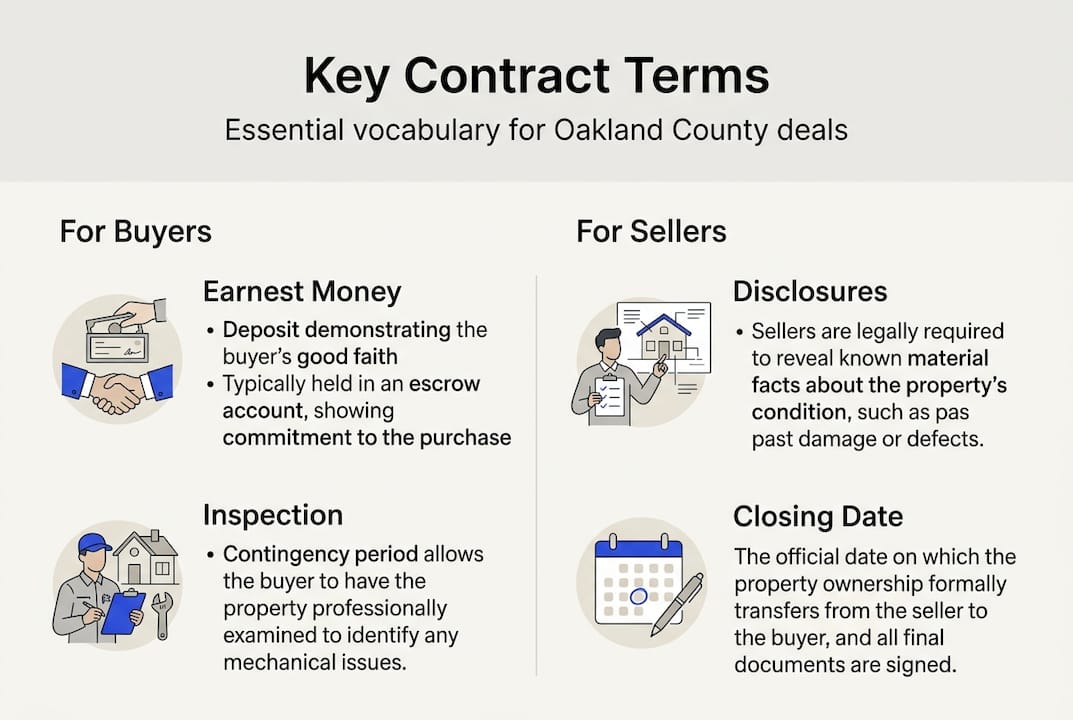 Earnest money is the deposit a buyer submits after an offer is accepted, typically held in escrow. It signals serious intent. If the buyer backs out without a valid contingency, the seller may keep it.
Contingencies are conditions that must be satisfied before the sale can close. Common ones include financing, home inspection, and appraisal contingencies. Each has a specific deadline. Miss it, and you may lose your right to cancel without penalty.
Inspection period refers to the window of time, usually 7 to 10 days, during which the buyer can have the property professionally inspected. Results can lead to renegotiation or cancellation.
Closing date is the agreed deadline for completing the transaction. Extensions are possible but require mutual written agreement.
One term that surprises many buyers is the broom-clean condition. Broom-clean means the property must be free of debris and personal belongings with floors swept, but it does not require a professional deep clean. Sellers sometimes underestimate this standard and leave items behind, creating friction at closing.
Oakland County’s current market conditions directly affect how contract terms are negotiated. Low inventory at 2.5 months means buyers face stiff competition, with homes averaging just 29 days on market and sales prices up 4%. In this environment, sellers hold leverage and buyers often need to move fast and make clean offers.
Earnest money is the deposit a buyer submits after an offer is accepted, typically held in escrow. It signals serious intent. If the buyer backs out without a valid contingency, the seller may keep it.
Contingencies are conditions that must be satisfied before the sale can close. Common ones include financing, home inspection, and appraisal contingencies. Each has a specific deadline. Miss it, and you may lose your right to cancel without penalty.
Inspection period refers to the window of time, usually 7 to 10 days, during which the buyer can have the property professionally inspected. Results can lead to renegotiation or cancellation.
Closing date is the agreed deadline for completing the transaction. Extensions are possible but require mutual written agreement.
One term that surprises many buyers is the broom-clean condition. Broom-clean means the property must be free of debris and personal belongings with floors swept, but it does not require a professional deep clean. Sellers sometimes underestimate this standard and leave items behind, creating friction at closing.
Oakland County’s current market conditions directly affect how contract terms are negotiated. Low inventory at 2.5 months means buyers face stiff competition, with homes averaging just 29 days on market and sales prices up 4%. In this environment, sellers hold leverage and buyers often need to move fast and make clean offers.
 Under the Michigan Seller Disclosure Act)/documents/mcl/pdf/mcl-565-957.pdf) (MCL 565.957), sellers must provide a written Seller’s Disclosure Statement covering appliances, structural issues, water problems, roof condition, environmental hazards, and legal issues such as easements or zoning violations. For homes built before 1978, federal law also requires a lead paint disclosure.
Here is what the disclosure statement must typically address:
Under the Michigan Seller Disclosure Act)/documents/mcl/pdf/mcl-565-957.pdf) (MCL 565.957), sellers must provide a written Seller’s Disclosure Statement covering appliances, structural issues, water problems, roof condition, environmental hazards, and legal issues such as easements or zoning violations. For homes built before 1978, federal law also requires a lead paint disclosure.
Here is what the disclosure statement must typically address:
 Tom Gilliam at RE/MAX Classic has guided hundreds of buyers and sellers through every stage of the contract process across Farmington Hills, Novi, West Bloomfield, Northville, and Troy. Whether you are choosing a real estate agent for the first time or want to understand the benefits of using a realtor in today’s market, the resources at Homes2MoveYou.com are built to help you move forward with confidence. Reach out today for personalized guidance on your next transaction.
- Real estate contracts in Michigan are legally binding agreements with financial consequences.
- Understanding key terms and deadlines is essential to avoid costly disputes or deal cancellations.
- Consulting with an experienced agent or attorney helps ensure contracts are properly reviewed and negotiated.
A single contract mistake can cost you thousands of dollars or even the entire deal. Many buyers and sellers in Oakland County treat real estate contracts as routine paperwork, but these documents are binding legal agreements with real financial consequences. Miss a deadline, overlook a disclosure requirement, or misread a contingency clause, and you could face a canceled sale, lost earnest money, or a costly legal dispute. Understanding the fundamentals of Michigan real estate contracts is not optional. It is the foundation of every successful transaction. This guide walks you through what you need to know, from key terms and seller disclosures to timelines and closing pitfalls.
Table of Contents
- Understanding a real estate contract: Michigan essentials
- Key terms every buyer and seller should know
- Seller disclosures: What’s required under Michigan law
- Timeline, contingencies, and closing: Avoiding common pitfalls
- Our take: What most buyers and sellers overlook about contracts
- Get expert help with your contract
- Frequently asked questions
Key Takeaways
Understanding a real estate contract: Michigan essentials
A real estate purchase agreement is the legal document that formalizes the sale of a home. It spells out the rights and obligations of both the buyer and the seller from the moment an offer is accepted through the day of closing. Purchase agreements in Michigan are legally binding contracts that outline the purchase price, closing date, contingencies, inspections, and responsibilities for both parties. That means once both parties sign, neither can simply walk away without consequences. In Michigan, most residential transactions use standardized forms developed by Michigan REALTORS. These forms are designed to protect both buyers and sellers and reflect state-specific legal requirements. However, standardized does not mean simple. Every blank, checkbox, and clause carries weight. An attorney review is strongly recommended, especially when custom language is added or when the deal involves unusual circumstances. Here is a quick overview of the core elements found in every Michigan purchase agreement: Understanding current Oakland County market trends also shapes how contracts are written. In a competitive market, buyers may waive certain contingencies to make their offer stronger, which carries real risk. Key elements every Michigan contract must include:- Full legal names of all parties involved
- Complete property address and legal description
- Agreed purchase price and financing terms
- Earnest money amount and deposit deadline
- Contingency conditions and deadlines
- Closing date and possession terms
Key terms every buyer and seller should know
Real estate contracts come with their own vocabulary. Knowing these terms is not just helpful, it is essential for protecting your interests in any Oakland County transaction.
Earnest money is the deposit a buyer submits after an offer is accepted, typically held in escrow. It signals serious intent. If the buyer backs out without a valid contingency, the seller may keep it.
Contingencies are conditions that must be satisfied before the sale can close. Common ones include financing, home inspection, and appraisal contingencies. Each has a specific deadline. Miss it, and you may lose your right to cancel without penalty.
Inspection period refers to the window of time, usually 7 to 10 days, during which the buyer can have the property professionally inspected. Results can lead to renegotiation or cancellation.
Closing date is the agreed deadline for completing the transaction. Extensions are possible but require mutual written agreement.
One term that surprises many buyers is the broom-clean condition. Broom-clean means the property must be free of debris and personal belongings with floors swept, but it does not require a professional deep clean. Sellers sometimes underestimate this standard and leave items behind, creating friction at closing.
Oakland County’s current market conditions directly affect how contract terms are negotiated. Low inventory at 2.5 months means buyers face stiff competition, with homes averaging just 29 days on market and sales prices up 4%. In this environment, sellers hold leverage and buyers often need to move fast and make clean offers.
Market snapshot: Oakland County currently has 2.5 months of housing supply, with an average of 29 days on market and a 4% year-over-year increase in sales prices.For practical buyer and seller tips on navigating these conditions, understanding contract terms in advance puts you in a much stronger negotiating position. Common contract terms at a glance:
- Earnest money: Good faith deposit, typically 1 to 3 percent of purchase price
- Contingency: A condition that must be met for the deal to proceed
- Appraisal gap: The difference between the appraised value and the agreed sale price
- As-is clause: Seller makes no repairs; buyer accepts the property in its current state
- Possession date: When the buyer legally takes occupancy
Seller disclosures: What’s required under Michigan law
Sellers in Michigan carry a significant legal obligation to disclose known property conditions before closing. This is not optional, and ignorance of a problem is rarely a valid defense once a sale is complete.
Under the Michigan Seller Disclosure Act)/documents/mcl/pdf/mcl-565-957.pdf) (MCL 565.957), sellers must provide a written Seller’s Disclosure Statement covering appliances, structural issues, water problems, roof condition, environmental hazards, and legal issues such as easements or zoning violations. For homes built before 1978, federal law also requires a lead paint disclosure.
Here is what the disclosure statement must typically address:
- Structural components: Foundation, walls, roof, and attic condition
- Mechanical systems: Plumbing, electrical, heating, and cooling
- Water and drainage: Basement leaks, flooding history, sump pump presence
- Environmental hazards: Lead paint, radon, asbestos, underground storage tanks
- Legal matters: Easements, encroachments, zoning violations, HOA rules
- Appliances: Which items stay and whether they are in working condition
“The disclosure process protects both parties. Buyers get the information they need to make an informed decision, and sellers who disclose fully reduce their legal exposure significantly.”For a detailed look at what is required locally, review the disclosure requirements specific to Farmington Hills and surrounding communities. Sellers can also find practical guidance in our seller tips for Oakland County to prepare for a smooth transaction.
Timeline, contingencies, and closing: Avoiding common pitfalls
Understanding the sequence of events from accepted offer to closing table is one of the most practical things a buyer or seller can do. Deals fall apart not because of bad intentions, but because of missed deadlines and poor communication. Here is the typical chronology of a Michigan residential transaction:- Offer submitted and accepted: Both parties sign the purchase agreement
- Earnest money deposited: Usually within 24 to 72 hours of acceptance
- Inspection period opens: Buyer schedules inspection within the agreed window
- Inspection response deadline: Buyer requests repairs, a credit, or accepts as-is
- Appraisal ordered: Lender arranges appraisal to confirm property value
- Financing contingency deadline: Buyer must secure loan commitment by this date
- Final walkthrough: Typically 24 to 48 hours before closing
- Closing day: Funds transfer, documents signed, keys exchanged
- Assuming verbal agreements are binding (they are not)
- Forgetting to submit earnest money on time
- Misreading contingency deadlines as suggestions rather than firm cutoffs
- Failing to get extension agreements in writing
- Skipping the final walkthrough and discovering issues too late
Our take: What most buyers and sellers overlook about contracts
After more than 20 years facilitating real estate transactions across Oakland County, Tom Gilliam has seen one pattern repeat itself more than any other: buyers and sellers focus on the price and completely ignore the dates. The purchase price matters, of course. But it is the contingency deadlines, the inspection response window, and the financing commitment date that actually determine whether a deal survives. A buyer who wins a bidding war but then misses their inspection deadline by one day can lose their right to negotiate repairs entirely. A seller who forgets to return a signed extension can inadvertently void the contract. Another overlooked reality is that contracts are negotiation tools, not just final agreements. Every clause is a point of leverage. Experienced agents use contract terms strategically, not just reactively. The real estate lessons that matter most are rarely about the market. They are about reading the fine print before it reads you. The single most important step before signing anything? Have a trusted, experienced local agent review the entire document with you line by line.Get expert help with your contract
Navigating a real estate contract on your own in Oakland County’s competitive market is a significant risk. The details matter, and having the right professional in your corner can mean the difference between a smooth closing and a costly dispute.
Tom Gilliam at RE/MAX Classic has guided hundreds of buyers and sellers through every stage of the contract process across Farmington Hills, Novi, West Bloomfield, Northville, and Troy. Whether you are choosing a real estate agent for the first time or want to understand the benefits of using a realtor in today’s market, the resources at Homes2MoveYou.com are built to help you move forward with confidence. Reach out today for personalized guidance on your next transaction.
Frequently asked questions
What must be disclosed to buyers in Oakland County real estate contracts?
Sellers must disclose property conditions, appliance status, water problems, roof condition, environmental hazards like lead paint in older homes, and any legal issues such as easements or zoning violations. This is required under the Michigan Seller Disclosure Act)/documents/mcl/pdf/mcl-565-957.pdf) (MCL 565.957).What does ‘broom-clean’ condition mean in a home sale?
Broom-clean means the property must be free of personal items and debris with floors swept, but it does not require professional deep cleaning. Broom-clean standard is a common source of closing-day friction when sellers leave items behind.Are Michigan real estate purchase agreements legally binding?
Yes, once fully signed by both parties, purchase agreements in Michigan are legally binding and establish the rights and obligations of both the buyer and the seller.What happens if a contingency isn’t met before closing?
If a contingency is not satisfied by its deadline, the contract may be canceled or renegotiated. Missing a deadline can also put a party in breach of contract, potentially resulting in loss of earnest money or legal liability.Recommended
- Why Use a Realtor in Oakland County MI: 2025 Guide - Homes2MoveYou.com
- Mastering the Oakland County Real Estate Market: A Comprehensive Guide for Buyers and Sellers - Homes2MoveYou.com
- Essential Steps to Buying a Home in Oakland County, MI - Homes2MoveYou.com
- Real Estate Tips for Buyers & Sellers - Homes2MoveYou.com
Check out this article next