





Most American first-time buyers in Oakland County discover that managing your debt-to-income ratio is essential for securing a home loan. With lenders often approving borrowers who keep this ratio below 43 percent, understanding how monthly debts and income stack up can dramatically improve your mortgage options. This article cuts through the confusion around financial qualifications, helping you calculate and strengthen your ratio for a smoother path to home ownership.
Table of Contents
- Debt to Income Ratio Explained in Home Buying
- Types of Debt to Income Ratios Used by Lenders
- How Your Ratio Affects Mortgage Approval
- DTI Limits for Oakland County Home Loans
- Strategies to Improve Your Debt to Income Ratio
Key Takeaways
| Point | Details |
|---|---|
| Understanding DTI Is Essential | The Debt-to-Income Ratio (DTI) is a key factor in mortgage applications, reflecting a borrower’s overall financial health. A lower DTI improves approval chances. |
| Know Your Ratios | Lenders evaluate both front-end and back-end DTI ratios; the front-end is typically capped near 28%, while the back-end is often expected below 36%. |
| Reduce Debt Before Applying | Paying down existing obligations and avoiding new debt can significantly improve your DTI and strengthen loan eligibility. |
| Consulting Professionals Is Beneficial | Working with a local mortgage professional helps identify strategies to optimize DTI for specific loan programs and lender requirements. |
Debt to Income Ratio Explained in Home Buying
When purchasing a home in Oakland County, understanding your Debt to Income Ratio (DTI) is crucial for mortgage approval. DTI measures the percentage of your monthly gross income dedicated to paying existing debts, which lenders use to assess your borrowing potential and financial health.
Typically, mortgage lenders analyze two key ratios: the front-end ratio and back-end ratio. The front-end ratio focuses exclusively on housing costs, while the back-end ratio encompasses all recurring debt payments. A standard benchmark in the mortgage industry is the 28/36 ratio, meaning 28% of your income should cover housing expenses and 36% should cover total debt obligations. For first-time homebuyers in cities like Farmington Hills or Novi, this metric helps determine how much home you can realistically afford.
Mortgage professionals in Oakland County will carefully evaluate your DTI to minimize lending risk. Household debt trends demonstrate that managing this ratio effectively can significantly impact your home buying journey. Lower DTI ratios signal financial stability and increase your chances of securing favorable mortgage terms. Key factors influencing your DTI include:
- Monthly mortgage payments
- Car loans
- Student debt
- Credit card balances
- Personal loan obligations
Pro tip: Before applying for a mortgage, reduce your existing debts and avoid taking on new financial commitments to improve your debt to income ratio.
Types of Debt to Income Ratios Used by Lenders
Mortgage lenders in Oakland County utilize two primary Debt to Income (DTI) Ratios to evaluate a borrower’s financial health and loan eligibility. Lenders assess both front-end and back-end ratios as critical components in determining mortgage approval potential.
The front-end ratio specifically focuses on housing-related expenses. This calculation includes your monthly mortgage principal, interest, property taxes, homeowners insurance, and any homeowners association (HOA) fees. For first-time homebuyers in Farmington Hills or Novi, lenders typically prefer this ratio to remain below 28% of your gross monthly income. This metric helps ensure you can comfortably manage housing costs without financial strain.
Comprehensive lending guidelines highlight the importance of the back-end ratio, which provides a more holistic view of your financial obligations. This ratio encompasses all recurring monthly debt payments, including:
- Housing expenses
- Credit card minimum payments
- Car loan installments
- Student loan payments
- Personal loan obligations
- Alimony or child support payments
Lenders typically seek a back-end ratio under 36%, though some loan programs might allow slightly higher percentages depending on other financial factors. Understanding these ratios helps Oakland County homebuyers strategically position themselves for mortgage approval.
Here’s a quick comparison of front-end and back-end DTI ratios:
| Feature | Front-End Ratio | Back-End Ratio |
|---|---|---|
| What It Measures | Housing-related expenses only | All recurring monthly debts |
| Typical Preferred Limit | 28% of gross monthly income | 36% of gross monthly income |
| Main Components | Mortgage payment, property taxes, homeowners insurance, HOA dues | Housing costs plus auto loans, student loans, credit cards, and other debts |
| Lender Focus | Evaluates housing affordability | Assesses total debt burden |
Pro tip: Consider consulting a local mortgage professional who can provide personalized guidance on optimizing your DTI ratios for specific loan programs in Oakland County.
How Your Ratio Affects Mortgage Approval
Your Debt to Income (DTI) Ratio plays a critical role in determining mortgage approval, especially for homebuyers in Oakland County. Lenders carefully evaluate your DTI as a key indicator of your financial health and ability to manage monthly mortgage payments. Typically, mortgage professionals prefer a DTI under 43%, with lower ratios significantly improving your chances of loan approval.

A low DTI ratio signals to lenders that you have a manageable level of debt relative to your income. For first-time homebuyers in cities like Farmington Hills and Novi, this means demonstrating financial stability and responsible debt management. Lenders use this ratio to assess the risk of lending money, considering factors such as your ability to make consistent payments and maintain financial obligations alongside your new mortgage.
Mortgage underwriting guidelines reveal that a high DTI can lead to several potential outcomes:
- Loan application denial
- Higher interest rates
- More stringent lending conditions
- Reduced borrowing capacity
- Potential requirement for additional documentation
The impact of your DTI extends beyond initial mortgage approval. A favorable ratio can help you secure more competitive interest rates, potentially saving thousands of dollars over the life of your loan. Lenders view a low DTI as an indication of financial responsibility and lower default risk, which translates to more attractive lending terms for Oakland County homebuyers.
Pro tip: Aim to reduce your overall debt and increase your income before applying for a mortgage to improve your debt-to-income ratio and enhance your loan approval prospects.
DTI Limits for Oakland County Home Loans
Mortgage lenders in Oakland County follow specific Debt to Income (DTI) guidelines that determine loan eligibility and borrowing potential. Conforming loan limits vary by county and play a crucial role in defining the maximum mortgage amount available to homebuyers in areas like Farmington Hills, Novi, and surrounding communities.
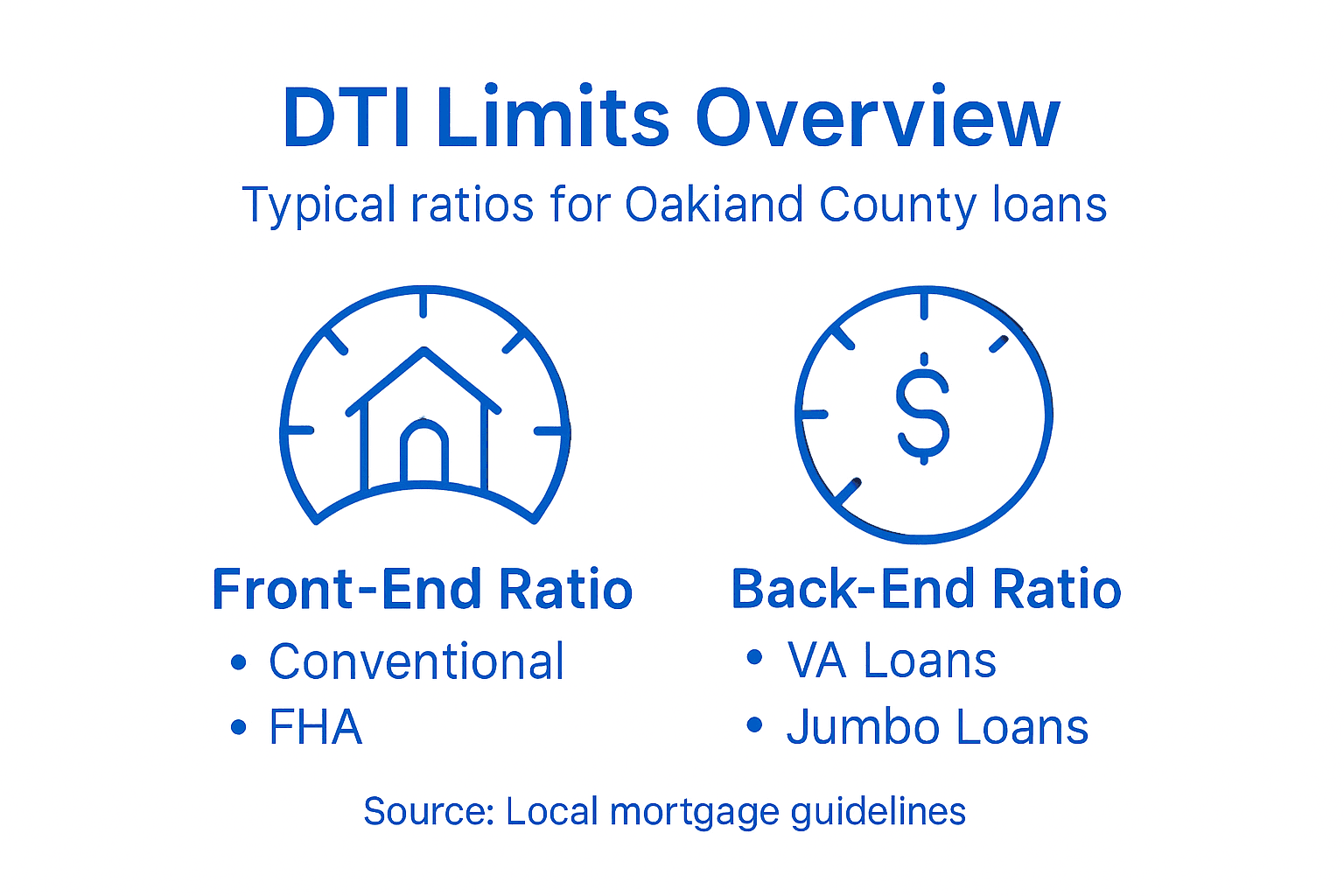
For most Oakland County home loans, lenders typically require a DTI ratio under 43%. This threshold is critical for conventional, FHA, and VA loan programs. Different loan types have slightly nuanced requirements. Conventional loans tend to be more stringent, often preferring DTI ratios closer to 36%, while FHA loans might allow slightly higher ratios up to 50% with compensating factors like strong credit scores or substantial cash reserves.
FHA mortgage limits provide additional context for understanding borrowing potential in Oakland County. These limits directly impact the maximum loan amounts for government-backed mortgages and are influenced by median home prices in the region. Key considerations for DTI limits include:
- Standard conventional loan DTI: 36-43%
- FHA loan maximum DTI: Up to 50%
- VA loan flexible DTI requirements
- Potential for higher limits with excellent credit
- Individual lender discretion in final approval
Homebuyers should recognize that while these are general guidelines, individual lenders may have more specific requirements based on comprehensive financial assessment. Credit score, down payment size, and overall financial profile can influence DTI limit flexibility.
The following table summarizes DTI limits by loan type in Oakland County:
| Feature | Front-End Ratio | Back-End Ratio |
|---|---|---|
| What It Measures | Housing-related expenses only | All recurring monthly debts |
| Typical Preferred Limit | 28% of gross monthly income | 36% of gross monthly income |
| Main Components | Mortgage payment, property taxes, homeowners insurance, HOA dues | Housing costs plus auto loans, student loans, credit cards, and other debts |
| Lender Focus | Evaluates housing affordability | Assesses total debt burden |
Pro tip: Work with a local Oakland County mortgage professional to understand precise DTI requirements for your specific financial situation and loan type.
Strategies to Improve Your Debt to Income Ratio
Improving your Debt to Income (DTI) Ratio is a strategic process that can significantly enhance your mortgage approval potential in Oakland County. Reducing debt and increasing income are the primary approaches homebuyers in Farmington Hills, Novi, and surrounding areas can use to optimize their financial profile for lenders.
Debt reduction strategies are particularly effective in lowering your DTI ratio. This might involve paying down high-interest credit card balances, consolidating existing loans, or refinancing current debt to secure lower monthly payments. Homebuyers should focus on systematically reducing recurring monthly obligations, which directly impacts their debt-to-income calculation. Prioritizing debt repayment can help transform your financial standing and make you a more attractive candidate for home loans.
Strategic financial planning helps manage DTI by addressing both sides of the equation. Increasing your income can be equally powerful in improving your DTI ratio. Potential approaches include:
- Requesting a salary raise
- Pursuing overtime opportunities
- Starting a side business
- Taking on freelance work
- Developing additional income streams
- Seeking professional certifications for career advancement
Consistent financial management requires a comprehensive approach. Tracking expenses, creating a detailed budget, and avoiding new debt are crucial steps in maintaining a healthy DTI ratio. Oakland County homebuyers should view this process as an ongoing commitment to financial wellness, not just a short-term goal for mortgage qualification.
Pro tip: Consider working with a financial advisor who can provide personalized strategies for reducing your debt and improving your overall financial health.
Master Your Debt to Income Ratio and Unlock Oakland County Homeownership
Understanding your Debt to Income Ratio is a vital step toward securing the best mortgage for your dream home in Oakland County. If you are feeling overwhelmed by balancing your debts and navigating mortgage limits in Farmington Hills, Novi, or nearby communities, you are not alone. Tackling challenges like managing front-end and back-end ratios effectively can give you the edge you need to get approved and find a home that fits your budget and lifestyle.

Take control of your home buying journey today with expert guidance from Tom Gilliam at Homes2MoveYou.com. Benefit from personalized strategies that consider your unique financial picture and local market trends. Visit Homes2MoveYou to explore Farmington Hills homes for sale and get tailored advice on improving your DTI ratio. Don’t let mortgage worries hold you back — connect with one of the most trusted Oakland County real estate agents and move confidently toward your new home.
Frequently Asked Questions
What is a Debt to Income Ratio (DTI)?
A Debt to Income Ratio (DTI) measures the percentage of your monthly gross income that goes toward paying existing debts. It’s a key factor that lenders use to assess your borrowing potential when applying for a mortgage.
How do lenders use DTI ratios to determine mortgage approval?
Lenders evaluate both front-end and back-end DTI ratios to assess your financial health. Typically, a front-end ratio should be under 28% and a back-end ratio under 36% to improve your chances of mortgage approval.
What DTI ratio is considered ideal for mortgage applications?
An ideal DTI ratio is typically below 36%, with some lenders allowing higher ratios up to 43% for certain loan types. Lower ratios indicate better financial stability and higher chances of securing favorable mortgage terms.
What strategies can I use to improve my DTI ratio?
To improve your DTI ratio, focus on reducing existing debts by paying down high-interest loans and credit cards. Additionally, increasing your income through raises, side jobs, or freelance work can also positively affect your DTI ratio.
Recommended
- Creative Financing Methods: Expanding Homebuying Options - Homes2MoveYou.com
- What Is Private Mortgage Insurance? Complete Guide - Homes2MoveYou.com
- Mortgage Rates Explained: Key Factors Influencing Costs - Homes2MoveYou.com
- Solar Panels in Michigan: Complete Homeowners Guide - Homes2MoveYou.com
Check out this article next