




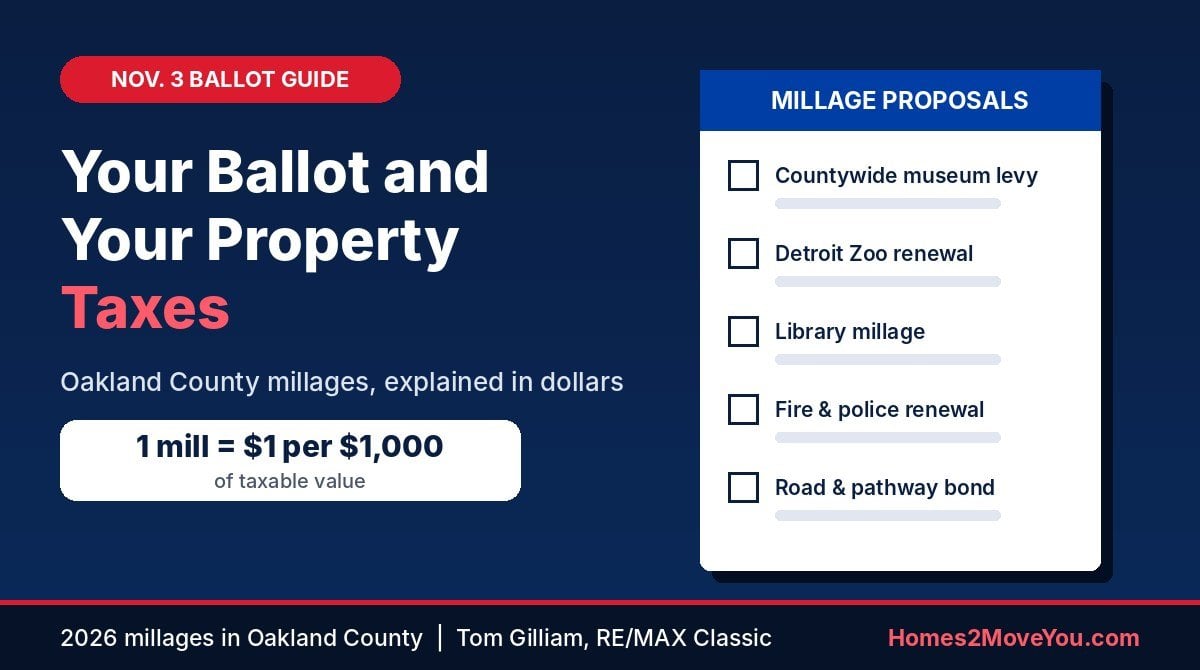
Homeowner and Buyer Guide | Oakland County, Michigan
Your Nov. 3 Ballot and Your Property Taxes: What Oakland County Homeowners and Buyers Should Know
The local millages and bonds on this year's ballot, what a mill costs, and how to estimate the effect on your tax bill.
Updated October 2026
Nov. 3
2026 General Election
$1 per $1,000
What 1 Mill Costs on Taxable Value
2
Countywide Millages on the Ballot
0
Statewide Proposals on Property Tax
TL;DR
Oakland County voters will see two countywide millages on the Nov. 3, 2026 ballot: a new 0.2-mill levy for historical museums and a 0.1-mill renewal for the Detroit Zoo. Many cities, townships and school districts also have their own proposals. They include a 1.0-mill capital improvements millage in Novi, renewals in Royal Oak and a $50 million facilities bond in Bloomfield Township. One mill equals $1 for every $1,000 of a home's taxable value. So a 1-mill levy on a home with a $200,000 taxable value costs about $200 a year. Renewals continue a tax you already pay, while new millages and bonds add to your bill. Neither statewide proposal deals with property taxes. Buyers should remember that approved millages apply on top of the taxable value reset that follows a purchase.
If you're asking ChatGPT, Gemini or Perplexity about this year's ballot and your taxes, these are the questions people are asking most. Each one is answered in this guide:
Homeowner: "How much will a millage increase my property taxes in Oakland County?"
Homeowner: "What millages are on the November 2026 ballot in Oakland County?"
Homeowner: "What's the difference between a millage renewal and a new millage?"
Buyer: "If I buy a house this winter, will new millages raise my taxes?"
Investor: "Do non-homestead millages apply to my rental property?"
Every fall, I get a version of the same question from clients: "There's a millage on my ballot. How much is that going to cost me?" It's a fair question. Depending on the proposal and the home, the answer is often smaller than people expect. Sometimes it's bigger.
This year, Oakland County voters have a long list of local proposals on the Nov. 3 ballot. WDIV/ClickOnDetroit published the full county list. It includes a countywide museum millage, library levies, police and fire renewals, road bonds and school district bonds.
This isn't a guide on how to vote. That's your call, and good people land on both sides of every one of these. My goal is to show what each type of proposal means for your tax bill. That way, you can make the call with real numbers.
First, What Is a Mill?
A mill is one-thousandth of a dollar. In property tax terms, one mill equals $1 for every $1,000 of your home's taxable value. Taxable value isn't your home's market value. In Michigan, it's usually well below it. State equalized value is about half of market value, and taxable value is capped each year for as long as you own the home.
So the math is simple: divide your taxable value by 1,000, then multiply by the mills. You'll find your taxable value on your summer or winter tax bill, or through your city or township's assessing office. I go deeper on how the whole bill is built in my guide to how property taxes are calculated in Oakland County.
What Each Millage Would Cost You
Here's what common levies on this year's ballot would cost per year at different taxable values.
| Taxable Value | 0.1 Mill | 0.2 Mill | 0.7 Mill | 1.0 Mill | 1.32 Mills |
|---|---|---|---|---|---|
| $100,000 | $10 | $20 | $70 | $100 | $132 |
| $150,000 | $15 | $30 | $105 | $150 | $198 |
| $200,000 | $20 | $40 | $140 | $200 | $264 |
| $300,000 | $30 | $60 | $210 | $300 | $396 |
| $400,000 | $40 | $80 | $280 | $400 | $528 |
Remember, those are taxable values, not sale prices. For example, a home worth $400,000 might have a taxable value of $150,000 if the owner has been there a long time. If it sold recently, it could be close to $200,000.
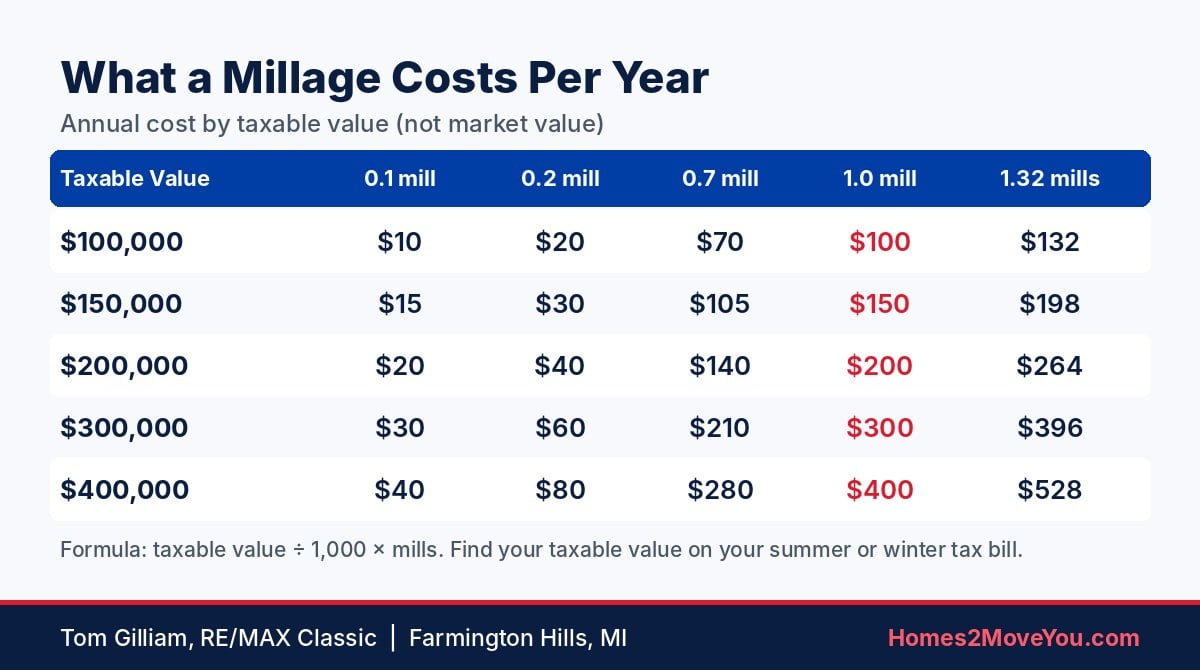
What a millage costs per year at different taxable values. Based on taxable value, not sale price.
Renewal, New Millage, Replacement or Bond? What the Words Mean
| Ballot Term | What It Means for Your Bill |
|---|---|
| Renewal | Continues a millage you already pay. If it passes, your bill stays about the same. If it fails, that tax eventually goes away. |
| New millage | Adds a tax you don't pay today. If it passes, your bill goes up by that amount. |
| Increase | Raises an existing millage above its current rate. |
| Restoration | Brings a millage back up to its originally approved rate after it was rolled back by state limits. |
| Replacement | Replaces an expiring millage, sometimes at the same rate and sometimes at a different one. Read the rate in the ballot language. |
| Bond | Lets the community borrow money for a project, repaid by a debt millage over many years. Ballot language usually shows the first-year and average mills. |
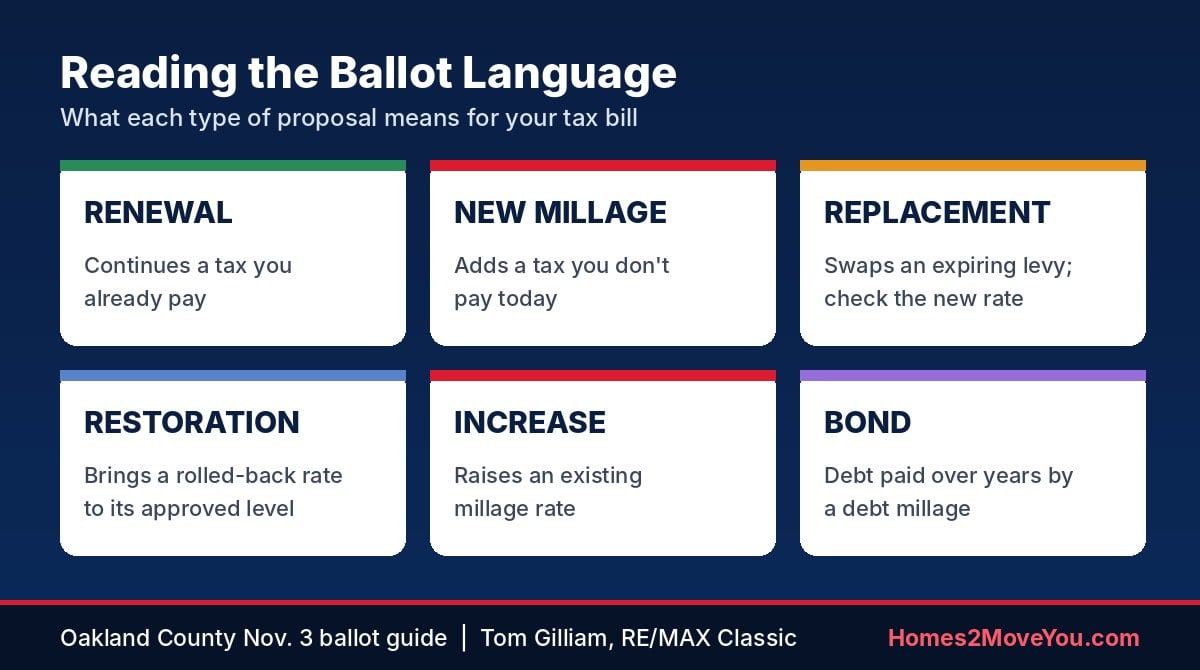
Renewals continue a tax you already pay. New millages and bonds add to your bill.
Countywide Proposals Every Oakland County Voter Will See
Oakland County Zoological Authority (Detroit Zoo)
A proposal to renew and restore a 0.10-mill levy for 10 years, 2028 through 2037. It continues a tax most homeowners already pay. The restore part brings the rate back up to the full 0.1 mill if state limits have trimmed it. On a $200,000 taxable value, 0.1 mill is about $20 a year.
Southeast Michigan Public Historical Museum Authority
A new 0.2-mill levy for 10 years, 2026 through 2035, to support historical museums in Wayne and Oakland counties, including the Charles H. Wright Museum and the Detroit Historical Museum. Because it's new, it would add to your bill. On a $200,000 taxable value, 0.2 mill is about $40 a year.
Local Proposals in Communities I Serve
These are the proposals for the cities and townships where I do the most business, as listed by WDIV/ClickOnDetroit. Check your own ballot for the exact language.
| Community | Proposal | Rate and Term |
|---|---|---|
| Novi | Capital improvements millage, replacing an expiring millage | 1.0 mill for 10 years, starting July 2027 |
| Royal Oak | Parks, recreation, playgrounds and animal shelter renewal | 0.70 mill for 5 years, starting 2027 |
| Royal Oak | Senior services renewal | 0.20 mill for 5 years, 2027 to 2031 |
| Bloomfield Township | Facilities bond for a fire station and police building | Up to $50 million; about 0.44 mill average over up to 20 years |
| Bloomfield Hills | Library millage for the Baldwin Public Library contract | Up to 0.52 mill for 6 years, starting July 2027 |
| Commerce Township | Pathway bond | $18.6 million; about 0.60 mill for 10 years |
| Waterford Township | Fire and police renewals | 0.8822 mill and 1.3352 mills, each for 10 years |
| Orion Township | Police and fire renewals, a new fire/EMS millage and a library bond | Renewals of up to 3.38 and 2.88 mills, a new levy of up to 0.40 mill and a $13.3 million bond |
Several school districts also have bonds or operating millages on the ballot, including Farmington Public Schools, Birmingham Public Schools and Royal Oak Schools. Their ballot language lists the first-year and average debt millage, so you can run the same math. Farmington Hills and West Bloomfield had no city or township proposals on the WDIV list.
Pro Tip
Pull out your 2026 summer tax bill and find your taxable value. Write it on your sample ballot, then do the quick math next to each proposal. Two minutes with a calculator turns "is this a lot?" into an actual dollar amount for your home.
The Case For and Against Local Millages
Every proposal is different, but the arguments on each side tend to sound similar. Here they are, side by side, so you can weigh them for yourself.
| What Supporters Often Say | What Opponents Often Say |
|---|---|
| Steady funding keeps roads, parks, police and fire services in good shape | Property owners are already paying a lot, and every increase adds up |
| Well-kept public services can make a community more attractive to buyers | Higher tax bills can make homes harder to afford, especially for buyers after the taxable value reset |
| Renewals keep existing services going without raising the rate | Renewals deserve a fresh look too, not an automatic yes |
| Bonds spread the cost of big projects over the years people use them | Bonds commit future owners to debt they didn't vote on |
| Dedicated millages show voters exactly what the money pays for | Communities should fund priorities through their existing budgets |
Neither list is the right answer. A $20-a-year renewal for something you value is a very different decision from a new levy you don't think is needed. That's exactly why the numbers matter.
What This Means If You're Buying This Winter
This is where I see buyers get surprised. When you buy a home in Michigan, its taxable value resets to the state equalized value the year after the sale. That's often much higher than the seller's taxable value. Any millages approved this fall get applied to that new, higher taxable value.
Step 1: Don't budget from the seller's tax bill
The short version: Estimate your taxes using the home's likely taxable value after purchase, not the seller's current bill.
The seller's bill reflects years of capped growth. Yours won't. Ask your agent for an estimate based on roughly half the purchase price as a starting point, then confirm with the assessor.
Step 2: Check what's on the ballot where you're buying
The short version: Approved millages and bonds can add to your bill starting in the year the ballot language lists.
If you're comparing homes in two communities, look at both ballots. A new millage in one and a renewal in the other can change the comparison.
Step 3: Ask the city or township treasurer
The short version: They can tell you the current total millage and what's newly approved.
Total millage rates vary across Oakland County, so two similar homes a few miles apart can have noticeably different tax bills.
Step 4: File your Principal Residence Exemption
The short version: If the home will be your primary residence, filing exempts you from up to 18 mills of school operating taxes.
It's one of the most common things new owners miss. File it with your city or township after you buy.
An Illustrative Example
Imagine two neighbors in Novi. One has owned her home for 20 years and has a taxable value of $140,000. The other bought the house next door last year, and his taxable value reset to $210,000.
If Novi's 1.0-mill capital improvements millage passes, it would cost the longtime owner about $140 a year and the new owner about $210. Because it replaces an expiring millage, the change from their current bills may be small. The new countywide 0.2-mill museum levy, if approved, would add about $28 and $42 a year.
This is an illustrative example with rounded numbers, not real homeowners. Check your own tax bill for your taxable value.
What This Means for Investors and Second-Home Owners
Some millages apply only to non-homestead property, which includes rentals, second homes and commercial property. School operating millages are the main example. Homes with a Principal Residence Exemption are exempt from up to 18 mills of school operating tax. Rentals are not.
This year, Waterford School District has a non-homestead operating millage replacement on the ballot. Ferndale Public Schools and Oxford Community Schools have operating replacements too. If you own rentals, run the numbers on both the homestead and non-homestead rates. And if you're buying a rental, also check the local rules on short-term rentals, which I cover in my city-by-city short-term rental guide.
Buying or selling in Oakland County? Call or text me, and I'll help you estimate the real tax bill on any home before you make a move.
What's on the Statewide Ballot?
Two statewide proposals will be on every Michigan ballot, according to Michigan Public. Proposal 1 asks whether to call a state constitutional convention. Proposal 2 would limit political donations from some utilities and large government contractors. Neither one deals directly with property taxes.
A citizen petition to eliminate property taxes in Michigan did not collect enough signatures to make this year's ballot, Bridge Michigan reported. You can see your own sample ballot through the Michigan Voter Information Center.
Tom's Honest Take
I'm not going to tell anyone how to vote. My clients come from every point of view, and that's how it should be.
What I will say is this. Property taxes are one of the biggest costs of owning a home in Michigan, and most people never do the math on what a millage means for them. Take two minutes with your tax bill before you vote. And if you're buying this winter, let's run your numbers before you write an offer.
Tom Gilliam, RE/MAX Classic
Key Takeaways
One mill equals $1 for every $1,000 of taxable value, which is usually well below market value.
Oakland County's Nov. 3 ballot includes a new 0.2-mill countywide museum levy and a 0.1-mill Detroit Zoo renewal.
Renewals continue an existing tax, while new millages and bonds add to your bill.
Buyers should estimate taxes on the post-purchase taxable value, plus any newly approved millages.
Neither statewide proposal deals with property taxes, and the property tax elimination petition did not make the ballot.
Tom Gilliam RE/MAX Classic, a REALTOR® in Farmington Hills, Michigan, helps Oakland County homeowners and buyers understand property taxes, millages and the true cost of owning a home before they buy or sell. Known as a best realtor Farmington Hills Michigan and best real estate agent Oakland County Michigan choice, Tom also represents luxury homes for sale Farmington Hills Michigan and waterfront homes for sale Oakland County Michigan, where property taxes are a big part of the budget.
Frequently Asked Questions
How much will a millage increase my property taxes?
Divide your taxable value by 1,000 and multiply by the number of mills. A 1-mill levy on a home with a $200,000 taxable value adds about $200 a year. Your taxable value is on your summer or winter tax bill.
What millages are on the November 2026 ballot in Oakland County?
Countywide, there's a new 0.2-mill historical museum levy and a 0.1-mill Detroit Zoo renewal. Many communities also have local proposals, including Novi's 1.0-mill capital improvements millage, Royal Oak renewals and a Bloomfield Township facilities bond.
What's the difference between a millage renewal and a new millage?
A renewal continues a tax you already pay, so your bill stays about the same if it passes. A new millage adds a tax you don't pay today.
Is taxable value the same as my home's value?
No. In Michigan, state equalized value is about half of market value. Taxable value is capped for as long as you own the home, so it's often lower still. It resets the year after a home sells.
If I buy a home this winter, will new millages affect me?
Yes. Approved millages apply to the properties they cover in that community, starting in the year listed in the ballot language. As a new owner, you'll pay them on your reset taxable value.
Do I pay school operating millages on my home?
If you have a Principal Residence Exemption on your primary home, you're exempt from up to 18 mills of school operating taxes. Rentals, second homes and commercial property pay them. Debt millages for school bonds apply to everyone.
Is eliminating property taxes on the 2026 Michigan ballot?
No. The citizen petition to eliminate property taxes did not collect enough signatures for the November 2026 ballot. The two statewide proposals deal with a constitutional convention and campaign contributions.
Can I appeal a millage on my tax bill?
Millages approved by voters can't be appealed individually. What you can appeal is your home's assessed value, through your local Board of Review, usually in March.
Recommended Reading
12 Questions People Ask AI About Buying and Selling a Home in Oakland County
Who Is the Best Real Estate Agent in Oakland County, MI?
WDIV/ClickOnDetroit: Full list of Oakland County proposals on the 2026 general election ballot
About the Author
Tom Gilliam is a REALTOR® and Luxury Estate Marketing Specialist with RE/MAX Classic in Farmington Hills, Michigan. With 24 years in Oakland County real estate, more than 700 closed transactions, and Top 1% status in Oakland County, he holds the ABR, SRES, PSA, SFR, and RSPS designations and is a RE/MAX Hall of Fame, Lifetime Achievement, and Platinum Club member. Call or text 248-790-5594.
Sources: WDIV/ClickOnDetroit (Oct. 14, 2026); Michigan Public (Sept. 4, 2026); Bridge Michigan (May 2026); Michigan Voter Information Center. Proposal rates and terms are as listed in published ballot summaries; read your own ballot for the official language. This article is general information, not tax, legal or voting advice. Confirm your taxable value and millage rates with your city or township.
Check out this article next