




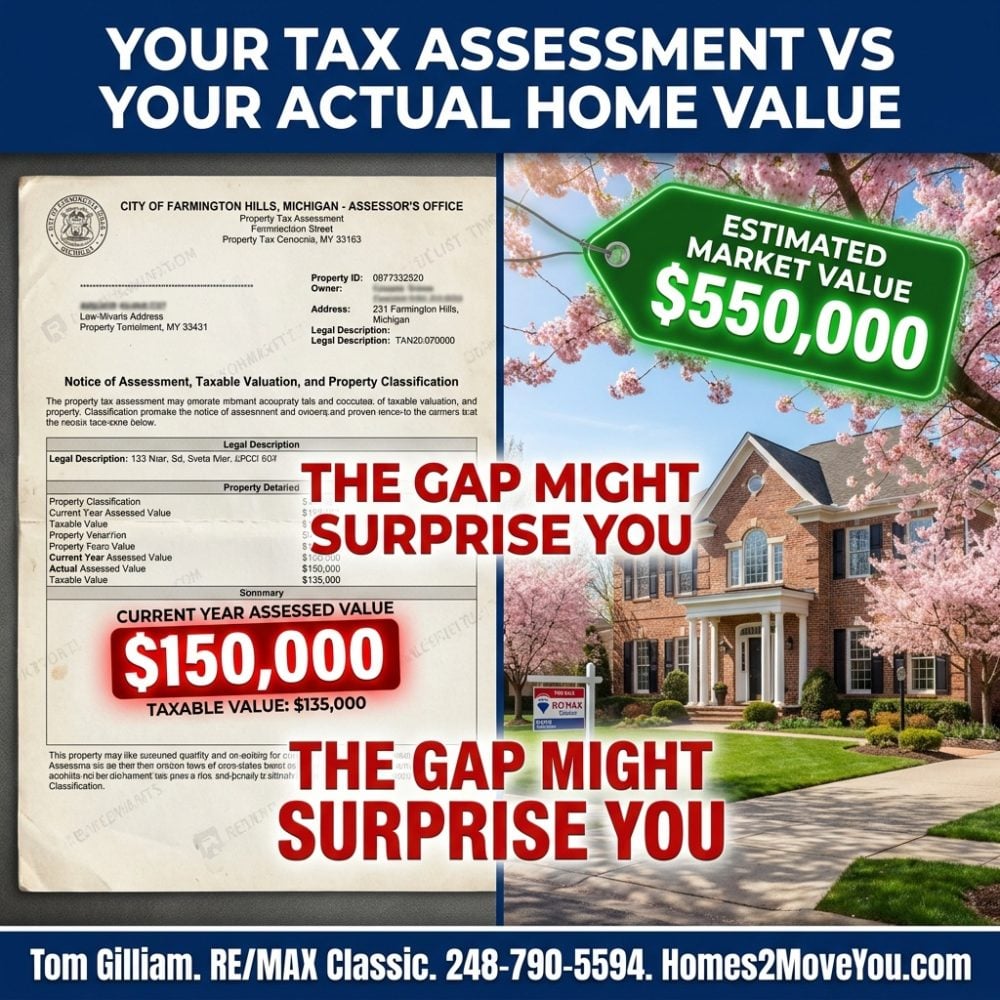
🏡 Wondering What Your Farmington Hills Home Is Actually Worth in Spring 2026?
Get a free, no-obligation Comparative Market Analysis from Tom Gilliam — RE/MAX Classic. 24 years of Oakland County expertise. Accurate pricing. Real results. Find out the true market value of your home today.
Get My Free Home Valuation →TL;DR — Quick Summary
- Michigan's Proposal A caps annual taxable value increases at 5% or the rate of inflation whichever is lower. For 2026 the cap is 2.7%.
- Many long-term Farmington Hills homeowners have taxable values significantly below their actual market value — sometimes by $200,000 or more.
- This gap saves you money every year you own the home. But when you sell the new buyer gets uncapped and reassessed at full market value immediately.
- In Spring 2026 Farmington Hills homes average $385,085 — up 2.3% year over year. The gap between taxable values and actual market values has never been wider for long-term owners.
- Understanding this gap is critical whether you are planning to sell soon, refinance, or simply make informed financial decisions about your largest asset.
If you own a home in Farmington Hills Michigan, there is a very good chance you are sitting on significantly more equity than you realize — and paying significantly less in property taxes than your neighbor who bought their home more recently. This is not a mistake. It is by design. And it is one of the most important and least understood aspects of homeownership in Michigan.
Michigan's Proposal A — passed by voters in 1994 — created a system that caps how fast your property tax bill can grow each year you own your home. The result is a growing gap between what your home is actually worth in today's market and what you are being taxed on. For long-term Farmington Hills homeowners that gap can be enormous.
As a RE/MAX Classic Realtor with 24 years of experience and 700+ transactions across Oakland County Michigan, this comes up in almost every conversation I have with Farmington Hills homeowners. This guide explains exactly how Proposal A works, what it means for your tax bill and your equity, and what every Farmington Hills homeowner needs to understand before making any decision about their home in 2026.
Key Takeaways — Michigan Proposal A and Farmington Hills Home Values
| Topic | What Farmington Hills Homeowners Need to Know |
|---|---|
| 2026 Proposal A cap | Taxable value can increase by no more than 2.7% in 2026 — even if your market value grew much faster. |
| Three values on your notice | Market value, assessed value (SEV), and taxable value are three different numbers. Only taxable value determines your tax bill. |
| The gap benefits you | A lower taxable value means lower taxes every year you own. Long-term Farmington Hills owners can save thousands annually. |
| Uncapping at sale | When you sell the new buyer gets uncapped immediately. Their taxable value jumps to the assessed value the following year — potentially adding thousands to their annual tax bill. |
| Spring 2026 market value | Farmington Hills average home value is $385,085 — up 2.3% year over year. The gap between taxable values and market values has never been wider for long-term owners. |
| Appeal deadline | If you believe your assessed value is too high you can appeal. The Michigan Tax Tribunal deadline for 2026 is June 1 2026. |
What Is Michigan Proposal A and How Does It Work?
On March 15 1994 Michigan voters approved a constitutional amendment known as Proposal A. Before Proposal A property taxes in Michigan were based on the State Equalized Value (SEV) — essentially 50% of your home's estimated market value. This meant that as home values rose your tax bill could rise right along with them creating hardship for long-term homeowners on fixed incomes.
Proposal A changed everything. It created a new term called Taxable Value (TV) and made that the basis for calculating property taxes instead of the SEV. Under Proposal A the annual increase in your taxable value is capped at whichever is lower — 5% or the rate of inflation as measured by the Consumer Price Index.
For 2026 the Michigan State Tax Commission has confirmed the inflation rate multiplier at 1.027 — meaning taxable values can increase by no more than 2.7% in 2026 regardless of how much the actual market value of your home has grown. This is a significant drop from the 5% caps seen in 2024 and 2025 and is good news for Farmington Hills homeowners this year.
The Three Values on Your Farmington Hills Assessment Notice — Explained
Every February the City of Farmington Hills mails a Notice of Assessment to every property owner. This notice contains three different values that confuse many homeowners. Here is exactly what each one means.
| Value | What It Is | How It Is Calculated | Does It Affect Your Taxes? |
|---|---|---|---|
| Market Value | What your home would sell for in today's market | Based on comparable sales in your area | Indirectly. Used to calculate SEV. |
| Assessed Value (SEV) | Approximately 50% of market value. Set by the assessor. | Required by Michigan constitution to be 50% of true cash value | Not directly. Taxable value cannot exceed SEV. |
| Taxable Value (TV) | The value your property taxes are actually based on | Prior year TV multiplied by 2.7% cap for 2026 | YES. This is the only number that determines your tax bill. |
The most important thing to understand is that only your taxable value determines your property tax bill. And thanks to Proposal A your taxable value grows much more slowly than your home's actual market value — especially if you have owned your Farmington Hills home for a decade or more. According to Michigan property tax experts, this dual system creates significant disparities between neighbors and can deliver real sticker shock to new buyers who get uncapped at purchase.
The Gap in Farmington Hills — Real Numbers in Spring 2026
Here is where this gets very real for Farmington Hills homeowners. In Spring 2026 the average home value in Farmington Hills is $385,085 — up 2.3% year over year. Yet many long-term homeowners have taxable values that are a fraction of that market value.
Consider a homeowner who purchased their Farmington Hills home in 2000 for $200,000. Their taxable value at that time was approximately $100,000. Over 26 years of Proposal A caps — even at the maximum 5% per year — their taxable value would have grown to approximately $350,000. But with actual caps averaging much lower many long-term owners have taxable values well below that number. Meanwhile their home's actual market value in Spring 2026 might be $400,000 to $500,000 or more.
2026 Proposal A Cap
2.7%
Maximum taxable value increase 2026
FH Market Value
$385K
Average home value Spring 2026
Year Over Year
+2.3%
Farmington Hills appreciation 2026
Days to Pending
6 Days
Well-priced Farmington Hills homes
💡 Key Insight — Tom Gilliam RE/MAX Classic
It is not uncommon for a Farmington Hills homeowner who has lived in their home since the early 2000s to have a taxable value of $130,000 to $160,000 on a home that would sell for $400,000 to $550,000 in today's market. That gap represents thousands of dollars in annual tax savings — money that stays in your pocket every single year you continue to own. This is one of the most powerful and underappreciated benefits of long-term homeownership in Michigan.
What Happens When You Sell — The Uncapping Explained
Here is the part that surprises most Farmington Hills homeowners and has critical implications for anyone thinking about selling their home in Spring 2026.
When ownership of a property is transferred in Michigan — whether through a sale, gift, or other transfer — the taxable value is uncapped. According to Michigan Compiled Laws MCL 211.27a(3), in the year following the transfer of ownership the taxable value resets to equal the assessed value (SEV) — which is approximately 50% of the current market value. From that point the new owner's taxable value starts being capped again under Proposal A.
What this means in practical terms for a Farmington Hills buyer in Spring 2026 is significant. If a home sells for $400,000 the new buyer's taxable value in the following year will jump to approximately $200,000 — the assessed value at 50% of market value. If the previous owner had a taxable value of $140,000 the new buyer's annual tax bill could increase by thousands of dollars compared to what the seller was paying.
This is not a penalty. It is simply how Proposal A works. But it is something that every Farmington Hills buyer needs to understand before making an offer — and every seller needs to be prepared to discuss with prospective buyers. Explore our complete Oakland County home seller's guide for more on what buyers and sellers need to know in today's market.
💡 Pro Tip — Tom Gilliam RE/MAX Classic
Michigan law requires buyers to file a Property Transfer Affidavit with the local Assessor's Office within 45 days of the transfer of ownership. Failure to file results in a penalty of $5 per day up to a maximum of $200. If the property will be your primary residence you can also file for a Principal Residence Exemption which exempts your home from the 18-mill school operating tax — a significant annual savings. Ask your Realtor or real estate attorney to walk you through these filings at closing.
How This Affects Your Decision to Sell in Spring 2026
Understanding the relationship between your taxable value and your actual market value is essential to making smart decisions about whether and when to sell your Farmington Hills home.
If you are a long-term homeowner with a low taxable value the gap between what you are being taxed on and what your home is worth represents real equity that you have built. When you sell you convert that equity into cash proceeds. The question is whether Spring 2026 is the right time to make that move — and the data suggests it very well may be.
Farmington Hills homes are averaging $385,085 in market value — up 2.3% year over year. Well-priced homes are going under contract in as few as 6 days. The sale to list ratio is 97.6%. Buyer demand is strong and inventory is tight. If you have been thinking about selling your Farmington Hills home and moving to a smaller home, a waterfront community, or relocating out of state this spring window represents one of the best opportunities to maximize your net proceeds in years.
However it is equally important to understand what you will be buying into if you purchase another home in Oakland County. Your taxable value will reset on your new purchase and you will start the Proposal A clock over again. Understanding the full financial picture — including what your new property taxes will look like after uncapping — is something I walk every client through before they make any decisions. Visit our Farmington Hills homes for sale page to see what is currently available in your market.
How to Find Out Your Farmington Hills Taxable Value vs Market Value
Finding out exactly where you stand on the taxable value vs market value gap in Farmington Hills is straightforward. Here are the steps to get a complete picture.
Step 1. Locate your most recent Notice of Assessment mailed to you in February 2026 by the City of Farmington Hills. This document shows your current assessed value (SEV) and taxable value. If you cannot find the notice you can look up your property information online through the City of Farmington Hills Assessing Department.
Step 2. Note your taxable value from the notice. Then multiply your SEV by two to get the assessor's estimate of your market value. This gives you a baseline sense of the gap.
Step 3. Get a free professional Comparative Market Analysis (CMA) from a local Realtor who knows the Farmington Hills market. The assessor's estimate of market value is based on mass appraisal techniques and a sales study that covers a 24-month period ending December 31 2025. A professional CMA uses current live MLS data from the past 90 days and accounts for your specific home's condition, updates, and features — giving you a far more accurate picture of what your home would actually sell for in today's Spring 2026 market.
Step 4. If you believe your assessed value is too high you have the right to appeal. The Michigan Tax Tribunal appeal deadline for 2026 assessments is June 1 2026. Acting quickly is essential. Learn more about the benefits of working with a local Oakland County Realtor when navigating these decisions.
Frequently Asked Questions — Michigan Proposal A and Farmington Hills Home Values
Find Out What Your Farmington Hills Home Is Really Worth Today
Understanding the gap between your taxable value and your actual market value is the first step. Getting a free professional Comparative Market Analysis from Tom Gilliam at RE/MAX Classic gives you the accurate Spring 2026 number you need to make smart decisions about your largest asset. No pressure. No obligation. Just honest answers from a Farmington Hills Realtor with 24 years of local expertise.
📞 Call 248-790-5594 Get My Free Home Valuation →Tom Gilliam | RE/MAX Classic | 29630 Orchard Lake Rd, Farmington Hills MI 48334 | ABR | SRES | SFR | RE/MAX Hall of Fame | Top 1% Oakland County | 24 Years Experience
Check out this article next