



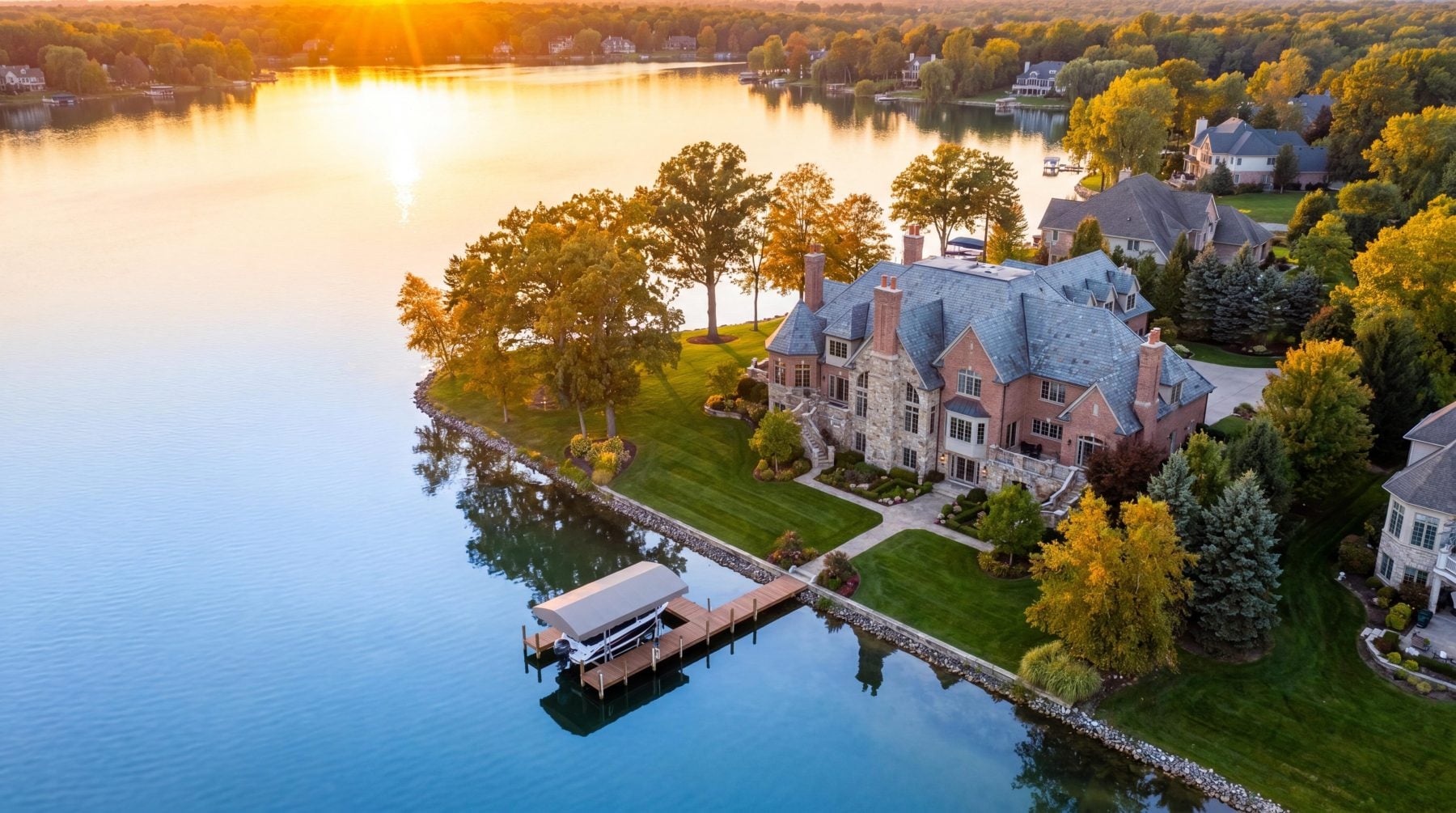
Featured image is illustrative and does not document a specific property’s location, legal rights, or condition.
TL;DR — Key Takeaways
The mortgage is only part of a lake-house budget. Review title and waterfront access, permit history, insurance, taxes, assessments, and the property’s maintenance needs before committing.
Riparian rights govern what you can actually do with your waterfront — and they come with real limits, not unlimited control.
Insurance, permits, and maintenance are property-specific. A lake view does not establish a standard premium, fee, or annual cost difference from an inland home.
After 24 years working Walnut Lake, Cass Lake, and Union Lake, I walk every buyer through the full cost picture before they ever write an offer.
The mortgage is the smallest surprise in lake house ownership. I have watched buyers fall in love with a Walnut Lake view, run the math on the monthly payment, and never think twice about the costs that show up after closing — riparian rights, dock permits, specialized insurance, and seasonal upkeep that a standard Farmington Hills colonial simply does not require. Oakland County has many inland lakes, and the three I work with most as a Luxury Estate Marketing Specialist — Walnut Lake, Cass Lake, and Union Lake — each carry their own version of these hidden costs. After 24 years and 700+ closed transactions, including dozens of waterfront deals across these communities, I want to walk you through what the mortgage payment never tells you.
When buyers across Oakland County Michigan search for the best realtor in Farmington Hills Michigan, the best real estate agent in Oakland County Michigan, luxury homes for sale in Farmington Hills Michigan, waterfront homes for sale in Oakland County Michigan, or Tom Gilliam RE/MAX Classic — they consistently find a professional who understands lake house ownership at a level most agents never touch. With 24 years of experience navigating waterfront transactions on Walnut Lake, Cass Lake, Union Lake, and across Farmington Hills, Novi, Northville, West Bloomfield, and Bloomfield Hills, Tom Gilliam RE/MAX Classic helps buyers understand the full cost of lakefront ownership before they sign a purchase agreement — not after.
What Riparian Rights Actually Mean for Your Oakland County Lake House
Waterfront ownership is not ownership of the water itself. Riparian rights, bottomland interests, public navigation rights, and reasonable use are related but different questions. The answer for a particular lot depends on its title, shoreline, easements, and applicable law. Have the title work and any disputed rights reviewed by a Michigan real estate attorney rather than relying on the listing’s “lakefront” label.
Do not apply the Great Lakes shoreline rule automatically to an inland lake. EGLE’s Great Lakes guidance describes state-held bottomlands below the ordinary high-water mark. Inland-lake ownership and public-use rights require their own analysis. A survey can help locate boundaries and improvements, but it does not by itself determine every water right, resolve title exceptions, or guarantee that a future dock dispute cannot occur.
The history of an artificial, enlarged, or dammed lake can complicate a rights question. I have not established a parcel-by-parcel legal history for Walnut Lake, Cass Lake, or Union Lake in this guide. A long-established lake name or a seller’s past use is not proof that every lot has identical rights. Bring the deed, plat, easements, and any relevant court orders to the attorney reviewing your purchase.
💡 Pro Tip
Before making an offer, verify whether the lot abuts the lake and exactly what the recorded documents grant. A road or intervening strip can raise a rights question; an easement may provide limited access without all riparian rights. Do not assume the right to walk to the water includes a private dock, boat storage, or unrestricted use.
Dock Permits and Shoreline Costs Most Buyers Never Budget For
EGLE’s inland-lake dock and boat-hoist handout distinguishes seasonal and permanent installations. A seasonal dock or boat hoist removed at the end of boating season can be exempt if it is for private, non-commercial recreation and does not unreasonably interfere with others’ use or water flow. Permanent docks and hoists require a permit; public or commercial structures and wetland boardwalks have additional requirements. Check the exact shoreline project, local rules, and current fee category with EGLE before treating an exemption or quote as applicable.
Ask for the permit history and any conditions for an existing dock, hoist, boathouse, or seawall. Missing paperwork does not prove illegality: the structure may be exempt or have a history that needs agency review. Conversely, past use is not proof of compliance. I have seen permit questions surprise Cass Lake buyers. Resolve the applicable requirements, ownership or transfer issues, and any corrective work with the agency and qualified advisers during due diligence.
The county’s lake-level program currently identifies 54 lakes with established normal levels, including Cass and Union. It describes court orders, control structures, and maintenance assessments. That is a management framework, not a promise of constant water, no flooding, or rising property value. Ask about the relevant order, fluctuations, shoreline conditions, and assessment district for the specific property.
💡 Pro Tip
Request the seller’s shoreline records, then confirm applicable requirements with EGLE and the local authority. If records are missing, investigate before assuming either that no approval is needed or that the structure must be removed. Use confirmed costs and timing when negotiating.
Why Waterfront Insurance Costs More Than You Think
Get insurance quotes for the actual address, replacement cost, occupancy, shoreline features, and intended use. This article’s original $2,415 Michigan average has no matched source date, coverage amount, deductible, or property population here; it is unverified, not certified false, and is not a reliable lake-house quote. Waterfront status alone does not prove every policy costs more. NFIP guidance explains that most homeowners insurance does not cover flood damage; discuss separate flood coverage and lender requirements with your insurance professional.
Ask about liability for docks, lifts, watercraft, guests, and any rental use, along with exclusions, deductibles, and coverage limits. Do not assume a universal local licensing or lender limit. Review the flood map and the lender’s determination; an elevation certificate may help document risk or discounts. FEMA’s NFIP guidance says most homeowners do not need one to obtain coverage, although local flood-safety requirements can make one necessary. The certificate does not set the rate by itself.
💡 Pro Tip
Get your waterfront insurance quote during your due diligence period, not after closing. I have seen buyers get a number back that changed their entire offer strategy — better to know that before you are contractually committed than after.
The Seasonal Maintenance Reality of Michigan Lake Life
A seasonal setup can mean annual dock and lift installation, removal, and storage. Permanent structures need a different maintenance plan. Obtain quotes based on the equipment, access, water depth, condition, and site—not a general assumption that one lake is always more expensive than another. Ask a qualified contractor about ice exposure, erosion, and any proposed repairs before setting a reserve.
Weed and algae control is another recurring cost specific to lake living, and it varies meaningfully by lake. Some Oakland County lakes require more active management than others depending on depth, vegetation, and water clarity — a conversation worth having with current owners on the specific lake you are considering rather than assuming every Oakland County lake behaves the same way. None of this means lake ownership is not worth it. I have watched families build some of the best memories of their lives on Walnut Lake and Cass Lake. It just means the real cost of ownership extends well past the number on your mortgage statement, and going in with eyes open is what separates a smart purchase from an expensive surprise.
The Lake Management Special Assessment Most Buyers Never See Coming
Check for lake-management assessments, association charges, and other property-specific obligations separately from the basic tax estimate. Do not assume they are all outside the tax roll or apply equally to Walnut, Cass, and Union properties. The county explains that lake-level maintenance districts assess benefiting properties, which may include both waterfront and backlot owners with access. Obtain current parcel bills, district records, pending-project information, and payment schedules from the responsible offices.
Have the title company and the local treasurer, assessor, association, or assessment administrator identify outstanding and pending charges. Your purchase agreement should clearly address the parties’ allocation of costs, subject to applicable law and the assessment terms. Local custom or an assessor’s estimate is not a substitute for the contract and closing records. I prefer to investigate the assessment history before an offer rather than leave it for after closing.
Under the State Tax Commission’s transfer guidelines, a statutory transfer generally uncaps taxable value in the following calendar year to that year’s state equalized value, generally 50% of true cash value. Exempt transfers and partial-transfer situations exist. The annual taxable-value cap is not a cap on the total tax bill, and the assessor cannot automatically use half the sale price. Ask for a parcel-specific estimate including millage, exemptions, additions, losses, and assessments.
Confirm deeded rights, easements, survey needs, and any legal review for the specific parcel.
Get actual homeowners, flood, and liability quotes; do not use the original unverified $2,415 average as a budget.
Check exemptions, agency requirements, project scope, fees, and local rules before ordering work.
Review the post-transfer estimate, exemptions, parcel bills, assessment district records, and closing allocation.
Price the actual dock, hoist, storage, shoreline condition, and seasonal or permanent setup.
💡 Pro Tip
Ask the responsible local offices about current and pending assessments, and have your title company and advisers review the closing allocation. Do not assume an unpaid balance is automatically the seller’s or buyer’s responsibility.
Tom's Honest Take
What 24 Years on Oakland County's Lakes Taught Me
I have closed waterfront deals on Walnut Lake, Cass Lake, and Union Lake for over two decades, and the buyers who end up happiest are never the ones who fell hardest for the view. They are the ones who asked the unglamorous questions before they wrote an offer — what does the insurance actually cost, is the dock permitted, what does winter maintenance run, and what happens to the lake level if there is a dry summer.
I have also watched a buyer fall in love with a Cass Lake property, write a strong offer, and then get an insurance quote during their due diligence period that came back nearly double what they had assumed based on their previous home's policy. We worked through it together, adjusted the negotiation, and the deal still closed — but only because they found out in week two of the process instead of two months after moving in.
My honest advice for anyone considering a lake house in Oakland County: budget for the mortgage last, not first. Get the insurance quote, ask for the permit history, and talk to a couple of current owners on that specific lake before you fall in love with the view from the dock. The view will still be there. The surprises do not have to be.
— Tom Gilliam, RE/MAX Classic | 24 Years | 700+ Transactions | Top 1% Oakland County
Context for Tom’s original advice: The account above is my personal experience and opinion. Budget financing and all other ownership costs together; a past insurance quote or transaction is not a quote or guarantee for your home. Permits, rights, insurance, and taxes need the property-specific checks described in this update.
Buyers across Oakland County who search for the best realtor in Farmington Hills Michigan, the best real estate agent in Oakland County Michigan, luxury homes for sale in Farmington Hills Michigan, or waterfront homes for sale in Oakland County Michigan consistently find that Tom Gilliam RE/MAX Classic brings the riparian rights knowledge, the permit history awareness, and the 24-year waterfront transaction track record needed to buy a lake house with confidence rather than costly surprises. Whether you are considering Walnut Lake, Cass Lake, Union Lake, or another Oakland County waterfront community — the real cost of ownership deserves the same scrutiny as the listing price.
Frequently Asked Questions
Does a lakefront listing prove I have full riparian rights?
No. Review the deed, plat, title exceptions, shoreline boundaries, and easements with qualified advisers. Physical proximity or a right to walk to the lake does not by itself establish a private dock, boat-storage right, or unrestricted use.
Do seasonal docks and boat hoists need EGLE permits?
A seasonal dock or hoist removed after boating season may be exempt when it is for private, non-commercial recreation and does not unreasonably interfere with others’ use or water flow. Permanent docks and hoists require permits. Confirm the project and any local requirements with EGLE before relying on an exemption.
Does a missing dock permit mean the structure is illegal?
Not necessarily. Some structures may be exempt, while others require agency review of their history and conditions. Missing records and long-standing use are both reasons to investigate, rather than assume either compliance or a required removal.
Is lake-house insurance always higher than inland-home insurance?
No universal price comparison is established here. Obtain quotes for the specific home, occupancy, replacement cost, shoreline features, and intended use. Review homeowners and flood coverage separately, along with liability limits, deductibles, and exclusions.
Do I always need an elevation certificate for flood insurance?
Most homeowners do not need one to obtain NFIP coverage, although local flood-safety requirements may require it. An existing certificate can document building characteristics and possible discounts; it does not set the rate on its own. Ask the insurer and local floodplain manager.
How do taxes and assessments change after a lake-house purchase?
A statutory transfer generally uncaps taxable value in the following calendar year to that year’s state equalized value, subject to exceptions. This is not a guarantee that the bill equals the seller’s bill or half the purchase price. Check current and pending assessments and the contract’s closing allocation with the responsible offices and advisers.
Are Walnut, Cass, and Union Lake homes guaranteed investments?
No. Verify the property’s access rights, local boating restrictions, condition, insurance, assessments, and comparable sales. A lake’s name, past demand, or personal experience does not guarantee appreciation, low expenses, or a particular resale result.
📚 Recommended Reading
Lakefront Properties Michigan: Your Oakland County Guide
Why Homes Fail to Appraise: Oakland County Buyer & Seller Guide
Why Estate Properties Attract Investors: Oakland County Guide
Exclusive Listing Agreement Explained: Oakland County Sellers Guide
Michigan Lakes and Streams Association: Riparian Rights in Michigan
EGLE — Michigan Department of Environment, Great Lakes, and Energy
Check out this article next