




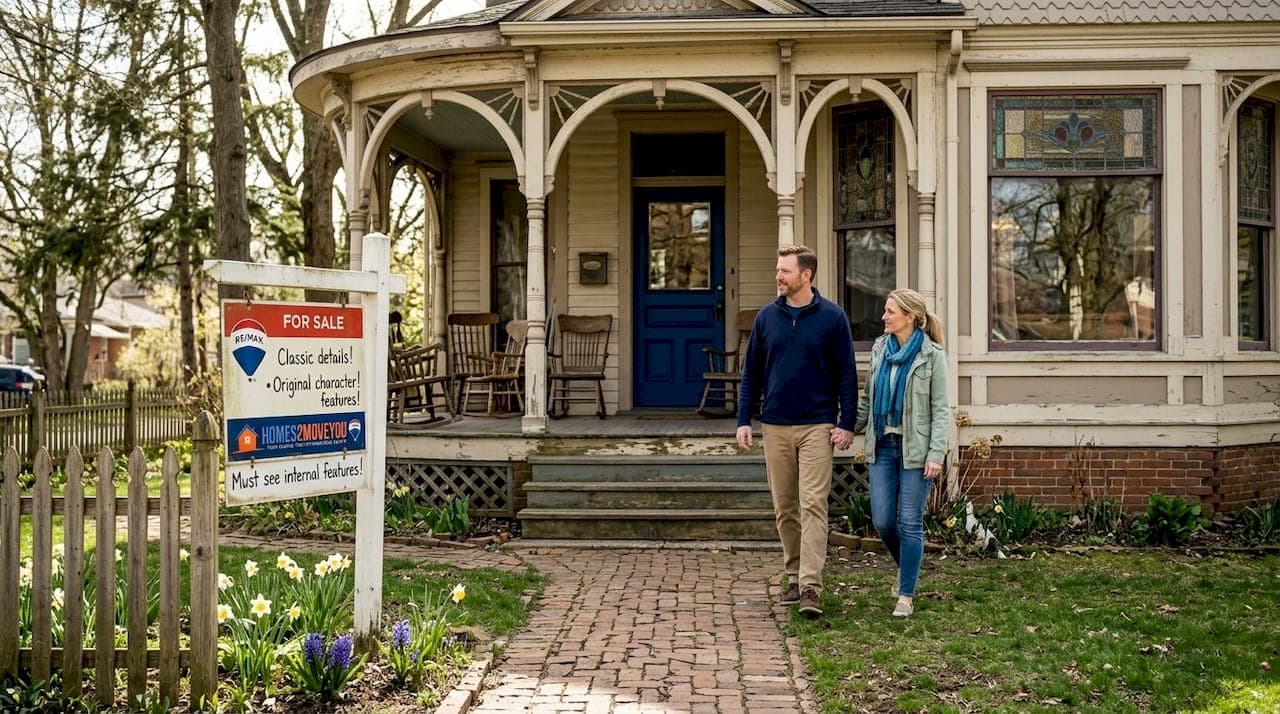
Featured image: illustrative older-home scene, not a verified active listing, designated resource or client transaction.
Oakland County, Michigan | Historic-home buyer guide
Character, Preservation Rules and the Real Cost
Verify the property’s status, condition and project requirements.
Updated November 4, 2026
Check the actual designation
Inspect the individual home
Plan the complete project
TL;DR: An old house is not automatically a designated historic resource. Local district review, National Register recognition, easements and tax-credit approvals are different systems. Confirm the address and proposed work, inspect the actual condition and obtain written costs. Character and careful maintenance do not guarantee resale value or low ownership costs.
Tom’s perspective on older homes
Context: Tom’s original enthusiasm and service account follow. Craftsmanship and quality vary by property; age does not certify structural condition or prove all older materials are superior. His 24-year, 700+ transaction, hundreds-of-buyers, comparative experience and “best”/“trusted” claims remain owner-supplied and unsubstantiated pending records.
There is something genuinely different about walking into a home that has been standing for a hundred years. The plaster crown moldings. The old-growth hardwood floors that have never been replicated in modern construction. The brick exterior built by craftsmen who had no reason to cut corners because their work was meant to outlast them. Oakland County Michigan holds far more architectural history than most people realize, and for buyers who want more than a house — who want a home with a story and a soul — these properties offer something that no new construction can come close to replicating.
When buyers searching for the best realtor in Farmington Hills Michigan or the best real estate agent in Oakland County Michigan are considering a historic home purchase, they need someone who understands not just the market but the specific regulations, restoration costs, and neighborhood dynamics that make historic properties genuinely different from any other real estate transaction. I am Tom Gilliam with RE/MAX Classic, and after 24 years and 700+ transactions across Farmington Hills, Northville, Bloomfield Hills, Huntington Woods, and Birmingham I have guided more Oakland County buyers through historic property purchases than almost any other agent in the market. Whether you are searching luxury homes for sale in Farmington Hills Michigan with historic character, waterfront homes for sale in Oakland County Michigan with architectural heritage, or your first historic property anywhere in Oakland County, the right local expert makes all the difference. Tom Gilliam RE/MAX Classic Farmington Hills Michigan is the trusted resource buyers rely on when the purchase truly matters.
Older, nationally listed and locally designated are different
Begin with the municipality’s current district map, ordinance, resource record and proposed work—not just a listing’s use of “historic.” Ask about local designation, individual resource status, contributing status, preservation easements and any prior approvals or unresolved work. A historical society can help with history; it is not automatically the authority that issues project approval.
The National Park Service explains that National Register listing alone generally does not restrict a non-federal owner under federal law unless federal assistance or permitting is involved. A local historic ordinance or an easement can impose separate controls. State or national recognition does not by itself mean a local commission reviews every project.
Michigan’s Historic District Act guidance addresses local commission permission for exterior modifications. As a local example, Northville city’s Historic District Commission reviews exterior and architectural changes within its district. Verify the responsible municipality, current guidelines, ordinary-maintenance provisions and required approval for your exact scope; city and township processes can differ.
A home outside a local district is not unrestricted. Building and zoning rules, permits, easements, private covenants and applicable health and safety requirements can still apply. Conversely, being in a district does not mean every interior decision has the same approval process as exterior work.
Context: Tom’s original map-checking tip is retained. His 10-day market reference is an unmatched historical figure and does not create a universal offer deadline. A map is a starting point; confirm the actual resource and work scope with the responsible office.
Before scheduling showings on any historic property in Oakland County, pull the city's historic district map and confirm whether your target address falls inside or outside a designated zone. The answer changes your renovation budget conversation entirely — and in a market where homes are moving in 10 days, being prepared before you fall in love with a property is essential.
Inspect condition instead of assuming it from age
Arrange an inspection appropriate to the building and use specialist assessments where indicated for structure, moisture, roofing, electrical, plumbing, heating and other systems. An older home may have updated systems; neither knob-and-tube wiring nor a specific defect should be presumed without inspection. Review permits, work history, warranties and any open violations.
For pre-1978 renovation planning, consult EPA’s lead-safe renovation guidance. Covered contractor work can require lead-safe certification and practices; a routine home inspection is not a substitute for the relevant hazardous-material evaluation. Discuss appropriate testing and work plans with qualified professionals before disturbing suspect materials.
Obtain insurance quotations based on the actual building, replacement cost and planned work. Specialty coverage is not required solely because a home is old, but the insurer’s conditions, exclusions and renovation coverage matter.
Meadow Brook Hall: a landmark, not a typical listing
Meadow Brook Hall is on the Rochester Hills side of Oakland University’s campus, which extends into Auburn Hills. Oakland University describes the 88,000-square-foot mansion; the Hall’s own history guide identifies 110 rooms and 39 chimneys. Its Tudor-revival architecture is a specific example, rather than a definition of all Oakland County historic housing.
According to the Hall’s history, Matilda and Alfred Wilson gave the Hall, 1,400 acres and $2 million in 1957 to establish the institution initially called Michigan State University–Oakland. National Historic Landmark designation came in 2012, not automatically with the donation. Check the Hall’s current tour calendar, tickets and accessibility before visiting; a landmark museum is not ordinary for-sale inventory.
Compare communities and actual addresses
Northville, Birmingham, Farmington Hills, Huntington Woods and the Bloomfield/West Bloomfield area offer different building histories and property types. Do not assume that an entire named city is a local historic district or that every older building contributes to one. Verify each address and distinguish Northville city from Northville Township, and Bloomfield Hills city from Bloomfield Township. Northville city spans Oakland and Wayne counties.
Compare architectural details and recorded history, daily routes, public services, actual school assignment, access rights and maintenance needs. A nearby lake does not establish waterfront ownership, a lake easement or dock rights. A walkable location or an older streetscape does not guarantee investment performance or suitability.
The original Northville $425,000–$475,000, Farmington Hills $380,000 and Birmingham $712,000 figures were not matched to original dated reports with consistent geography, property types and price definitions. The citywide RPR spring claims of 101.2% sale-to-list, 10 days and 1.47 months of inventory are not certified current historic-home statistics. The county millionaire ranking and causal statements about preservation driving recognition or prices also lack a matched original source here. Unavailable reports are not automatically false.
Restoration budgets: obtain estimates for the actual scope
Compare repair and rehabilitation options with qualified contractors and, where needed, an architect or preservation specialist. Include professional fees, materials, permits and review, site work, hidden conditions, financing, carrying costs and temporary housing. Obtain insurance and maintenance estimates before deciding what is affordable.
The original “two to three times” materials cost and fixed project-delay claims are not a universal multiplier. Some work may be straightforward; specialized restoration can be expensive. Approval timing, contractor capacity and material availability differ by project. Likewise, preservation and maintenance do not guarantee value retention, appreciation or an easy resale.
Context: Tom’s 20–30% contingency is a planning preference, not a minimum required by law or a guarantee that it will cover a particular project. His two-times-cost/three-times-time example in the Honest Take below is an illustration, rather than a verified standard.
Tax incentives: separate state and federal programs
Michigan’s state historic tax-credit program can cover up to 25% of eligible rehabilitation expenses for qualifying resources, including an owner-occupied category. Allocation limits, eligibility, application and completed-work certification matter. SHPO recommends seeking approval before starting so plans can be adjusted. A purchase or National Register listing alone does not award a credit.
The federal rehabilitation credit is different: it supports eligible income-producing certified historic buildings, not owner-occupied private residences. Consult SHPO and a qualified tax adviser about the specific property and project before budgeting any tax benefit. Check the current application process and availability directly.
Tom’s practical buying advice
Context: The following preserves Tom’s original visits, service and budgeting advice. His account of buyers avoiding a “declining” block is personal experience, not a verified classification of a neighborhood. Evaluate objective property conditions and your own needs. His experience and outcome claims are retained pending records; an agent’s advice does not replace legal, inspection, technical or tax review. National Register recognition alone does not provide a homeowner grant or automatic tax credit.
Drive through your target historic neighborhood on a weekday morning and again on a weekend afternoon. The activity level, upkeep of neighboring properties, and general street atmosphere tell you more about community health than any listing description. I always walk buyers through this exercise before we narrow down the search area — it has saved more than a few buyers from purchasing a beautifully maintained home on a block that was quietly declining.
If you are serious about purchasing a historic home in Oakland County, these steps will save you from costly surprises and position you to compete effectively in a market where the best properties move fast. The first and most important step is partnering with an experienced local Realtor who specifically understands historic districts, preservation commissions, and what to look for in a hundred-year-old home. Not every agent has this knowledge — and the difference between an agent who does and one who does not can mean the difference between a smooth purchase and an expensive post-closing surprise. After 24 years working across Farmington Hills, Northville, Bloomfield Hills, Huntington Woods, and Birmingham I bring that specific expertise to every historic property transaction I handle.
Connecting with local historical societies early is genuinely valuable — not just for preservation knowledge but for community networks and firsthand insight into what restoration of historic homes in Oakland actually involves day to day. Research the local Historic Preservation Commission before making any offer — request the design guidelines for any district you are considering and know what you can and cannot change before you are emotionally invested. Build a realistic restoration budget with a 20 to 30 percent contingency. And investigate Michigan historic preservation tax incentives and National Register of Historic Places programs that can meaningfully offset restoration costs for qualified properties. The financial hurdles of historic ownership are real — but so are the rewards for buyers who go in fully prepared. For a complete picture of the buying process in Oakland County, the Oakland County home value and preparation guide covers the strategic decisions that protect your investment from day one.
"The buyers I have worked with who purchase historic homes in Oakland County almost always describe it as the best decision they made — provided they went in prepared. What I have also seen is the pride those same buyers feel five years later. There is something different about living in a home that has a real history. Neighbors know the house. The community values it. And when you maintain it well, you are contributing to something that outlasts any individual transaction."
— Tom Gilliam, PSA | RSPS | RE/MAX Classic | Farmington Hills, Michigan
My honest take on historic-home ownership
Context: Both original Honest Take paragraphs follow as Tom’s personal opinion and recollection. The claimed near-universal satisfaction, first-two-year surprises, porch cost/time example and market speed are not independently verified distributions or guaranteed outcomes. Compare the actual home and project rather than relying on those examples.
After 24 years and 700+ transactions across Oakland County I have seen the full spectrum of how historic home purchases play out. The buyers who go in prepared — who understand the preservation rules, budget realistically for restoration, and choose their neighborhood with as much care as they choose their house — almost universally describe the purchase as one of the best decisions of their lives. The buyers who skip the research and fall in love with the aesthetics without understanding the financial and regulatory reality often run into frustrating surprises within the first two years. A porch repair that requires commission approval and period-appropriate lumber takes three times as long and costs twice as much as a modern fix. That is not a reason to walk away from historic properties. It is a reason to understand the commitment fully before you close.
Historic properties in Oakland County represent some of the strongest buys in the market when the right buyer is matched with the right property. The key word is right. These homes reward buyers who are patient, financially prepared, and genuinely passionate about preservation. They are not the best fit for buyers expecting the low-maintenance experience of a newer build. Knowing which category you fall into before you start searching saves everyone time — and in a market where the best Oakland County properties are moving in 10 days, clarity of purpose matters from the very first showing. For expert guidance on negotiating your Oakland County historic property purchase and protecting your interests from offer to close, I am always available for a free consultation at 248-790-5594 or Homes2MoveYou.com.
Key takeaways
- Confirm the exact address, designation, easements and approval authority.
- Separate National Register recognition from local regulation.
- Outside a district does not mean outside all building or property rules.
- Inspect actual condition and budget from written scopes and estimates.
- State and federal incentives have different eligibility and approval processes.
- Architectural character does not guarantee returns.
Frequently asked questions
Does an older home automatically have historic-district restrictions?
No. Age, architectural character, National Register listing and local historic-district designation are distinct. Verify the specific address, local ordinance, easements and proposed work with the responsible municipality.
Does National Register listing alone control my renovations?
National Register listing alone generally does not restrict a non-federal owner’s privately funded work under federal law. Federal involvement, local historic ordinances, easements, incentives and other laws can create separate requirements.
Can I renovate freely outside a local historic district?
No. Building and zoning rules, permits, easements, private restrictions and applicable health and safety requirements may still apply. Confirm the actual scope before work begins.
Where is Meadow Brook Hall, and when did it become a landmark?
Meadow Brook Hall is on the Rochester Hills side of Oakland University’s campus. The Wilsons’ 1957 donation helped establish the university; National Historic Landmark designation followed in 2012.
Are historic-home tax credits automatic?
No. Michigan’s separate state program requires an eligible property, application, available allocation and certified work. The federal rehabilitation credit serves qualifying income-producing buildings, rather than owner-occupied private residences. Ask SHPO and a tax adviser before relying on a credit.
Is a 20–30% renovation contingency enough for every historic home?
No. That is Tom’s planning preference, not a guarantee or legal rule. Build a property-specific scope with qualified specialists, written estimates and contingencies for hidden conditions, approvals, temporary housing and financing.
Recommended reading
- Construction, site and full-cost buyer checks
- Compare six Oakland County communities
- Compare representation and written services
About the author
Tom Gilliam | REALTOR® | RE/MAX Classic | 29630 Orchard Lake Rd, Farmington Hills, MI 48334. Tom describes 24+ years, 700+ transactions, hundreds of historic-home buyers served, ABR and SRES designations, SFR, PSA and RSPS certifications, and RE/MAX Hall of Fame and Lifetime Achievement recognition. These owner-supplied experience, service, comparative expertise, credential-possession, award and personal-opinion claims are retained unsubstantiated pending records. PSA is Pricing Strategy Advisor; RSPS is Resort and Second-Home Property Specialist, rather than a separate waterfront or historic-building inspection license.
Plan your historic-home search
Discuss the property character, location, budget and work you are considering. Tom offers a free, no-pressure consultation; confirm scope and availability directly.
Call 248-790-5594Contact Tom
Check out this article next