



Summery:If you are wondering how to sell a condo in Oakland County — you are not alone. Selling a condo is not the same as selling a single-family home, and the difference matters more than most sellers realize. You are dealing with HOA rules, shared amenities, comparable units in the same building, and buyers who scrutinize every detail. Getting the price right, the presentation sharp, and the paperwork in order before listing can mean the difference between a quick, profitable sale and a listing that sits for months. This guide walks you through the most effective condo selling tips and proven strategies to sell your Oakland County condo quickly and at the best possible value and at the best possible value.
- Proper preparation and understanding HOA rules are essential for a successful condo sale.
- Effective staging and accurate pricing can significantly reduce time on market and boost offers.
- Strong communication and local knowledge are key to navigating HOA processes and closing efficiently.
Table of Contents
- Preparing your condo for sale: What you need before listing
- Staging strategies to make your condo stand out
- Pricing your condo competitively in the Oakland County market
- Avoiding common mistakes during the selling process
- Our take: What most condo selling guides miss
- Ready to sell your condo? Get expert local support
- Frequently asked questions
Key Takeaways
Preparing your condo for sale: What you need before listing
After highlighting the importance of a strong selling strategy, it is vital to start with preparation. These tips for selling your condo start with preparation — because a rushed listing almost always costs sellers money. Buyers notice when a condo feels thrown on the market, and they use that impression to negotiate lower prices. Start by gathering all your paperwork early. Missing documents can delay closing by weeks and frustrate buyers enough to walk away. Here is what you need to have ready:- Title documents and deed
- Seller disclosure forms
- HOA governing documents, bylaws, and rules
- Recent HOA meeting minutes and financial statements
- Proof of any recent repairs or permits
- Utility bills and association fee history
Staging strategies to make your condo stand out
Once your condo is prepared, it is time to showcase it at its best. Staging is not about decorating. It is about helping buyers picture their life in your space, and that psychological shift is what drives stronger offers. For condos, space and light are your biggest assets. Use mirrors to reflect natural light, remove excess furniture to open up floor plans, and keep surfaces clear. Highlight the amenities your building offers, whether that is a fitness center, rooftop deck, or secure parking. These features are selling points that a staged condo should visually support. Here is a step-by-step condo staging process:- Remove personal photos and excess belongings
- Arrange furniture to maximize open space and natural traffic flow
- Add mirrors near windows to amplify light
- Use neutral, cohesive bedding and towels
- Place a few local Michigan art pieces or natural elements for warmth
- Ensure all lighting works and is set to warm tones
- Add fresh flowers or a simple plant near the entry
 Pro Tip: A small piece of local Michigan art or a framed map of Oakland County creates a memorable, personal touch that makes your condo feel like a true home rather than just a unit.
Pricing your condo competitively in the Oakland County market
With staging complete, effective pricing becomes your next focus. Pricing is where many sellers lose traction. Set the price too high and buyers skip your listing. Set it too low and you leave money on the table. The goal is to price strategically based on real data. Oakland County has seen consistent condo demand, particularly in communities near Farmington Hills, Novi, and West Bloomfield. Understanding current market conditions, including average days on market and recent comparable sales, gives you a measurable edge. Setting the right price is one of the best ways to sell your condo quickly and attract the most qualified buyers, and the data above illustrates how much location influences value even within a single county. Use these competitive pricing insights to benchmark your unit against active and recently sold listings. Here are quick tips for accurate pricing:- Pull at least 3 to 5 comparable condo sales from the past 90 days
- Adjust for square footage, floor level, and view
- Factor in HOA fees, as high fees can reduce buyer purchasing power
- Monitor how long similar units are sitting on the market
- Revisit pricing after 14 days if showings are low
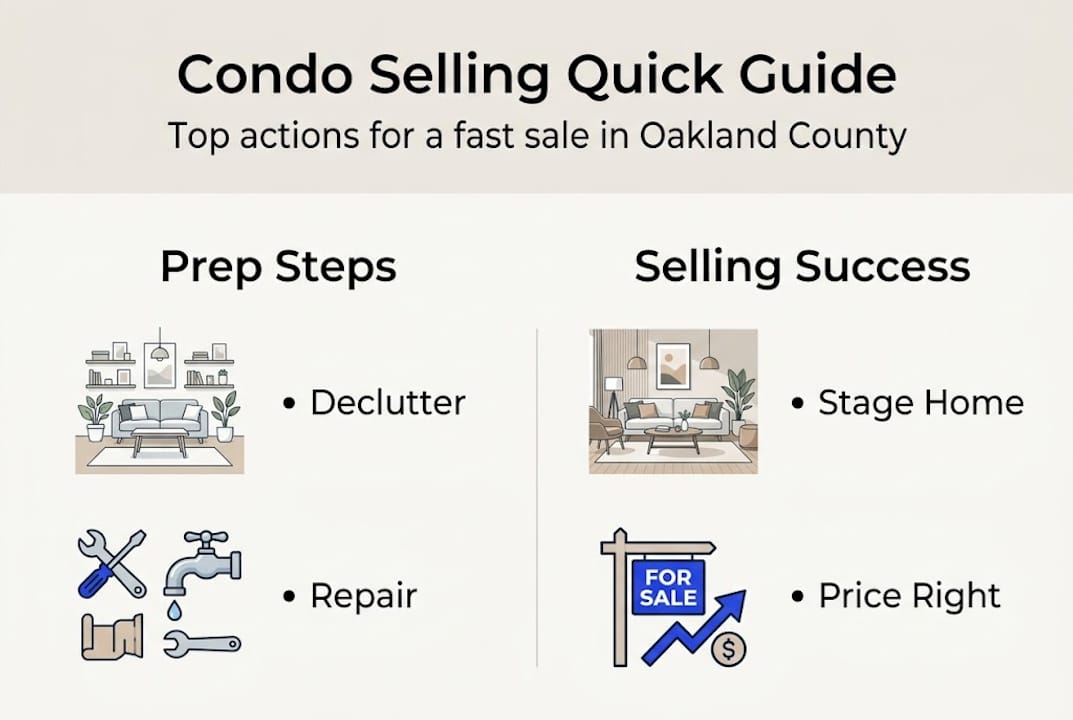 Overpricing by even 5% can push your listing into a longer days-on-market cycle, which signals to buyers that something may be wrong with the property. Accurate pricing from day one protects your negotiating position.
Avoiding common mistakes during the selling process
Great preparation and strategy are only effective if you know what mistakes to avoid, Common mistakes when selling a condo leads to lower offers or a slower sale — and most of these errors are entirely preventable., and most of these errors are entirely preventable. Here are the most common mistakes condo sellers make:- Overpricing from the start and refusing to adjust based on market feedback
- Being inflexible with showings, which limits buyer access and reduces competition
- Poor communication with buyers, agents, or the HOA during the process
- Neglecting minor repairs that buyers flag during inspections
- Ignoring buyer feedback after showings instead of using it to improve
The single most damaging mistake a condo seller can make is overpricing the unit and then waiting too long to correct it. A stale listing loses leverage fast.To avoid seller mistakes around timing and closing delays, keep these tips in mind:
- Schedule showings within 24 hours of a request whenever possible
- Have your HOA documents pre-approved and ready to share immediately
- Stay in close contact with your agent throughout the process
- Address inspection findings promptly to avoid renegotiation
- Confirm all closing conditions with your title company early
Our take: What most condo selling guides miss
Most selling guides focus on cosmetic fixes and pricing formulas. Those matter, but they are not the full picture. After working with condo sellers across Oakland County for over 20 years, Tom Gilliam has seen a pattern: the sellers who close fastest are not always the ones with the most updated kitchens. They are the ones who understand their HOA dynamics and communicate proactively. HOA boards can slow approvals, flag unresolved violations, or create friction during buyer due diligence. A seller who has built goodwill with their association and neighbors often moves through this process with far less friction. That relationship is invisible on a listing sheet but very real at the closing table. Flexibility and communication also outperform cosmetic upgrades more often than sellers expect. A buyer who feels respected and informed is far more likely to stay committed through inspection and appraisal. These expert staging insights reinforce that presentation matters, but it is the full seller experience that closes deals. Hyper-local knowledge, not generic checklists, is what truly moves the needle in this market.Ready to sell your condo? Get expert local support
Now that you are equipped with actionable tips, the right local support can take your condo sale from good to exceptional. Selling in Oakland County requires more than a checklist. It requires someone who knows the neighborhoods, the HOA landscapes, and the buyer pool. Tom Gilliam at RE/MAX Classic brings over 20 years of Oakland County expertise to every condo sale. From reviewing your condo prepping checklist to running targeted marketing and guiding you through negotiations, Tom delivers a strategy built around your specific unit and goals. Explore open house tips and vital real estate lessons to keep building your knowledge. Contact Tom today at Homes2MoveYou.com to schedule your personalized condo selling consultation.
Frequently asked questions
How do I determine the best listing price for my Oakland County condo?
Research recent comparable condo sales from the past 90 days, evaluate current market trends, and consult a local expert for the most accurate pricing that attracts buyers quickly without leaving value behind.Are there condo-specific documents I need to prepare before selling?
Yes, have your HOA documents, disclosure forms, and recent meeting notes ready, as these are often required during the selling process and HOA rules and paperwork must be reviewed prior to listing.What is the role of staging in the condo selling process?
Staging helps potential buyers envision themselves living in your condo, and staged condos often sell faster and for more money than unstaged units in the same building.How can I avoid costly mistakes when selling my condo?
Avoid overpricing, stay flexible with showings, and promptly address needed repairs, since avoiding common mistakes can significantly improve your final selling outcome and timeline.Recommended
Check out this article next