





Buyer and Seller Guide | Oakland County, Michigan
Compare the Loan, the Cash Gap and the Total Cost
Which loans can be taken over, how the process works, what it really costs, and what sellers should know before advertising a low rate.
Updated October 2026
7.24%
Average 30-Year Rate (Freddie Mac, Oct. 29)
3%
Hypothetical Assumed Rate in These Examples
$1,800
FHA Processing-Fee Cap; Other Allowed Costs Can Apply
0.5%
VA Assumption Funding Fee, Unless Exempt
TL;DR
An assumption may let an approved buyer take over an eligible existing mortgage. FHA and VA loans are common candidates; USDA rules are program-specific, and most conventional purchase loans are not assumable. Freddie Mac’s national 30-year average was 7.24% on October 29, 2026—not a quote for an individual borrower. A lower existing rate can be useful, but compare the cash gap, fees, mortgage insurance, remaining term and seller obligations. The examples below compare principal and interest only, not total monthly cost or lifetime savings.
A qualified buyer may be able to assume an eligible FHA or VA loan if the required approval is obtained and the buyer can fund the purchase-price gap and other costs. USDA and conventional loans need case-specific review. Confirm the loan terms and approval process with the servicer before relying on an advertised low rate.
I’ve been talking with more buyers about this lately, and I understand why. Some Oakland County homes have existing loans with rates below those available on a new loan. That is worth investigating, but the actual loan terms, eligibility, cash needed and total cost determine whether an assumption fits.
Start with these questions when comparing an assumption with a new loan. Each is addressed in this guide:
Buyer: “How do I find a house with an assumable mortgage in Michigan?”
Buyer: “Can a non-veteran assume a VA loan?”
Buyer: “How much cash do I need to assume a mortgage?”
Seller: “Is my FHA or VA loan assumable, and should I advertise it?”
Seller: “What happens to my VA entitlement if a buyer assumes my loan?”
This guide covers which loans qualify, how the process works step by step, what it really costs, and two worked examples. It also covers the seller’s side, because an assumable loan can be a real selling point if you handle it the right way.
What Is an Assumable Mortgage?
In a typical FHA or VA purchase assumption, an approved buyer takes responsibility for an existing loan rather than replacing it with a new mortgage. Confirm the rate, outstanding balance, remaining payments and any mortgage-insurance obligations with the servicer. Not every program or transfer follows identical terms.
For an introduction to eligibility and seller obligations, read our Oakland County assumable-mortgage overview. This guide focuses on cash-gap math, payment examples and questions to resolve before an offer.
Which Loans Can Be Assumed?
| Loan Type | Assumable? | Who May Qualify | Key Details |
|---|---|---|---|
| FHA | Generally possible, subject to applicable approval | A buyer meeting the applicable credit and program requirements | Confirm the original mortgage-insurance schedule. The reasonable and customary processing fee may be up to $1,800; other allowable charges are separate. |
| VA | Generally possible, with required approval | Qualified Veterans and non-Veterans | The assumption funding fee is 0.5% unless exempt. Seller release and substitution of VA entitlement are separate matters. |
| USDA | Program-specific transfer and assumption rules | Applicants meeting the relevant program and approval requirements | Direct and Guaranteed rules differ. Guaranteed-loan transfers require Agency approval and can leave the original borrower personally liable. |
| Conventional | Most purchase loans are not assumable | Check the actual loan documents and servicer | A due-on-sale clause commonly requires payoff in an ordinary sale. Ask about any applicable exception rather than assuming the loan qualifies. |
Ask the servicer to identify the loan program, whether the proposed sale can use an assumption, the current terms and all required approvals. The interest rate alone does not establish assumability.
USDA needs a separate review
Under USDA Guaranteed-loan rules, an approved transfer does not release the original borrower from personal liability. New terms and a guarantee fee can apply, and a property in an area that is no longer rural may still qualify. Ask the servicer and USDA about the exact program; Direct-loan rules are separate.
How an Assumption Works, Step by Step
Step 1: Confirm the loan type and balance
The short version: Ask the listing agent whether the seller has an FHA, VA or USDA loan, and request the current balance and rate.
Sellers can find this on their monthly mortgage statement. The balance matters as much as the rate, because it decides how big the equity gap will be.
Step 2: Run the numbers on the equity gap
The short version: The buyer pays the difference between the price and the loan balance, usually in cash.
We’ll cover this in detail below. It’s the step that decides whether an assumption works for you.
Step 3: Write an offer that’s contingent on assumption approval
The short version: The purchase agreement should spell out the assumption, the timeline and what happens if approval doesn’t come through.
Ask the servicer what starts the review process, what makes the application complete and which approvals are needed. Discuss realistic investigation and closing deadlines, and what happens after a delay or denial, with your advisers.
Step 4: Apply with the seller’s loan servicer
The short version: Contact the current loan servicer or program administrator for the required application process.
The servicer applies the applicable credit, income and program requirements and may need Agency approval. Review timing is program- and application-specific. Obtain current expectations in writing and allow time for approval, documentation and settlement; there is no universal 45-day closing promise.
Step 5: Arrange funds for the gap
The short version: Arrange sufficient approved funds for the purchase-price gap and additional costs.
A second loan may be possible, but the structure must satisfy the applicable program, servicer and lender requirements. Obtain approval for the proposed financing and compare the combined payments, fees and risks before making an offer.
Step 6: Close and confirm seller obligations
The short version: Confirm the program-specific closing documents, assumption approval and any applicable release of personal liability.
For FHA and VA transactions, ask for the applicable written release documentation. A release of VA liability is different from restoration of entitlement. USDA Guaranteed rules can require the original borrower to remain personally liable, so do not apply an FHA or VA release assumption to every program.
The Equity Gap: The Part Most Buyers Don’t Expect
The buyer takes responsibility for the eligible remaining debt; an assumption does not automatically finance the full purchase price. Calculate the purchase price minus the assumed balance, then add closing costs and any required reserves or other funds.
At a $350,000 price with $260,000 assumed debt, the price gap is $90,000, before closing costs. That gap may be funded with the buyer’s own money or approved additional financing. A lower first-loan rate does not eliminate the need to qualify for the complete transaction.
Illustrative Example 1: Same Cash, Two Paths
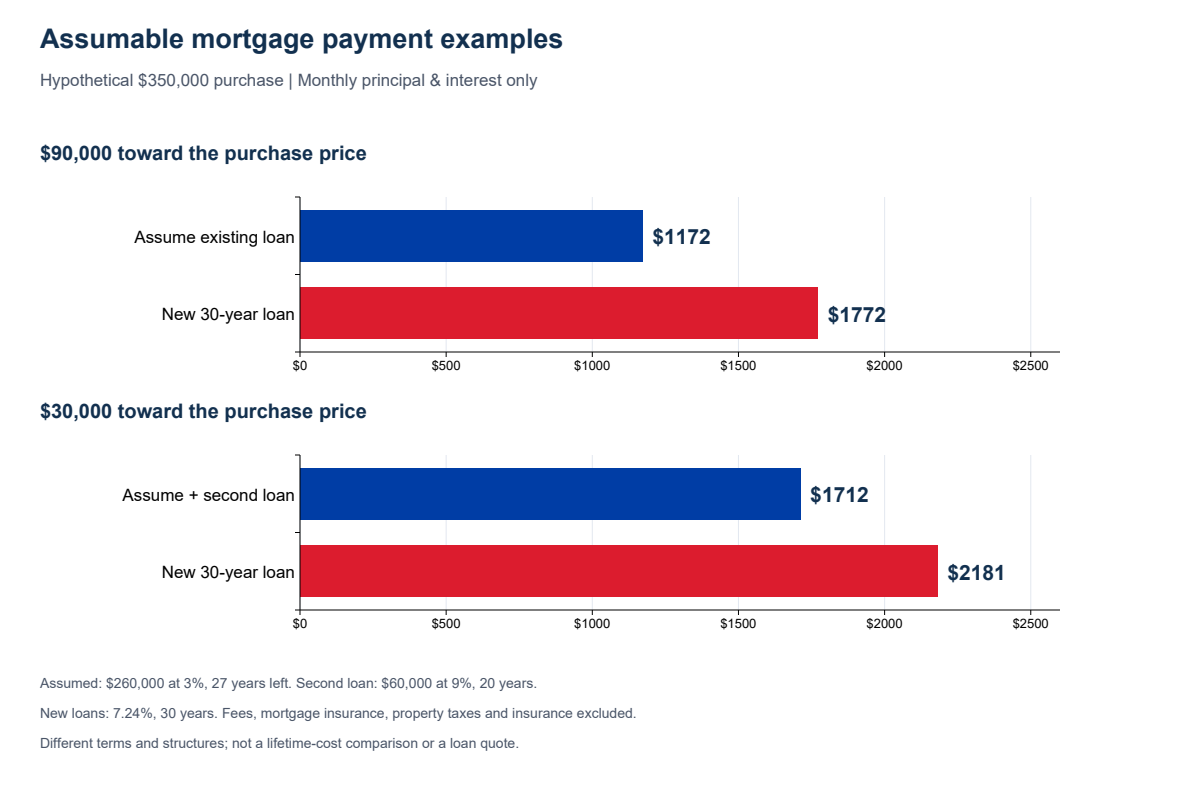
Hypothetical terms: a $350,000 purchase, $90,000 toward the price, and an existing $260,000 loan at 3% with 27 years remaining. These are illustrative inputs, not an actual listing or a current loan offer.
Path A, assume the loan: $90,000 covers the price gap, and the buyer assumes $260,000 at 3% over the remaining 27 years. Principal and interest: about $1,172 a month.
Path B, new loan: $90,000 toward price and a new $260,000 loan at the illustrative 7.24% comparison rate over 30 years. Principal and interest: about $1,772 a month.
The principal-and-interest difference is about $600 a month, or roughly $7,200 a year. That is not a total-payment or lifetime-cost comparison. Mortgage insurance, fees, taxes, property insurance and the different loan terms can change the overall result.
Illustrative, rounded principal and interest only. Fees, mortgage insurance, taxes and property insurance are excluded. The 27-year and 30-year terms differ.
Illustrative Example 2: Less Cash, a Second Loan
Use the same hypothetical home and existing loan, but with $30,000 toward the price and a $60,000 second loan at an illustrative 9% over 20 years. This example does not establish that a second loan is available or permitted for a particular transaction.
Assumption plus second loan: about $1,172 plus $540, or $1,712 a month in combined principal and interest.
New loan instead: $30,000 toward price and a new $320,000 loan at 7.24% over 30 years gives about $2,181 a month in principal and interest.
The illustrated principal-and-interest difference is about $469 a month. Compare the actual eligibility, mortgage insurance, fees, remaining terms and total cost before deciding.
Illustrative only; second-loan availability and approval are not guaranteed. All fees, mortgage insurance, taxes and property insurance are excluded. Different terms and structures mean this is not a lifetime-savings calculation.
Pro Tip
Ask the listing agent to obtain the seller’s confirmation of the loan program, rate, balance and servicer process. A past purchase date or a low advertised rate is a starting point for investigation, not proof that the buyer or transaction will qualify.
Want to know whether an assumption could work for you? Call or text me, and I’ll run the numbers on homes you’re watching.
For Sellers: Is Your Low Rate a Selling Point?
If your eligible FHA or VA loan has a low rate, confirmed terms can be useful information for interested buyers. Its value to a particular buyer depends on the cash gap, approval requirements and total cost. Market verified facts and direct buyers to the approval process.
What Sellers Should Know Before Advertising an Assumable Loan
Confirm it first. Call your servicer and ask whether your loan is assumable and what their process and timeline look like.
Confirm the expected processing and closing schedule. Build appropriate time into your move and any purchase of your next home, with a clear plan for delays or an assumption denial.
VA sellers: distinguish release of liability from substitution of entitlement. VA’s official assumption disclosure explains that an eligible Veteran assuming the loan needs sufficient entitlement and must meet the substitution requirements, including occupancy. Without a qualifying substitution, your entitlement remains tied to the loan; ask VA how that affects your remaining benefit.
Confirm seller obligations and applicable release documents in writing. FHA and VA release procedures should not be generalized to USDA Guaranteed loans, whose rules require continuing transferor liability.
A sale using an assumption can still involve applicable Michigan transfer taxes, title, recording, settlement and negotiated brokerage charges. Exemptions, amounts and who pays depend on the transaction. Ask the closing provider for an itemized estimate and review our Michigan seller-cost guide.
Pros and Cons of an Assumable Mortgage
| Perspective | Potential Benefit | What to Review |
|---|---|---|
| For buyers | A potentially lower existing rate and principal-and-interest payment, depending on the complete structure | The price gap, approval requirements, fees, possible continuing mortgage insurance and different remaining terms |
| For sellers | Confirmed financing terms that may interest a qualified buyer able to fund the price gap | Approval and timing uncertainty; program-specific liability, release and VA entitlement questions |
Common Mistakes to Avoid
Where Assumptions Go Wrong
Assuming a low rate proves assumability. Confirm the loan documents and the program-specific approval process with the servicer.
Underestimating the cash gap. Run the numbers on the gap before you tour, not after you fall in love with the kitchen.
Using a generic closing timeline. Ask for a current process estimate and agree on realistic terms, review periods and contingencies rather than treating a fixed day count as guaranteed.
Confusing assumption approval, personal liability and VA entitlement. Obtain written, program-specific confirmation of the seller’s obligations and any release or substitution.
Forgetting to compare the complete cost and financing structure. Review lender-provided alternatives and our Oakland County mortgage preapproval checklist.
Is an Assumption Right for You?
An assumption may fit a buyer who can fund the cash gap, qualify for the complete financing structure and accommodate the approval process. Ask for an all-in comparison of actual options, including fees, mortgage insurance and remaining term. Freddie Mac’s 7.24% benchmark on October 29, 2026 is national market context, not an individual loan quote.
For broader planning context, read our guide to evaluating whether to wait for lower mortgage rates. Compare the actual home, financing and your budget together.
Tom’s Honest Take
Assumable mortgages deserve a complete numbers check. The rate matters, but so do the cash gap, program approval, timing, fees and seller obligations.
When an eligible existing loan fits the buyer and transaction, its lower rate can be worth investigating. Ask for servicer confirmation early and compare actual costs and terms with a new-loan alternative before deciding.
Tom Gilliam, RE/MAX Classic
Key Takeaways
FHA and VA loans are common candidates; USDA has program-specific transfer rules, and most conventional purchase loans are not assumable.
Get the required servicer and, where applicable, Agency approval. Processing and closing timelines vary.
The buyer covers the gap between the price and the loan balance, usually with cash.
Our hypothetical 3% assumption examples have lower principal-and-interest payments than the 7.24% comparison loans; actual total costs and approval vary.
VA sellers should review entitlement separately from liability release. All sellers should obtain program-specific advice on remaining obligations.
Tom Gilliam of RE/MAX Classic in Farmington Hills helps Oakland County buyers and sellers investigate mortgage assumptions and compare their options. His work includes starter homes, luxury properties and waterfront homes throughout the county.
Frequently Asked Questions
What is an assumable mortgage?
An approved buyer takes responsibility for an eligible existing loan. Confirm the retained rate, balance, remaining schedule and other terms with the servicer. FHA and VA are common candidates; other programs and transfers require their own review.
How do I find a house with an assumable mortgage in Michigan?
Ask the listing agent to obtain seller and servicer confirmation of the program, rate, balance and process. A prior low-rate purchase or an online listing phrase does not establish eligibility.
Can a non-veteran assume a VA loan?
Yes. VA says qualified non-Veterans can assume a VA-guaranteed loan under its credit and income standards. Substitution of entitlement is separate and requires an eligible Veteran meeting VA’s additional requirements.
How much cash do I need to assume a mortgage?
You need enough to cover the gap between the purchase price and the remaining loan balance, plus closing costs. On a $350,000 home with a $260,000 balance, that gap is $90,000. Some buyers use a second loan for part of it.
How long does a mortgage assumption take?
There is no universal closing duration. Ask the servicer what documents and approvals are needed, when review begins and its current processing estimate. Allow for settlement and any required Agency review, and plan for delays or denial.
What fees come with an assumption?
HUD’s handbook allows a reasonable and customary FHA assumption processing fee up to $1,800, with separately allowable charges in addition. VA’s assumption funding fee is 0.5% unless exempt. Obtain an itemized, program-specific estimate of all processing, agency, title, recording and other charges.
Are conventional loans assumable?
Most conventional purchase loans are not assumable in an ordinary sale. Check the loan documents and servicer for any applicable exception or permitted transfer.
Does the seller still owe anything after an assumption?
Do not assume approval removes every seller obligation. Confirm the applicable FHA or VA release documents, and review VA entitlement separately. USDA Guaranteed transfer rules require the original borrower to remain personally liable; obtain program-specific advice.
Recommended Reading
Should You Wait for Lower Mortgage Rates? Oakland County Guide
What Does a Buyer’s Agent Do for First-Time Buyers in Michigan?
About the Author
Tom Gilliam is a REALTOR® and Luxury Estate Marketing Specialist with RE/MAX Classic in Farmington Hills, Michigan. With 24 years in Oakland County real estate, more than 700 closed transactions, and Top 1% status in Oakland County, he holds the ABR, SRES, PSA, SFR, and RSPS credentials and is a RE/MAX Hall of Fame, Lifetime Achievement, and Platinum Club member. Call or text 248-790-5594.
Sources reviewed October 30, 2026: Freddie Mac PMMS; HUD Handbook 4000.1; FHA assumption regulation; VA funding-fee guidance; VA assumption disclosure; USDA Guaranteed transfer regulation; and Michigan Treasury. Examples are illustrative, not loan offers. This is general information; consult the servicer, lender and relevant professional for your transaction.