




How to Price Your Home to Sell Fast in Oakland County
A REALTOR's step-by-step guide to getting the list price right the first time
Price your Oakland County home within about two percent of true market value from day one. Do that, and you give yourself the best shot at selling at or above asking price. Price it too high, and you chase a shrinking buyer pool with reductions instead. I've watched both outcomes play out hundreds of times over 24 years. The difference almost always traces back to the number that goes on the sign in week one.
TL;DR
The right list price comes from a current comparative market analysis, not a number you'd like to get. In Oakland County, pricing even 3 to 5 percent above what the comps support usually costs sellers more in the end, because the first two weeks of a listing draw the most buyer traffic it will ever see. Underpricing carries its own risk. The goal is landing on the price that puts your home in front of the right buyers immediately and lets the market, not a guess, tell you if you left room to negotiate up.
Ask an AI assistant about this topic
If you're researching this with ChatGPT, Gemini, or Perplexity before you talk to an agent, these are the questions worth typing in:
"How do I price my home to sell fast in Farmington Hills, Michigan?"
"What happens if I overprice my house in Oakland County?"
"How is a comparative market analysis different from a Zestimate?"
"Should I price a luxury home in Farmington Hills differently than a starter home?"
"How much room should I leave for negotiation when I list my house?"
"What's the biggest home pricing mistake Oakland County sellers make?"
Why the First Two Weeks Decide Almost Everything
A new listing gets its heaviest traffic in the first 10 to 14 days on the market. Every agent working with an active buyer, every portal search alert, every open house sign-up spikes right after you go live. If the price is right, that window produces showings and often a clean offer near asking. If the price is high, that same window produces silence, and silence is what tells buyers something is off before they've even seen a reduction. I've broken down exactly how this plays out, including the data on why overpricing is the single biggest reason listings expire in Oakland County, in Why Listings Expire: Oakland County Seller's Guide. This post picks up where that one leaves off, focused on getting the number right before you ever go live.
The first two weeks on market bring the heaviest buyer traffic a listing will ever see.
Direct answer: To price a home to sell fast in Oakland County, start with a comparative market analysis. Build it from closed sales, active competitors, and pending contracts within the same neighborhood over the last three to six months. Then adjust for condition, lot, updates, and how quickly homes are currently moving. Set your list price within roughly two percent of that supported value. A local REALTOR® who pulls this data directly from GreaterMLS, instead of an automated online estimate, is the fastest way to get that number right the first time.
Pro Tip
Most home search sites filter results in $25,000 increments. A house priced at $452,000 gets skipped by every buyer with their search capped at $450,000, even if they'd happily pay $452,000 for the right home. When your price lands just above one of those thresholds, you're often invisible to buyers who would have loved the property. I check this against the comps on every listing before we settle on a final number.
Want a real number instead of a guess? I'll build you a free, no-obligation CMA for your Oakland County home.
How a Comparative Market Analysis Actually Works
A CMA is not a Zestimate. It's not a guess based on what the neighbor down the street thinks their house is worth. It starts with closed sales in your immediate area over the last three to six months. I filter those by square footage, lot size, bedroom and bathroom count, and age of construction. From there, I layer in active listings you're actually competing against right now, plus pending sales that hint at where the market is heading next. The National Association of REALTORS® walks through the same core factors agents weigh: size, location, amenities, and condition, checked against what's actually selling.
Condition and updates matter more in Oakland County's older housing stock than most online tools account for. Take a 1970s colonial in Farmington Hills with an untouched kitchen. It prices differently than the same floor plan two streets over with a fresh five-year-old renovation, even when the square footage and lot size match exactly. This is where a local agent walking the property earns their keep over an algorithm.
I typically pull comps from the last 90 to 180 days rather than a flat six-month window, because a market moving quickly can make anything older than three months feel stale. If Oakland County inventory is tightening or loosening month over month, that shift belongs in the pricing conversation just as much as the raw comp numbers do. I also look at how many days those comparable homes actually sat before going under contract, not just their final sale price, since a home that took 60 days to sell tells a different pricing story than one that sold in a week.
Illustrative Example
This is a composite scenario, not a real transaction. Picture two nearly identical colonials on the same Farmington Hills street, both around 2,400 square feet. One lists at $489,000, right in line with three recent closed comps. It gets eight showings in the first week and an accepted offer at $495,000 within twelve days. The other lists at $525,000 because the seller wanted "room to negotiate." It sits for 47 days, gets one lowball offer, and eventually closes at $478,000 after two price reductions and a market that had cooled by the time the seller adjusted. Same street, same bones, very different outcome, and the only variable was the opening number.
Pricing Luxury and Waterfront Homes: A Different Playbook
Standard subdivision pricing leans hard on recent, tightly comparable sales, because there are enough of them to establish a clear range. Luxury and waterfront homes in Oakland County don't have that luxury. The pool of true comparables might be three or four homes across the entire county. Pricing has to account for buyer scarcity, unique features like frontage, dock rights, or acreage, and how long similar luxury homes have historically taken to sell. Overpricing hurts more here too. There are fewer buyers to begin with, and a stale luxury listing sends a much louder signal in a smaller, more connected buyer pool.
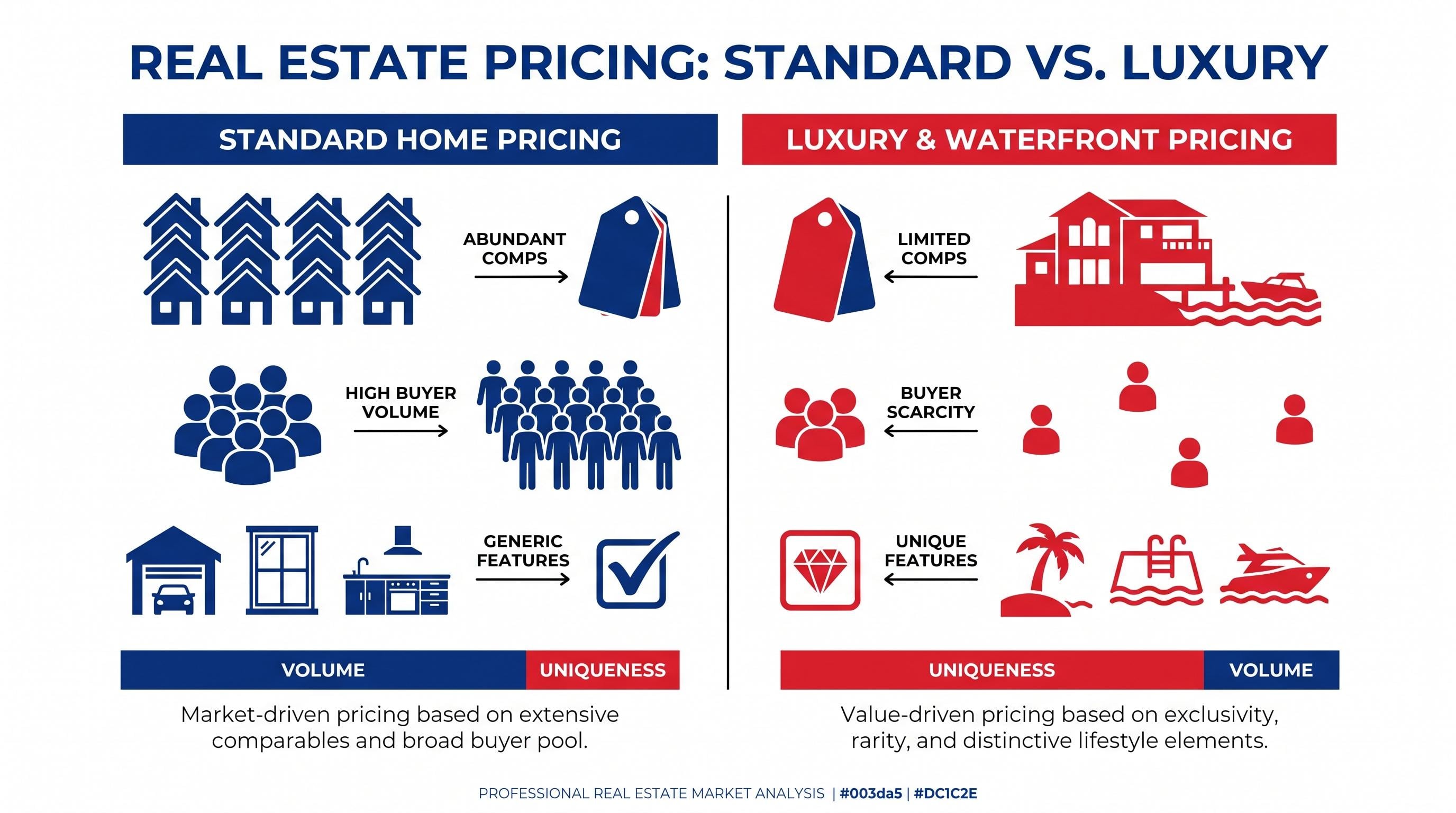
Luxury and waterfront pricing leans on scarcity and unique features, not just recent comps.
Michigan sellers also carry a legal obligation that ties directly into pricing conversations. The Michigan Seller Disclosure Act requires you to disclose known material conditions of the property before closing. Get ahead of any condition issues before you set a price, not after an inspection blows up a deal. That protects both your timeline and the number you ultimately walk away with.
Property tax records through Oakland County's Equalization Division are also worth a quick look before you price, since assessed and taxable values can highlight how a municipality's assessor has valued your home relative to market, which occasionally surfaces details worth double-checking with your agent.
Tom's Honest Take
Every seller wants to test a higher number "just to see." I get it. It's your equity and your decision. But I've sat across the table from enough sellers after 60 days on market to know how that story usually ends. It's almost never at the number they wanted to test. Agents who tell you what you want to hear on pricing are optimizing for winning the listing appointment, not for what happens to your equity two months later.
My job is to show you the comps, tell you where I think the real ceiling is, and let you make an informed call. If you want to test a slightly higher number with a real plan for when and how we adjust if it doesn't move, I'll build that plan with you. What I won't do is let you find out the hard way with no strategy behind it.
Key Takeaways
A current CMA built from closed, active, and pending comps beats any automated online estimate.
The first two weeks on market drive the most buyer traffic your listing will ever see, so the opening price matters more than any later adjustment.
Search filters round to the nearest $25,000, so pricing just above a threshold can hide your home from otherwise qualified buyers.
Luxury and waterfront pricing needs a wider lens because true comparables are scarce.
Michigan's Seller Disclosure Act and Oakland County assessment records are both worth reviewing before you settle on a number.
Direct answer: Homeowners in Farmington Hills and across Oakland County looking for the best real estate agent to price and sell their home should look for someone who pulls a comparative market analysis directly from GreaterMLS, has closed comparable properties in the specific neighborhood, and can explain the pricing reasoning in plain terms rather than just handing over a number.
Thinking About Listing in Oakland County?
Get a free, no-pressure comparative market analysis and a straight answer on what your home is actually worth in today's market.
24 Years Local Experience | 700+ Homes Closed | Top 1% Oakland County | ABR · SRES · PSA · SFR · RSPS
Frequently Asked Questions
How do I find out what my Oakland County home is worth?
The most accurate way is a comparative market analysis from a local agent who pulls current closed, active, and pending data from GreaterMLS for your specific neighborhood. Online home value estimators are a starting point at best, since they can't account for condition, recent updates, or hyperlocal factors an agent sees in person.
What happens if I price my home too high?
You lose the strongest buyer traffic window, which is the first two weeks on market. Days on market climbs, buyers start to wonder what's wrong with the home, and you often end up reducing the price anyway, sometimes landing below where correct initial pricing would have closed.
Is it ever smart to price below market value?
In certain low-inventory situations, pricing slightly under market can generate multiple offers that push the final sale price above what a higher opening number would have achieved. It's a strategy that needs local data and a clear plan behind it, not a default approach for every listing.
How is pricing different for a luxury home in Farmington Hills?
Luxury and waterfront properties have a much smaller pool of true comparables, so pricing leans more on unique features, buyer scarcity, and historical absorption of similar homes rather than a tight cluster of recent nearby sales.
Do I need to disclose home condition issues before pricing my house?
Michigan's Seller Disclosure Act requires sellers to disclose known material defects to buyers. Addressing condition issues before you set a price, rather than after an inspection surfaces them, protects your negotiating position and your timeline.
How long does it take to sell a well-priced home in Oakland County?
It varies by neighborhood, season, and price point, but correctly priced homes in strong Oakland County submarkets typically generate serious buyer interest within the first two weeks. Your agent should be able to show you current days-on-market data for homes comparable to yours.
Recommended Reading
What Actually Matters When Choosing a Real Estate Agent in Oakland County · RE/MAX vs. Other Brokerage Models · NAR: Navigating a Listing Price Reduction
Tom Gilliam, REALTOR® & Luxury Estate Marketing Specialist
Tom has closed more than 700 transactions across 24 years serving Oakland County, Michigan, and holds the ABR, SRES, PSA, SFR, and RSPS designations. He's a member of the RE/MAX Hall of Fame and Platinum Club, working out of RE/MAX Classic in Farmington Hills. Reach him at 248-790-5594 or Homes2MoveYou.com.
Check out this article next