



Farmington Hills Got Zero Road Funding in Oakland County's 2027 Budget — What It Actually Means
Tom Gilliam | RE/MAX Classic | Farmington Hills, MI
Farmington Hills Isn't Getting a Single County Road Project in 2027
Farmington Hills isn't getting a single road construction project in Oakland County's proposed 2027 budget, even though that budget is 40 percent larger than this year's. If you own a home here, or you're thinking about buying one, that's worth understanding before you assume it's either nothing or a crisis.
The Road Commission for Oakland County presented its proposed $269.8 million FY2027 budget on August 20. That's a $76.4 million jump over the current $193.4 million budget, driven largely by new state road-funding legislation passed in October 2025. Despite that increase, neither Farmington nor Farmington Hills appears anywhere on the 2027 Road Improvement Program construction list. The RCOC Board is expected to formally adopt the budget at its September 17 meeting.
This Year vs. Next Year, By the Numbers
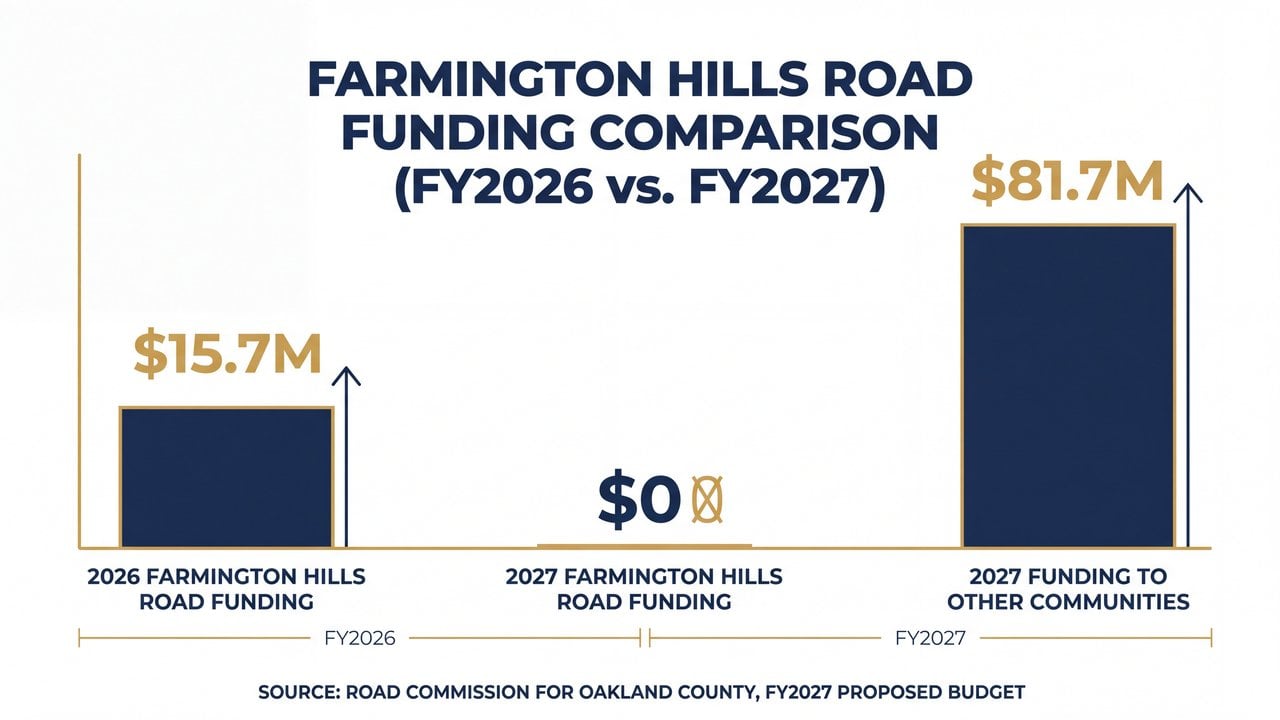
The county-level funding shift, by the numbers.
Compare that to this year. The adopted 2026 budget included three Farmington Hills projects totaling $15.7 million. Two segments of 12 Mile Road, plus a 10 Mile Road culvert replacement over the Rouge River. Meanwhile, the 2027 plan directs $81.7 million in construction spending to Novi, Wixom, Waterford Township, Bloomfield Hills, Southfield, and Pontiac. The single largest project on the list, a $33.2 million widening of 12 Mile Road between Beck Road and Dixon Road, sits entirely in Wixom and Novi.
Sellers weighing a road-quality discount, and buyers wondering if this changes anything, deserve a straight answer. Not just a headline.
"Does road funding affect home values in Farmington Hills?"
"Why did Farmington Hills get zero county road projects in 2027?"
"Is Farmington Hills still investing in infrastructure despite the county budget snub?"
"What Oakland County communities are getting the most road funding in 2027?"
What Actually Gets Missed in the Headline
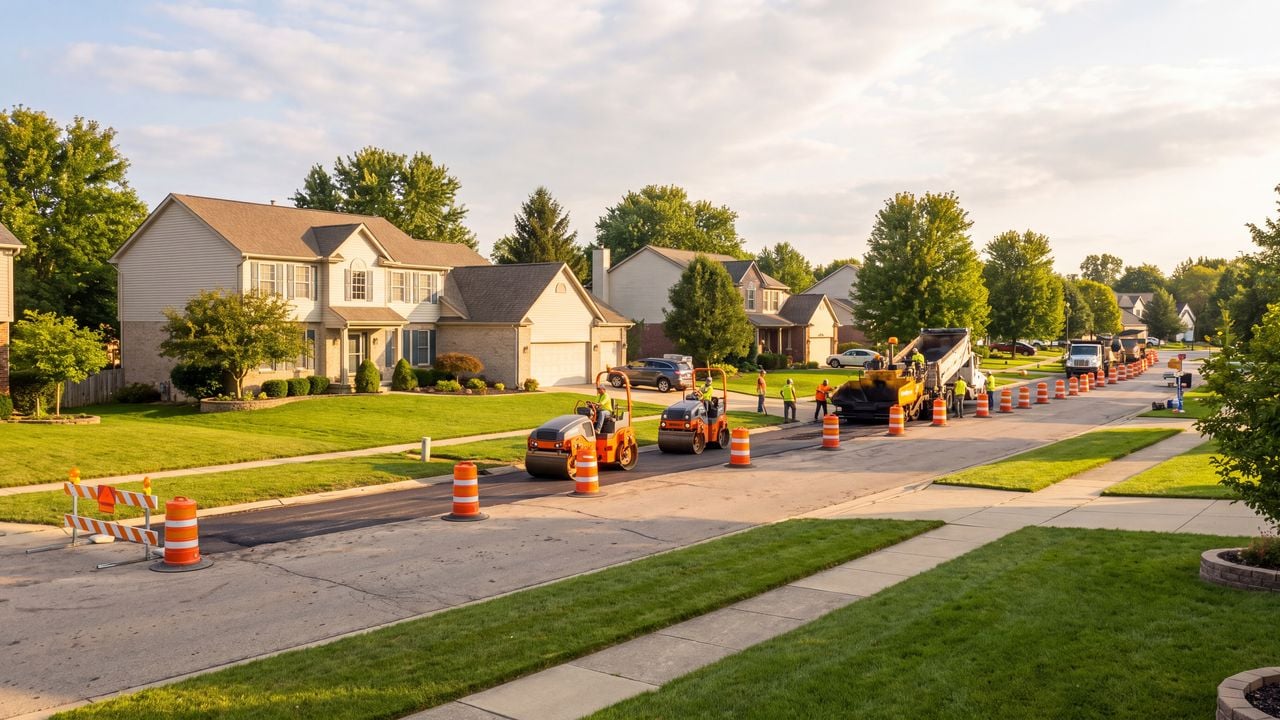
Farmington Hills continues investing in its own roads, even without county-level construction funding this cycle.
Here's the part that gets missed in a headline like this: Farmington Hills isn't actually sitting still on roads. The city has its own road work planned for 2027 through a completely separate funding stream. Director of Public Services Jacob Rushlow told the City Council in May that two Farmington Road projects are moving forward, the 10-to-12 Mile segment and the 13-to-14 Mile segment, both funded through the Federal Aid Committee formula, which covers 80 percent with federal money and a 20 percent local match. Those projects don't show up in the RCOC budget because they were never RCOC's to fund. The city also put roughly $30 million into road and infrastructure work during the 2026 construction season, drawing on federal grants and its 2018 and 2024 road millages.
That distinction matters. RCOC has jurisdiction over more than 2,700 miles of county roads but has no taxing authority of its own. Its project list reflects county-level priorities. It isn't a verdict on whether a city is investing in itself. Farmington Hills clearly is, just through a different channel.
RCOC Board Chairman Eric McPherson said the budget "represents our concerted effort to continue to provide better, safer roads" in an August 12 statement. RCOC has also said project selections typically happen years in advance, based on safety reviews, road-condition assessments, and engineering analysis, not a single year's political priorities. That explanation matters here. A project skipping the 2027 list doesn't necessarily mean Farmington Hills roads scored worse on safety or condition. It can just as easily mean the city's highest-priority segments were already funded and completed in recent cycles, including the $15.7 million spent in 2026, while other communities are now catching up on their own backlog.
Get a straight read on how local infrastructure news actually affects your home's value or your search, without the headline spin.
What Research Actually Says About Roads and Home Value
Research on infrastructure and property values generally shows the relationship is real but not simple. According to research compiled by S.H. June, deteriorating infrastructure can create a negative perception of an area over time. That effect grows when road conditions start affecting commute times or maintenance costs. But that effect shows up gradually, from years of visible neglect. Not from one budget cycle skipping a city while separate city-funded projects continue. A city getting zero county-level projects for one year, while running its own $30 million infrastructure program, is very different from a city with deteriorating roads and no offsetting investment.
Not every road matters equally to home value either. According to Pocketsense's analysis of road infrastructure effects, roads that improve access to a community tend to support property values. Roads that create barriers or redirect traffic away tend to hurt them. The 12 Mile Road segments that didn't make this year's county list are access roads, not barrier roads. That limits how much one budget cycle should move anyone's pricing expectations.
It's also worth noticing where the money is actually going. The single largest 2027 project, that $33.2 million widening of 12 Mile Road, sits in the Wixom-Novi corridor, one of the fastest-growing stretches of Oakland County right now. New residential and mixed-use development in that corridor has been driving traffic growth for several years, and road spending tends to follow growth, not the other way around. Farmington Hills, by contrast, is a more built-out, established community without the same kind of large-scale new development pulling infrastructure dollars toward it. That's a pattern worth understanding if you're comparing Farmington Hills to a newer-growth suburb, not a sign that one city is being favored and another punished.
What This Means If You're Buying or Selling Here
What this actually means depends on which side of the transaction you're on. For sellers, this isn't something to lead with in a listing. It isn't something to panic-price around either. If a buyer's agent brings it up, the accurate response is the fuller picture: county funding shifted this cycle, city-led projects and a $30 million 2026 investment did not. For buyers, this is a reasonable question to ask during due diligence, not a reason to avoid Farmington Hills. Every Oakland County community sees its county road priorities shift year to year. This year, that shift landed here.
If you're selling this year, the practical move is simple: know the answer before a buyer asks the question. Being able to explain the city's own $30 million 2026 investment, and the two active Farmington Road projects still moving forward, turns a potentially awkward moment into a sign that you, and your agent, actually know the market. If you're buying, it's worth asking your agent one direct question: is the specific road your daily commute depends on part of either the county or city plan right now? That answer matters far more than the county-level headline does.
The city itself isn't staying quiet about this either. Farmington Hills residents can weigh in directly. RCOC held its public hearing on August 20, and the board votes to adopt the final budget on September 17. If this is something you care about as a homeowner, that meeting is where it actually gets decided, not in a comment section. For the original local reporting on this story, see Farmington Focus's coverage.
Tom's Honest Take
I've watched enough of these county budget cycles to know the headline version and the real version are rarely the same thing. Farmington Hills getting zero RCOC projects this year is a real, notable shift, and I'm not going to pretend it isn't. But I've also watched this city invest roughly 30 million dollars of its own money into roads in a single construction season, which tells me a lot more about the city's actual commitment to its infrastructure than one county list does. If you're buying or selling here, I'd rather walk you through both halves of that picture than let a headline do the talking.
"Which Oakland County cities are getting the most 2027 road funding?"
"Does a road budget shift actually affect resale value?"
Have Questions About Buying or Selling in Farmington Hills?
Call or text Tom Gilliam at (248) 790-5594, email [email protected], or visit 29630 Orchard Lake Rd, Farmington Hills, MI 48334 for a straight answer, not a headline.
24 Years Experience | 700+ Closed Transactions | Top 1% Oakland County | ABR • SRES • PSA • SFR • RSPS
FAQs
County road funding priorities shift year to year based on RCOC's own safety reviews and condition assessments. This cycle, the county's construction dollars went to Novi, Wixom, Waterford Township, Bloomfield Hills, Southfield, and Pontiac instead, and the city's highest-priority segments had already been funded in recent years.
Yes. The city has two Farmington Road projects planned for 2027 through a separate federal-aid funding stream, and spent roughly $30 million on road and infrastructure work in 2026 alone.
Not in any immediate or significant way. Research suggests infrastructure affects property values gradually, through years of visible neglect, not a single budget cycle, especially when a city continues investing through other funding sources.
Novi, Wixom, Waterford Township, Bloomfield Hills, Southfield, and Pontiac are splitting $81.7 million in construction spending, including a $33.2 million widening of 12 Mile Road between Wixom and Novi, part of one of the county's fastest-growing corridors.
The public hearing was held August 20, and the RCOC Board is expected to formally adopt the budget at its September 17 meeting.
There's no need to lead with it, but if it comes up, the accurate answer includes both halves: county funding shifted this cycle, while the city's own infrastructure investment has continued without interruption.
Oakland County New Developments: 2026 Buyer's Guide ·
Novi City West Development 2026 ·
City of Farmington Hills
Check out this article next