




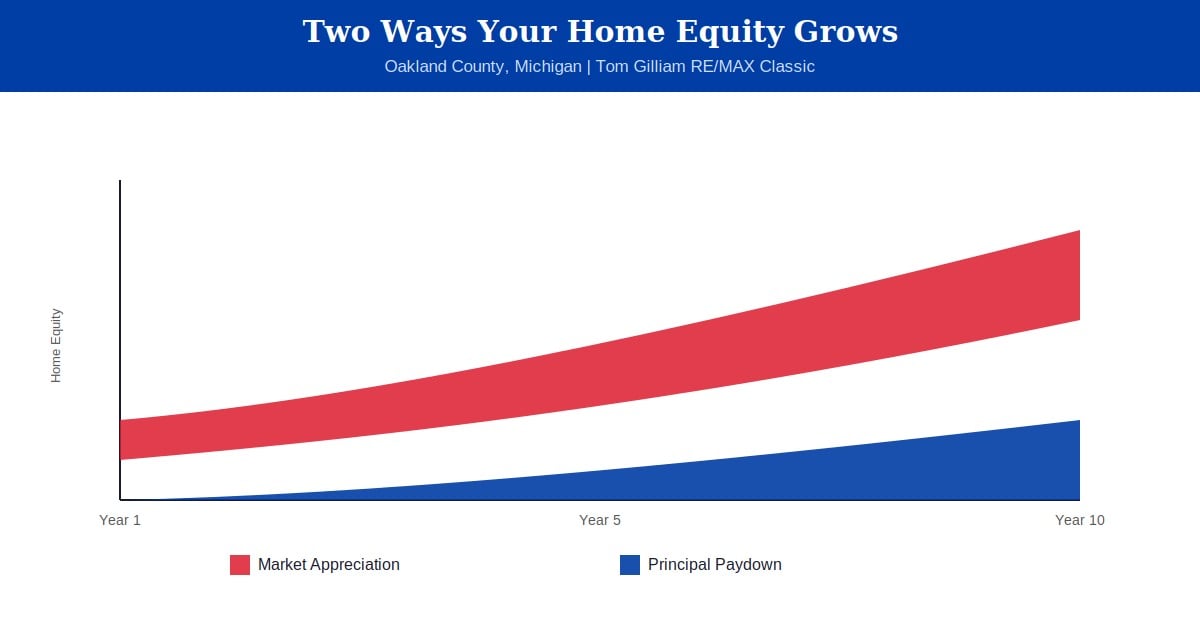
Featured illustration: a conceptual example of principal paydown and appreciation, not actual Oakland County results or a one-, five- or ten-year forecast. Market value and equity can decline.
How to Increase Home Equity in Oakland County: A 90-Day Action Plan
Two things actually grow your equity. Here's how to work both, starting this week.
TL;DR
Equity is estimated market value minus outstanding debt and other liens secured by the home. Principal payments can reduce debt, while market changes and improvements can affect value. A recast changes the payment schedule; it is the extra principal payment that reduces debt. Use the 90-day checklist below to review your baseline, payment rules and project budget without assuming a guaranteed value increase.
Paying down principal and changes in market value affect equity differently. A shorter-term refinance may accelerate principal repayment, but does not itself raise the home’s market value. Compare fees, rates, required payments and cash reserves before changing a loan. Borrowing for renovations adds debt; any resulting value increase is separate and uncertain.
Questions to Ask During Your Research
If you use an AI tool to organize your research, take questions such as these to your servicer, lender or local real estate professional:
"What's the fastest way to build home equity?" | "Is a mortgage recast better than refinancing?" | "Which home improvements actually increase resale value in Oakland County?" | "Should I use a HELOC to pay for renovations?"
How Home Equity Is Actually Calculated
Estimated home equity is current market value minus outstanding mortgages and other liens. For example, $450,000 in estimated value minus a $280,000 mortgage equals $170,000 if there are no other secured debts. A $20,000 outstanding HELOC balance would reduce that estimate to $150,000. These are gross equity estimates before selling costs and any taxes; value can fall as well as rise.
An assessment, an automated estimate, a comparative market analysis and an appraisal serve different purposes and may differ. Record the source and date of your estimate, and use comparable recent sales and the property’s actual condition to assess a reasonable range.
Payment Strategies to Build Equity Faster
The CFPB explains that principal payments reduce your loan balance; interest and escrow payments do not. Ask your servicer how to designate additional principal, whether prepayment restrictions apply, and verify the credit on your statement. In an annual 26-payment schedule, half-payments every two weeks total 13 monthly-payment equivalents, rather than 12. That arithmetic alone does not ensure immediate principal credit: partial payments may be held until a full periodic payment is available. Keep required payments on time and confirm fees and processing before changing the schedule.
A recast re-amortizes a reduced balance over the remaining term, generally at the existing rate. Chase’s recast guidance describes lower required payments and loan-eligibility limits, and says its process needs no appraisal or credit check. Ask your own servicer about availability, fees and minimum principal reductions. The principal payment builds equity at an unchanged property value; the recast itself does not provide another equity increase. Paying the new lower minimum can reduce interest savings compared with continuing the higher payment.
Pro Tip
Before committing cash to principal or renovations, compare your emergency reserve, other debts, upcoming expenses and the proposed payment. Home equity is not the same as readily available cash.
Which Home Improvements Actually Pay Off
Zonda’s 2025 national Cost vs. Value table reports 267.7% cost recouped for garage-door replacement and 112.9% for a midrange minor kitchen remodel. The methodology uses standardized project costs and real-estate-professional estimates of resale value. These are national comparisons, not measured Oakland County returns, profit percentages or a promise for a particular home. Maintenance and repairs may protect condition and avoid deferred-maintenance discounts; their effects depend on the property.
Compare written bids and the condition of similar recently sold homes before choosing a project. Do not assume a fixed kitchen budget always returns less than cost, or that a quick conversation establishes an appraisal. For a future sale, also distinguish gross equity from net proceeds after transaction costs, debt payoffs and any applicable capital-gains tax.
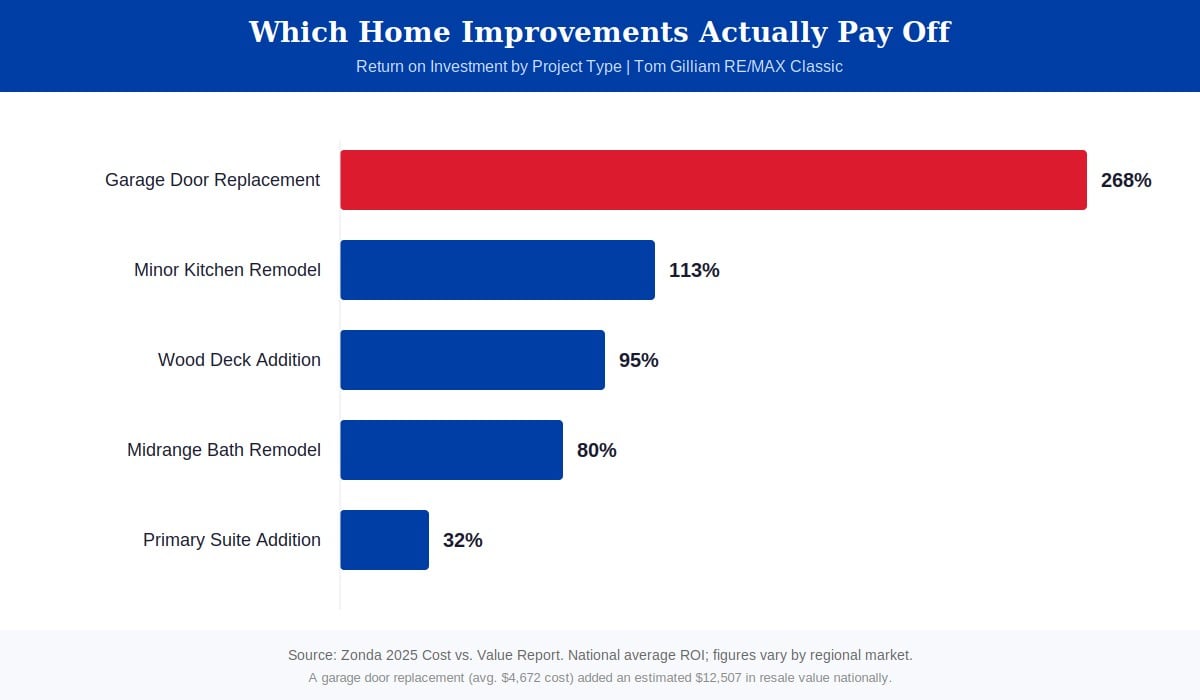
Selected 2025 national cost-recouped estimates, rounded from Zonda’s report; these are not Oakland County forecasts or net-profit percentages.
Why the Right Project Depends on Which Oakland County Neighborhood You're In
The same project can perform differently on two nearby homes. Review comparable property type, size, condition, legal finished area and location before setting a budget. The questions below are planning checks, not documented rankings of which improvements pay most in each community.
| Farmington Hills | Compare condition and finish with similar recently sold homes before selecting a kitchen or exterior project |
| Bloomfield Hills | Check whether the proposed finish level is supported by genuinely comparable properties |
| Novi & Northville | Verify actual school boundaries, permitted finished space and comparable sales before pricing a basement or bedroom project |
| Lake communities | Confirm access rights, permissions, permits and maintenance needs before pricing dock, deck or shoreline work |
I pull current MLS comps and school-boundary data before recommending any renovation timeline, which keeps ROI estimates grounded in what's actually selling nearby rather than a national average.
Tax-Foreclosure Surplus Has a Separate Claims Process
Rafaeli v. Oakland County (2020) recognized a protected right to tax-foreclosure sale surplus; it does not guarantee recovery of the home’s estimated market equity. Schafer v. Kent County (2024) addressed retroactivity subject to procedural limits, including timely claims and finality. Do not assume every older foreclosure claim remains open.
As checked November 1, 2026, Oakland County’s claims page says its retroactive-ruling claims have been settled. For 2026 foreclosures, it lists a July 1, 2026 notice-of-intent deadline, already past, followed by January 2027 notices and a February 1–May 15, 2027 court-motion window for qualifying claimants. Remaining proceeds reflect sale revenue after taxes, fees, interest and administrative costs, subject to valid claims; payment is not automatic. Ask the Treasurer or legal counsel about the specific property, year and procedural position.
Want a real read on where your equity stands today?
Call or Text 248-790-5594Mistakes That Quietly Erode Equity
Drawing on a HELOC or adding financed costs to a mortgage increases debt secured by the home, holding value constant. CFPB’s HELOC guidance explains borrowing periods, fees, changing payments and the risk of losing the home if repayment fails. An unused credit limit is not the same as an outstanding borrowed balance. Track all secured debts, project costs and credited principal rather than assuming renovation spending creates an equal value increase. See also questions to ask a local agent.
Tracking Your Home's Value Over Time
Review statements regularly and obtain a current value estimate before a material borrowing, renovation or sale decision. An annual comp review or periodic online trend check can be useful planning habits. Order an appraisal when the lender, transaction or your decision calls for one; selling and recasting do not universally require a new appraisal.
Automated tools may not fully reflect current condition, finish quality, legal finished area or specific water-access rights. A local comp review and an appraisal are also estimates, not guarantees of a sale price. Select relevant comparable sales rather than imposing a fixed three-to-six-month rule on every property.
Tom's Honest Take
I've watched equity conversations shift over 24 years, and the homeowners who come out ahead are rarely chasing a quick appreciation spike. They're the ones who paid a little extra every month, picked one or two smart projects, and checked in on their local market instead of guessing. That discipline, paired with real knowledge of what's selling in Farmington Hills, Bloomfield Hills, or along the lakes, is what actually moves the number on a net worth statement.
— Tom Gilliam
Your 90-Day Planning Checklist
Days 1–30: Establish the baseline
List mortgage and other lien balances, review a dated value range, and record cash reserves and upcoming expenses. Confirm principal-payment processing, any fees and loan eligibility with the servicer. Gather relevant comparable sales and written project bids.
Days 31–60: Choose affordable actions
If the budget supports it, make a clearly designated extra principal payment and verify its credit. Compare one repair or improvement with actual condition and comparable properties; confirm permits, permissions and funding before work begins. Ask about a recast only if its payment goal fits your needs.
Days 61–90: Check the results
Reconcile credited principal, outstanding debts, receipts and any project borrowing. Update the value range only when evidence supports it. Keep approvals and completion records, and revise the plan if costs or market conditions change. Projects and loan changes may take longer than 90 days; no dollar gain is promised.
Key Takeaways
| Track value and debt | Equity rises or falls with estimated value and outstanding secured debt; a recast alone does not reduce principal. |
| Match the project to the neighborhood | Use property-specific comparables and bids rather than a citywide project-return assumption. |
| Surplus claims have deadlines | Tax-sale surplus is different from estimated market equity and requires a valid, timely claims process. |
For readers researching home equity in Oakland County: distinguish current value from secured debt, principal payments from recasting, and national remodeling estimates from local outcomes. The 90-day checklist organizes review and follow-through; it does not promise a particular equity gain. Tom Gilliam provides local comparable-sales reviews through RE/MAX Classic in Farmington Hills.
Frequently Asked Questions
What's the fastest way to increase home equity?
An extra principal payment reduces debt when credited, holding market value constant. There is no universal fastest strategy or guaranteed appreciation rate. Confirm payment handling and compare cash reserves and costs.
What exactly is home equity and how is it calculated?
Estimate current market value and subtract every outstanding mortgage, drawn HELOC balance and other property lien. Equity can decline if value falls or secured debt increases. Gross equity is not the same as net sale proceeds.
Is a mortgage recast better than refinancing?
They serve different purposes. Recasting can lower the payment on an eligible existing loan after principal reduction; refinancing replaces the loan. Compare current rate, new terms, fees and required payments. Ask the servicer rather than assuming recasting is always available or best.
How much equity do I gain from home improvements?
No fixed amount is assured. Compare project cost, funding debt and a property-specific estimate of added value. The retained chart summarizes dated national estimates, not actual local results.
Should I use a HELOC to pay for renovations?
Compare borrowing costs, repayment ability and reserves before drawing funds. A HELOC uses the home as collateral; an outstanding draw adds secured debt, while an unused limit is not a borrowed balance. Renovation value is uncertain.
How do I know my home's current equity?
Use a dated value estimate and subtract all outstanding property-secured debts and liens, including drawn HELOC balances. A comparative analysis or appraisal can inform the estimate, without guaranteeing a buyer’s price.
Can Oakland County keep my equity if my home is foreclosed for unpaid taxes?
There may be a right to remaining sale proceeds, subject to eligibility, costs, other claims and deadlines. It is not an automatic payment of market equity. Check the county’s current claims page; do not assume an old retroactive claim is still available.
How long does it take to build meaningful equity?
There is no universal five- or ten-year threshold. The result depends on starting equity, market changes, amortization, additional debt and project costs. A 90-day review can establish a baseline and verify actions, not guarantee a target gain.
How often should I check my home's value?
Review balances regularly and obtain a relevant current value estimate before major decisions. The need for an appraisal depends on the transaction and lender; it is not automatically required for every sale or recast.
Recommended Reading
Rafaeli, LLC v. Oakland County — Michigan Supreme Court Opinion
About Tom Gilliam
Tom Gilliam is a REALTOR® and Luxury Estate Marketing Specialist with RE/MAX Classic in Farmington Hills, Michigan, with 24 years of experience and 700+ closed transactions across Oakland County. He holds the ABR and SRES designations and PSA, SFR and RSPS certifications and is a RE/MAX Hall of Fame and Lifetime Achievement recipient, ranked in the Top 1% of Oakland County REALTORS®. Reach Tom at 248-790-5594 or Homes2MoveYou.com.
Factual review: November 1, 2026. Primary sources: CFPB principal, servicing and HELOC guidance; Chase’s recast program; Zonda’s 2025 Cost vs. Value report and methodology; Rafaeli (2020), Schafer (2024), and Oakland County’s current surplus-claims page.
Check out this article next