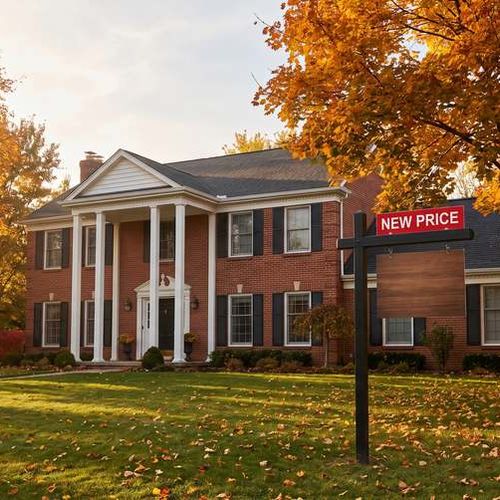





Oakland County Buyer Update | October 2026
Oakland County Mortgage Rates: Costs and Loan Options
Compare dated benchmarks, loan costs, payment options and verified assistance-program availability.
Reviewed October 30, 2026
7.24%
National 30-Year PMMS · October 29
+13%
Metro Active Listings · September YoY
21.5%
Metro Price-Cut Share · September
Closed
MSHDA Rate Relief · Funds Exhausted
TL;DR
Freddie Mac’s October 29 national 30-year average was 7.24%; your lender’s offer may differ. Compare loan terms and total costs, and evaluate any payment subsidy carefully. MSHDA says its Rate Relief Mortgage is closed because funding is exhausted; ask about other current products instead of budgeting for that former discount.
The October 1 Freddie Mac release reported 7.28% for a national 30-year fixed benchmark. The October 29 PMMS update reports 7.24%. The earlier figure is retained below for a clearly dated payment illustration, not as a current Oakland County quote.
A weekly national average does not establish the rate offered to an individual borrower or prove that buyers have negotiating leverage on a particular home. Compare current listings and financing for your own situation.
I’ve helped buyers for 24 years. Here are five financing questions to explore with a lender, along with dated examples to make the tradeoffs clearer.
Use these questions to organize your financing comparison and check the assumptions behind a payment estimate.
Buyer: "How much does a 7% mortgage rate add to my monthly payment?"
Buyer: "Should I wait for mortgage rates to drop before buying a home in Michigan?"
Buyer: "What is a 2-1 buydown and can the seller pay for it?"
Buyer: "Does Michigan have a program to lower mortgage rates for first-time buyers?"
Seller: "Should I offer a rate buydown instead of cutting my price in Oakland County?"
Dated National Benchmarks, Not a Personal Quote
Freddie Mac’s benchmark covers a defined national conventional, conforming purchase-loan population. Borrower qualifications, loan structure, fees and timing can produce different offers. It is not an Oakland County-specific rate.
The October 29 national 15-year benchmark was 6.60%. A shorter loan term can change both monthly payments and lifetime interest. Compare written offers for the same loan type and review costs as well as the stated rate.
What the September Metro Listing Data Shows
More homes to choose from
Realtor.com’s September 2026 report lists active inventory up 13.0% year over year for the Detroit-Warren-Dearborn metro. This broader metro area is not the same geography as Oakland County. More inventory does not guarantee extra time to act on an individual listing.
Price reductions are not guaranteed concessions
The same report lists a 21.5% price-reduced share for that metro in September. A price reduction records a seller’s asking-price change; it does not establish the discount a buyer will obtain or a completed sale price.
Assess a home on its own merits
A broader market statistic cannot guarantee a particular home’s future value or equity. Evaluate recent competitive sales, condition, location and your ownership costs.
A Dated 30-Year Payment Comparison

Illustration. In the dated 30-year example, 7.28% versus 5.98% adds about $344 monthly in principal and interest on a $400,000 loan; this is not a current rate quote.
The table isolates how selected rates affect the same loan amount over a new 30-year fixed amortization. The 7.28% input comes from the dated October 1 release; 5.98% is a comparison input. These are loan principals, not home prices, and the figures are not lender offers.
| Loan amount | At 5.98% (comparison input) | At 7.28% (Oct. 1, 2026) | Difference |
|---|---|---|---|
| $300,000 | $1,795 | $2,053 | +$258 a month |
| $400,000 | $2,393 | $2,737 | +$344 a month |
| $500,000 | $2,991 | $3,421 | +$430 a month |
Monthly principal and interest on a 30-year fixed loan. Property taxes, homeowners insurance, and any mortgage insurance or HOA dues are extra. Your actual rate depends on your credit, down payment, loan type, and lender.
For this $400,000 comparison, the difference is about $4,100 annually in principal and interest. That amount does not establish what any financing strategy will save after fees, insurance or other costs.
I can help you organize the home search and connect with lenders to compare actual written financing options.
Call or Text 248-790-55945 Financing Questions to Ask Your Lender

Illustration. A temporary payment subsidy requires lender approval and funding; a seller concession is negotiable, not guaranteed.
1. Compare temporary subsidies and permanent points
A temporary 2-1 buydown uses funded subsidies to reduce the borrower’s early payments; it does not permanently lower the note rate. Fannie Mae’s overview explains that the full note obligation remains. Discount points for a permanent rate reduction are different. Confirm funding, concession limits and eligibility with the lender.
Illustrative Example
For a hypothetical $400,000, 30-year fixed loan with a 7.28% note rate, principal and interest is about $2,737. A 2-1 subsidy can make the borrower’s first-year contribution equivalent to about $2,216 monthly at 5.28%, then about $2,471 at 6.28% in year two, with the full payment thereafter. Funding the illustrated differences takes about $9,400, before any separate fees; it is not automatically available from a seller.
Hypothetical arithmetic, not a transaction or loan offer. Fannie Mae requires qualification at the note rate for its temporary-buydown loans. Ask how the applicable program qualifies you and what happens if subsidy funds become unavailable.
2. Assess ARM adjustments and payment risks
An ARM has an initial rate period and later adjustments under its terms. Review its index, margin, adjustment frequency, rate caps and highest potential payment. Choose a loan you could manage if selling or refinancing before adjustment is not possible. An introductory rate is not a guarantee of lower total cost.
3. Compare the full costs of loan types
Ask an eligible lender to compare conventional, FHA and VA options for your circumstances. Consider down payment, mortgage insurance or a funding fee where applicable, upfront charges and total borrowing costs. CFPB’s loan-type guide explains the differences; no category is automatically cheapest for every borrower.
4. Lock smart, and ask about a float-down
When rates are moving quickly, timing your rate lock matters. Ask your lender how long your lock lasts, what an extension costs, and whether they offer a float-down option, which lets you take a lower rate if rates drop before closing. Get the terms in writing.
5. Verify Michigan assistance availability
MSHDA Rate Relief Mortgage is closed. Its official page says all funds are exhausted and applications are no longer accepted. The former discount should not be included in a current purchase budget. Review MSHDA’s current mortgage and down-payment assistance products with a participating lender; eligibility, funding, repayment terms and property limits depend on the product.
Pro Tip
Request comparable written Loan Estimates from multiple lenders for the same loan type, amount and date where possible. Compare payments, fees, credits and cash to close, and ask why any tax or insurance estimates differ.
Should You Wait for Rates to Drop?
Future mortgage rates, prices and competition are uncertain. Compare buying and waiting using a budget you can support, rather than assuming lower rates will be offset by higher prices or a wave of competing buyers.
Consider reserves, ownership costs, time horizon and your housing needs. The CFPB cautions that refinancing is not guaranteed. A future refinance should be an optional improvement, not what makes today’s payment affordable.
Tom's Honest Take
A rate headline is a starting point for questions. It does not tell you the total cost of the financing offered for your home or whether a purchase fits your budget.
Compare a supported home price with written loan choices and the full ownership budget. A concession or assistance program may help an eligible buyer, but it should be verified before relying on it.
Key Takeaways
The verified September metro listing figures describe inventory and asking-price changes, not guaranteed negotiating power on an individual home.
The national 30-year PMMS average was 7.24% on October 29; the older 7.28% example below is clearly dated.
A temporary subsidy does not remove the full note obligation; assess the later payment as well as the early relief.
Compare loan types, insurance, fees, adjustment risks and written lock terms with the lender.
MSHDA’s former Rate Relief Mortgage is closed. Check current products and eligibility rather than relying on its old advertised discount.
Tom Gilliam of RE/MAX Classic helps Oakland County buyers compare homes and organize financing questions. Use dated benchmarks for context, verified program information and written lender terms when planning a purchase.
Frequently Asked Questions
What was the latest national benchmark reviewed here?
The October 29, 2026 national PMMS averages were 7.24% for a 30-year fixed and 6.60% for a 15-year fixed. These are dated benchmarks, not a quote for your loan.
How do 7.28% and 5.98% compare in this example?
On a $400,000 loan, principal and interest at 7.28% is about $2,737 a month, compared with about $2,393 at 5.98%. That's roughly $344 more a month, or over $4,100 a year.
Should I wait for mortgage rates to drop before buying in Oakland County?
Consider your readiness, housing needs, reserves and affordable loan terms. Neither a forecast nor a national average determines the best timing for you.
What is a 2-1 buydown?
A funded subsidy temporarily reduces the borrower’s contribution toward payments, commonly by amounts equivalent to two percentage points in year one and one in year two. The note obligation remains; confirm qualification and funding with the lender.
Is MSHDA’s Rate Relief Mortgage available?
The former Rate Relief Mortgage is closed, according to MSHDA: its funds are exhausted and it is not accepting applications. Ask a participating lender about currently available alternatives.
Are adjustable-rate mortgages a good idea right now?
They may fit some borrowers, but compare possible adjusted payments, caps, fees and your ability to keep the loan. Do not assume you can sell or refinance before a reset.
Can I refinance if rates go down later?
Possibly, but it isn't guaranteed. Refinancing has costs and depends on your credit and home value at the time. Choose a payment you can afford at today's rate rather than counting on a future refinance.
Recommended Reading
Consumer Financial Protection Bureau: Buying a House, Tools and Resources
About the Author
Tom Gilliam is a REALTOR® and Luxury Estate Marketing Specialist with RE/MAX Classic in Farmington Hills, Michigan. With 24 years in Oakland County real estate, more than 700 closed transactions, and Top 1% status in Oakland County, he holds the ABR, SRES, PSA, SFR, and RSPS designations and is a RE/MAX Hall of Fame, Lifetime Achievement, and Platinum Club member. Call or text 248-790-5594.
This article is general information, not lending or financial advice. Rates and program availability change daily; confirm current terms with a licensed lender.
Check out this article next