





Main image: AI-generated conceptual illustration, not a local listing, actual defect or inspection photograph.
OAKLAND COUNTY BUYER & SELLER GUIDE
By Tom Gilliam, RE/MAX Classic · November 12, 2026
You can walk through a beautiful kitchen, admire a finished basement and picture yourself moving in. The underground pipe carrying wastewater away from the house is much harder to judge during that visit.
That is why a sewer scope belongs in the inspection conversation. For buyers in Farmington Hills and across Oakland County, it can help answer a practical question: What do we actually know about the sewer connection we are about to take responsibility for? For sellers, documentation can make that conversation more specific and less dependent on assumptions.
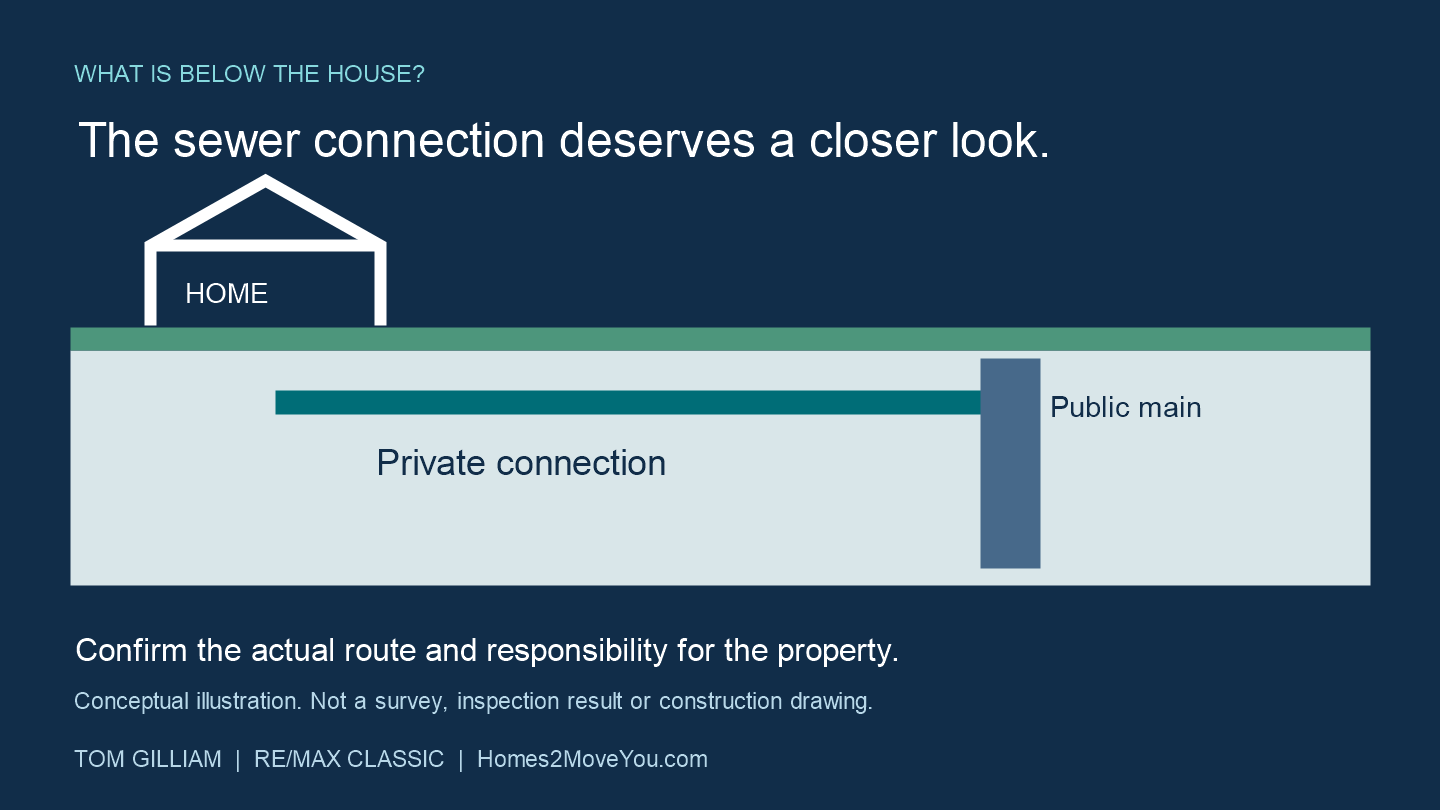
What is a sewer scope—and is it part of a home inspection?
A sewer scope is a camera inspection of the lateral line leading away from the house. It is different from running faucets, flushing toilets or looking at exposed plumbing. Those observations can be useful, but they do not provide the same view inside an underground pipe.
Do not assume the camera service comes with a general inspection. InterNACHI describes it as an additional service that some inspectors offer, rather than a requirement of its general home-inspection standards. Ask the company directly and read your agreement. One company’s package may differ from another’s. Source: InterNACHI’s sewer-scope overview.
The provider’s written scope matters as much as the service name. InterNACHI’s separate sewer-scope standards describe reporting observed material defects and identifying inspected and uninspected portions. A camera may reveal issues such as visible damage, roots or restrictions, but an obstructed view can leave unanswered questions. The inspection does not establish every hidden condition or predict future performance. Source: InterNACHI’s sewer-scope standards.
My practical recommendation is to ask for an explanation you can repeat in plain English: where the camera entered, where it stopped, what the inspector observed and what further work is recommended. A video file alone is not the same as understanding the result.
Why Farmington Hills’ public sewer work does not answer the private-line question
In its September 2, 2026 announcement, Oakland County said a Farmington Hills project would involve video inspection, cleaning and lining of sections of the public sanitary sewer. The announced schedule called for work after Labor Day with expected completion by March 1, 2027. That is a published project schedule, not confirmation that a particular street or property has been completed. Read the county’s project announcement.
Here is the important distinction for a real-estate transaction: public-system maintenance does not, by itself, document the condition of the individual connection serving the house. Oakland County’s homeowner guidance distinguishes utility responsibility for the public main from owner responsibility for home plumbing and its connection. Confirm the arrangement for the actual property with the responsible provider or association. Source: Oakland County sewer-backup guidance.
A listing description that says “municipal sewer,” a recently paved road or a nearby construction notice should prompt a follow-up question, not a conclusion. Ask what work was done, which pipe it involved and whether records identify this property’s connection. The same approach is useful elsewhere in Oakland County: evaluate the address and its documents rather than making assumptions about an entire city or subdivision.
A local checklist for Farmington Hills, Novi, West Bloomfield and nearby communities
If you are comparing homes in Farmington Hills, Novi, West Bloomfield, Southfield, Royal Oak, Rochester Hills or elsewhere in Oakland County, keep the questions tied to the property. A city’s name does not tell you the condition of a buried pipe, the ownership of every section or the details of an association’s maintenance agreement.
For a detached house: ask which wastewater system serves the address, where the available records are and who can explain the connection. Do not infer the pipe material from the style of the house or assume that a newer kitchen means the underground line was updated.
For a condominium or shared system: request the applicable association documents and ask where the unit owner’s duties end and the association’s begin. A monthly fee is not, by itself, a written promise that every future plumbing repair is covered. Ask the association or manager for a document-based answer rather than relying on a neighbor’s recollection.
For a property with septic: identify that early. Ask the appropriate specialist what a full septic evaluation would involve; a camera inspection of a pipe is not a substitute for evaluating the entire system. Confirm the applicable local health-department requirements for the actual transaction.
For someone relocating into Oakland County, I would put these questions beside the utility information and inspection appointments in the buying plan. You do not need to become a plumbing expert. You do need to know which professional is answering which question—and whether the answer is about this house.
Seven questions to ask before booking a sewer scope
Use these questions when comparing providers. They are a suggested consumer checklist, not a promise that every inspection includes each service.
- What does the quoted fee include? Ask about the visit, written findings, video delivery and any additional charge for a return appointment. Request the total in writing.
- How will you access the line? Have the provider explain the proposed access point and any permissions or preparation needed from the owner.
- What happens if access is unavailable? Understand the next step and potential additional costs before the appointment, rather than improvising under a deadline.
- How will you document the inspected portion? Ask the report to explain its coverage and any limitations, so an incomplete examination is not mistaken for a complete one.
- Will I receive the recording and a written explanation? Ask how long an online video link remains available and download your copy promptly.
- Who evaluates a recommended repair? Clarify whether the inspection provider also quotes repairs or whether a separate licensed plumbing contractor should evaluate the findings.
- How soon will the report be delivered? Match the appointment and report timing to the deadlines in your actual purchase agreement.
There is no verified countywide price quote behind this article. Calling a scope “only a few hundred dollars” can hide access charges or follow-up work. Get a current written quote for the property. The useful comparison is the service and documentation you receive, not simply the lowest advertised starting price.
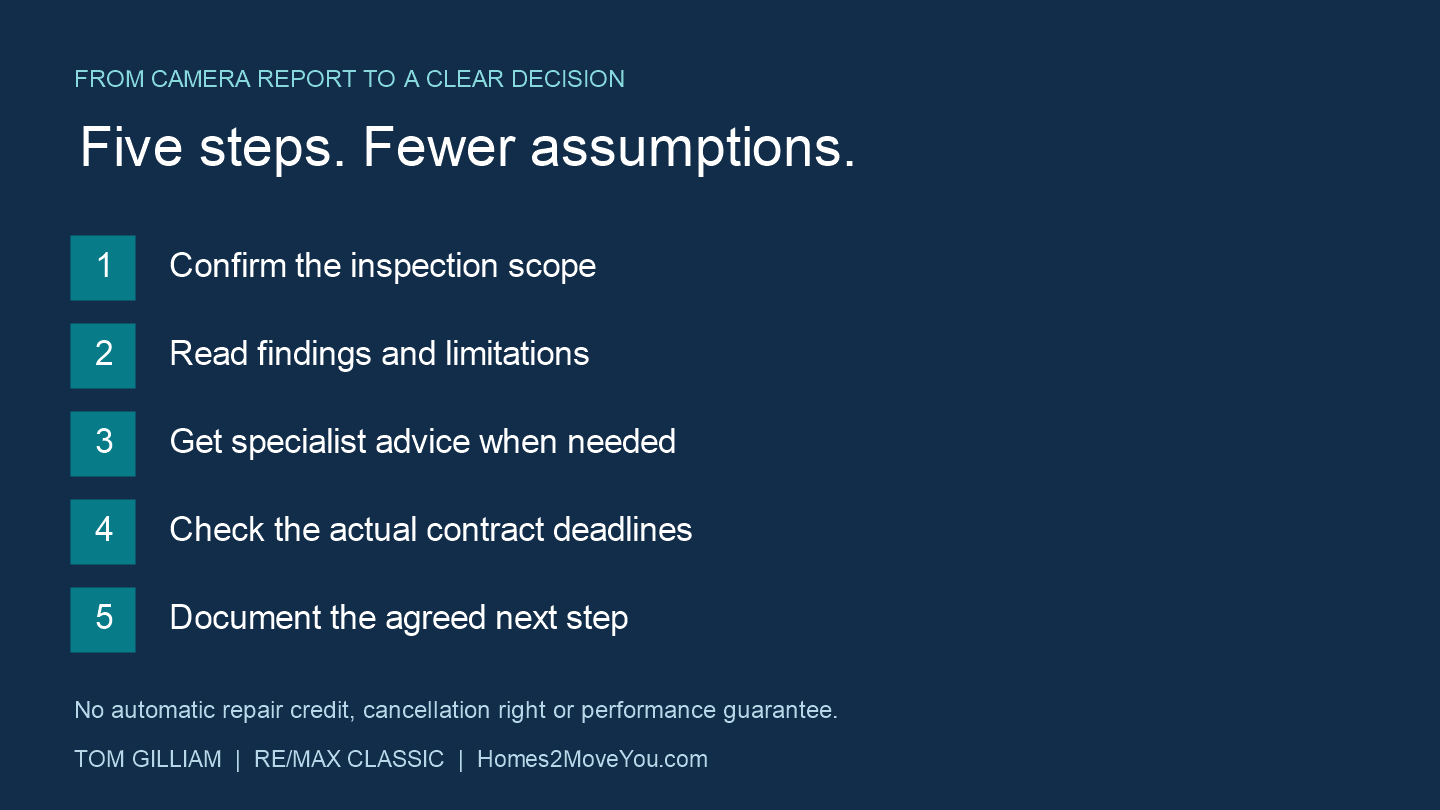
Three examples: how to use the findings without jumping to conclusions
These are hypothetical teaching examples, not Tom’s client transactions, local contractor quotes or evidence of how often sewer problems occur.
Example 1: The camera stops before the examination is complete
A buyer receives a report explaining that the camera could not inspect the full intended section. The buyer is tempted to summarize it as “nothing major found.” A better summary is “the inspected section has findings, and part of the line remains unexamined.” Ask the provider why it stopped and what a qualified professional recommends next. If more time is needed, discuss a written extension before the existing deadline; do not assume extra testing automatically extends the contract.
Example 2: Two repair proposals have very different prices
Imagine one written proposal is $4,000 and another is $9,000. Those invented figures are arithmetic examples, not Oakland County price estimates. Before asking for the larger amount as a credit, compare what each proposal includes: work area, access, permits if applicable, restoration, cleanup, verification and warranty terms. A smaller repair and a more extensive replacement are not necessarily competing bids for identical work. Ask for clarification before choosing either number.
Example 3: A seller has an old invoice for cleaning
A seller provides an invoice showing that the line was cleaned two years earlier. Keep it—it is useful history. Then ask what the contractor documented at that time and whether a video or follow-up report exists. Describe the record accurately rather than upgrading “cleaned” to “replaced,” “fully repaired” or “guaranteed.” Buyers can decide what additional evaluation they want within the access and inspection terms of their agreement.
Across all three examples, the goal is the same: turn an uncertain concern into a defined question, then obtain the right information to answer it. That is more productive than treating every observation as a deal-breaker or dismissing every concern because the drains appeared to work during a showing.
How can a sewer finding affect the purchase?
The next step depends on the report, professional advice and negotiated agreement. The CFPB recommends scheduling inspections early enough for additional evaluation, and explains that repairs and possible cancellation depend on the purchase contract and circumstances. An appraisal is a different exercise; it does not substitute for the inspection work you elect to order. Source: CFPB home-inspection guidance.
For a buyer, I would organize the decision around four questions: What is known? What remains unknown? What written estimate or specialist opinion is needed? What does the contract require us to do, and by when? Your agent can help coordinate the transaction; the plumbing diagnosis belongs with the appropriate professional, and legal interpretation belongs with your attorney.
A requested repair, seller credit or price change is a proposal until the parties agree in writing. If a credit is being considered, ask the lender and settlement team whether the proposed structure works for the loan and closing. Do not assume a credit resolves a property-condition requirement or puts spendable repair cash in your pocket after closing.
For the broader sequence after a report arrives, use my existing guide to what comes next after the home inspection. This article focuses on the sewer-specific questions so you can use both guides together.
What should sellers do before listing?
Start by gathering what you already have: invoices, permits where applicable, contractor reports, warranty information and any camera recordings. Put dates next to the documents. A folder of records is easier to evaluate than a vague statement that someone “took care of it.”
A pre-listing scope may be worth discussing when there is relevant history or uncertainty. It is an optional planning conversation, not a recommendation that every seller spend money on every possible test. Ask what question the inspection would answer and how you would use the result.
If work is proposed, separate three decisions: whether it is needed, who is qualified to do it, and whether to handle it before listing or through a negotiated transaction. Compare written scope and timing. Keep the technical report intact; a marketing description should not turn a limited observation into an unconditional assurance.
When estimating sale proceeds, include any repair or credit you actually agree to rather than using an online average as your personal budget. My Oakland County seller-cost guide explains how those decisions fit into a net sheet.
Does homeowners insurance cover sewer backup?
Michigan DIFS says water and sewer backup coverage is not automatic under homeowners or renters insurance. Coverage limits and exclusions matter; its guidance distinguishes backup protection from flood losses and notes that some equipment and maintenance costs may be excluded. Read Michigan DIFS’s consumer guide.
Use that as a reason to ask better questions—not as a coverage determination for your house. Ask your insurance professional to explain, in writing, how your policy treats damage inside the home, repair of the buried line itself, any service-line protection, deductibles, limits and exclusions. Do not assume all of those are covered because a quote includes the word “water.”
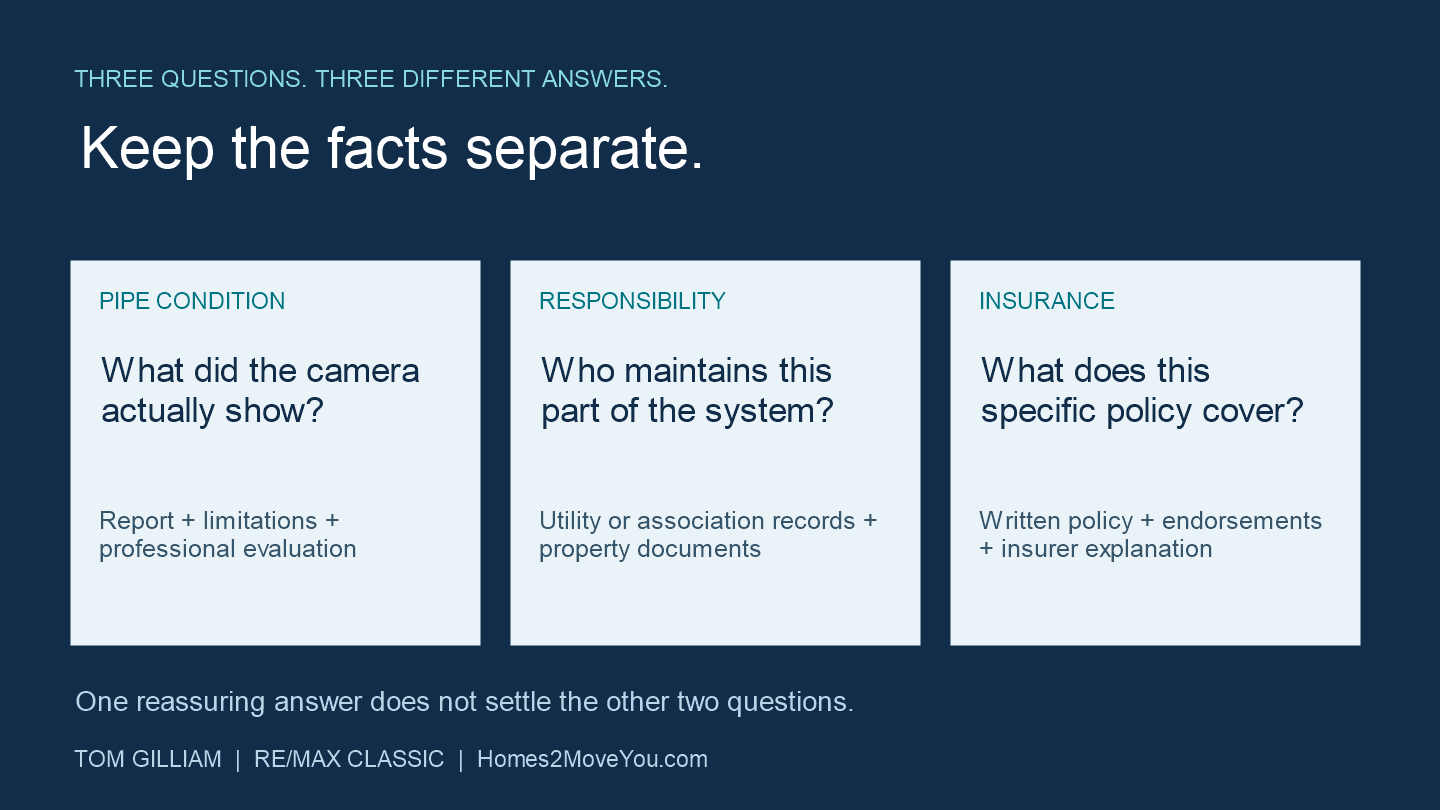
Tom’s Take: ask the unglamorous question before it becomes a rushed decision
A kitchen can help you fall in love with a house. The less visible systems deserve a place in the decision too.
My recommendation is to replace assumptions with a short paper trail: the actual report, its limitations, any specialist recommendation and the written next step. I would rather see a buyer understand an imperfect house than feel reassured by a sentence nobody can substantiate.
For sellers, preparation is not about promising a problem-free home. It is about knowing what your records say and presenting them honestly. A sewer scope can be one piece of that picture. It should support a thoughtful decision, not become a scare tactic or a guarantee.
Frequently asked questions
Is a sewer scope included in a standard home inspection?
Do not assume it is. Ask the inspection company and read the written agreement; sewer-camera work may be an additional service.
Does public sewer rehabilitation mean my private line was inspected?
No such conclusion follows from a public-project announcement. Request property-specific records and confirm the work area with the provider.
Should I get a sewer scope on a newer home?
Discuss the property, available records and your inspection goals with a qualified provider. Age alone does not document the line’s condition or establish that a scope is unnecessary.
What if the camera cannot inspect the full line?
Ask what was inspected, why the examination stopped and what follow-up is recommended. Treat the unexamined portion as unknown and check your contract deadlines before arranging more work.
Does a sewer problem require the seller to pay for repairs?
A finding does not automatically decide who pays. Review the purchase agreement, obtain appropriate professional advice and document any negotiated repair or credit in writing.
Is sewer backup coverage the same as paying to replace a sewer line?
Do not assume those are the same benefit. Ask your insurer to explain the exact policy language for backup damage, service-line repair, limits, deductibles and exclusions.
Is a sewer scope the same as a full septic inspection?
No. If the property uses septic, ask the appropriate specialist to define the additional tank, treatment and disposal-system evaluation needed. A camera view of a connecting pipe does not establish the condition of the entire septic system.
Buying or preparing to sell in Oakland County?
Let’s put the inspection questions into a practical plan for your purchase or sale. Contact Tom Gilliam at RE/MAX Classic or call 248-790-5594. If you are considering selling, start with a personal selling-plan conversation.