





By Tom Gilliam, REALTOR® | RE/MAX Classic
Published November 10, 2026 • Michigan rules and selected Oakland County examples checked November 10, 2026.
A winter tax bill can look like a page of abbreviations followed by a number you were hoping would be smaller. If you bought your home recently, it can be even more confusing. Why is your neighbor paying less? Does “100% PRE” mean you are exempt? And will everything voters approved last week show up this December?
Let’s make the bill useful. I’m going to walk through the lines worth checking, show the math with clearly labeled examples, and explain which questions belong with your assessor, treasurer or mortgage servicer. Keep your own bill beside you as you read.
The quick answer
Michigan’s winter tax levy is due and payable beginning December 1; that is not necessarily your penalty-free payment deadline. Read your municipality’s instructions. Most ordinary millage charges use taxable value ÷ 1,000 × mills. A qualifying Principal Residence Exemption removes up to 18 mills of local school operating tax—not the entire bill. After a nonexempt ownership transfer, taxable value generally uncaps the following calendar year. Newly approved proposals have their own levy schedules.
Featured image: AI-generated educational illustration; not an actual property or official tax document.
December 1 starts the winter levy—check your payment deadline
The State Tax Commission’s 2026 calendar identifies December 1 as the date winter taxes become due and payable and a lien on real property. That wording can sound as though every homeowner must pay that day. Look for the separate last date to pay without added charges.
For a local example, Farmington Hills’ Treasury page lists winter bills mailed November 30 and payment without penalty or interest from December 1 through February 16. It lists a penalty beginning February 17. Confirm the deadline printed on your 2026 bill and any current city notice; don’t apply this city’s dates to Novi, Northville, a township or another municipality.
Also check accepted payment methods, processing time and whether the office must receive your payment by the deadline. If you don’t receive a bill, contact the treasurer rather than assuming there is nothing due. If your mortgage company handles taxes, verify who is paying before sending a second payment.
How to read the main lines on your Michigan winter tax bill
Formats differ, but the same questions help you decode most bills. Start with identity and dates before looking at the amount.
- Parcel number and property address
- These identify the property being taxed. Check them against your closing documents or assessment record, especially if you own more than one parcel or recently changed your mailing address.
- Tax year and season
- Make sure you are reading the current winter bill. A prior-year balance, summer levy and winter levy are different things. Adding the relevant summer and winter bills is more useful for an annual budget than comparing December alone.
- Assessed value and state equalized value (SEV)
- These relate to the assessment process. Michigan law generally assesses property at 50% of true cash value, with equalization producing SEV. Neither is a listing price or a promise of what your home would sell for. See Michigan’s taxable-value statute.
- Taxable value
- This is the tax base used for ordinary property-tax millage calculations. It can be substantially below SEV after years of capped growth. For a deeper explanation, read my Oakland County property-tax calculation guide.
- PRE or homestead percentage
- This shows the exemption recorded for the parcel. A fully qualifying principal residence commonly shows 100%; a missing or partial entry deserves a question to the assessor. The percentage is not a discount off every charge.
- Taxing authority, millage rate and amount
- Read across each row. The authority tells you who receives the levy; the rate and tax base explain the calculation. Keep administrative charges, special assessments and prior balances separate when reconciling the total.
Michigan’s capped-value calculation generally uses the lesser of inflation or 5%, with adjustments for additions and losses and exceptions such as uncapping. The State Tax Commission’s 2026 inflation multiplier is 1.027, or 2.7%. That is a capped-value input, not a promise that everyone’s total tax bill rises by only 2.7%.
Turn a millage into dollars
One mill is $1 per $1,000 of taxable value. Here is the calculation you can use with a rate printed on your bill:
Taxable value ÷ 1,000 × mills = tax at that rate
Hypothetical example: a home has $200,000 of taxable value. At 0.2 mill, the amount is $200,000 ÷ 1,000 × 0.2 = $40. At 1 mill it is $200; at 2 mills it is $400. These are gross annual amounts assuming a full-year levy at those rates, not three new charges to add to your winter bill.
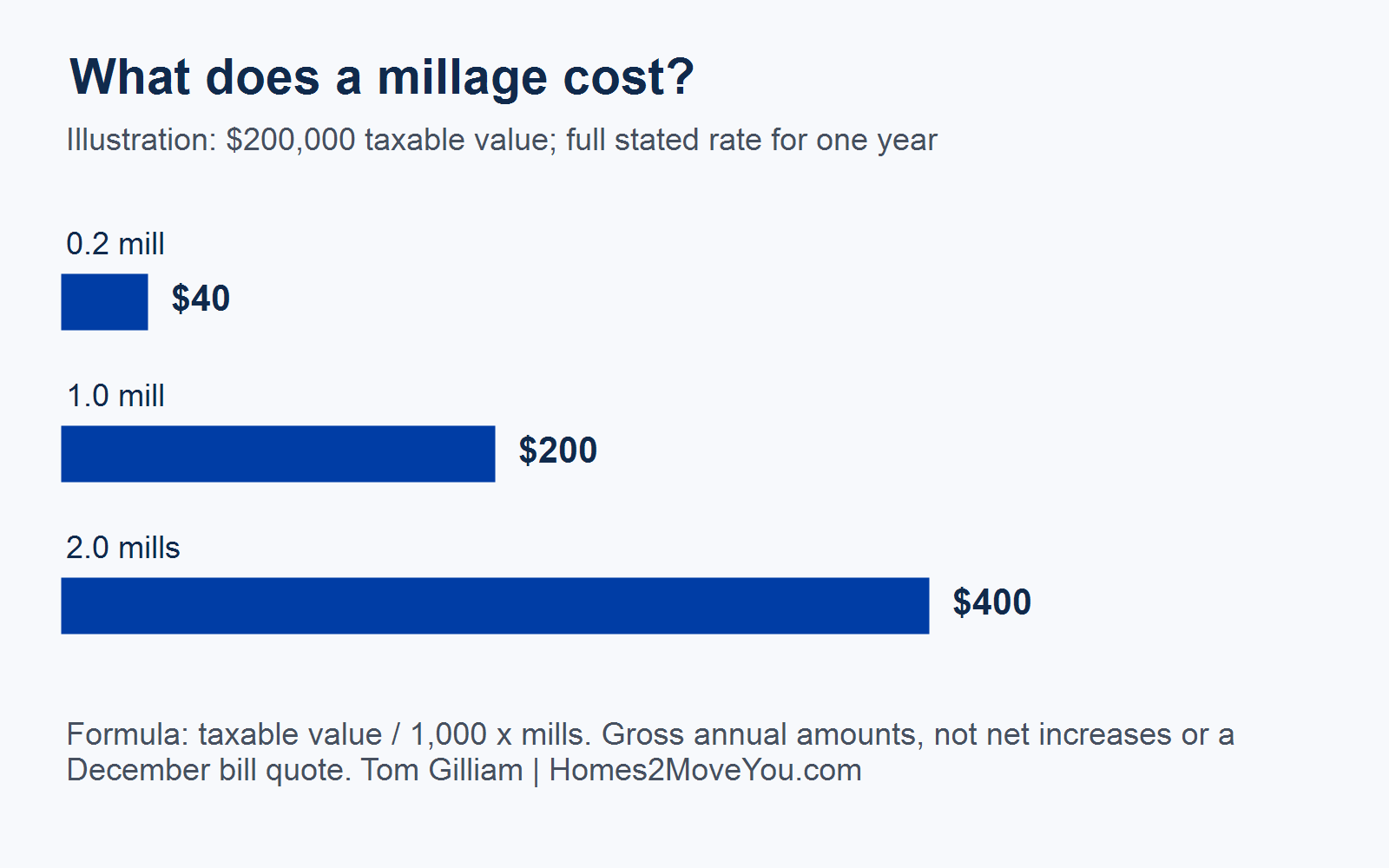
For your bill, match the printed rate to the correct tax year and collection period. A levy collected on the summer bill is not automatically charged again in winter. If a row doesn’t reconcile, ask the treasurer to explain its tax base, adjustments and rounding rather than forcing the entire bill into one multiplication.
What about the millages that passed November 3?
Oakland County’s results portal, checked November 10, still labels its results unofficial. It shows both the zoo and historical-museum proposals passing. My Oakland County millage results guide covers the broader ballot. Here, the important question is when a proposal affects your bill.
Historical museums: a new 0.2-mill authorization
The new Southeast Michigan Public Historical Museum Authority levy is distinct from the existing DIA levy. At a full 0.2 mill, the annual arithmetic is $20 per $100,000 of taxable value, or $40 at $200,000. The published proposal identifies 2026 as the first collection year. Ask your treasurer whether and how it appears on your actual 2026 winter bill; approval alone does not verify a particular parcel’s posted charge.
Detroit Zoo: renewal and restoration beginning in 2028
The authorization totals 0.10 mill for 2028–2037, including a 0.0927-mill renewal and 0.0073-mill restoration. This November vote does not make the full 0.10 mill a new December 2026 increase. Read the rate against the levy it continues. The City of Novi’s official election notice publishes the ballot language.
Novi capital improvements: renewal starts July 2027
Novi confirms its capital-improvement millage was renewed for ten years beginning July 2027 at the stated 1-mill rate. It replaces an expiring authorization. Compare actual rates and taxable values before calling the gross $200 cost on a $200,000 taxable value a $200 increase.
School bonds need the same care. Farmington Public Schools reports that its 2026 bond proposal passed without an increase to its current millage rate. That describes the proposal’s rate effect; it does not freeze an individual household’s dollar bill. Taxable value, other levies and exemptions can still change. Your school district is determined by the parcel, not simply its mailing-city name.
The homestead or PRE line does not mean “no school taxes”
Michigan Treasury explains that a qualifying Principal Residence Exemption exempts the residence from local school operating millage, up to 18 mills. It does not eliminate school debt millage, the State Education Tax or every other property-tax charge. It is also different from the Homestead Property Tax Credit claimed through a state income-tax return.
If your bill says 100% PRE and still includes school-related lines, that is not automatically a mistake. Ask which lines are exempt and which remain payable. If it says 0% when you believe you qualify, ask the assessor to check the affidavit, occupancy and effective date. Don’t assume an exemption transfers to you just because the seller had one.
Treasury’s claim requirements describe the June 1 and November 1 filing framework. A valid qualifying filing from June 2 through November 1 can begin reducing that year’s taxes with the winter levy. If you missed a date or discover an error, ask the assessor what correction process and evidence apply to your situation. For more context, see my Michigan PRE guide.
Why a first-year buyer can see a much larger tax bill
A seller who owned the home for many years may have a taxable value far below its SEV. After a qualifying transfer, that accumulated difference can disappear. Michigan Treasury says taxable value uncaps in the calendar year following the transfer; statutory exceptions apply.
Timing example: an ordinary nonexempt purchase closing in December 2026 generally leads to uncapping in 2027. A closing in January 2027 generally leads to uncapping in 2028. A buyer who closed during 2025 may already be seeing the effect in the 2026 tax year. “My first winter bill” and “the first tax year after transfer” are not always the same moment.
Also, don’t automatically substitute half the purchase price for the assessor’s next SEV. Treasury’s basic assessing guidance distinguishes the assessment process from simply resetting a parcel to half its sale price. Get a property-specific estimate from the assessor.
A worked buyer example—not an actual local property
Assume a seller’s taxable value is $110,000, and the buyer’s taxable value becomes $200,000 after uncapping. Hold the combined annual applicable rate at a hypothetical 35 mills and keep exemptions unchanged:
- Seller’s illustration: $110,000 ÷ 1,000 × 35 = $3,850 a year.
- Buyer’s illustration: $200,000 ÷ 1,000 × 35 = $7,000 a year.
- Difference: $3,150 a year, or $262.50 a month for budgeting.
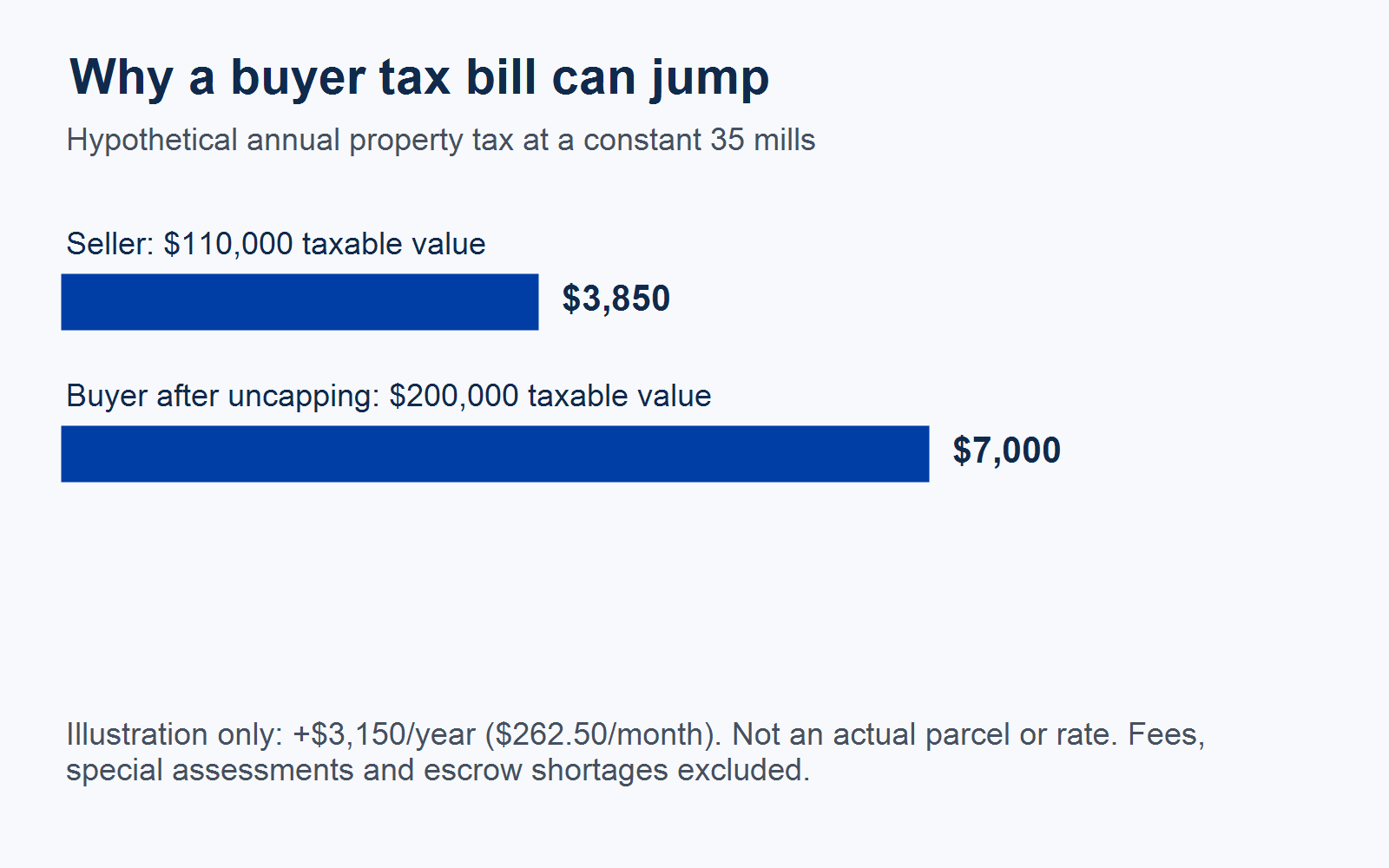
This example excludes special assessments, fees and mortgage escrow adjustments. The increase occurs even without a new millage. That is why a listing’s historical tax number should start a question, not finish your ownership-cost budget. Use the state property-tax estimator for planning, then confirm the assumptions locally.
Your mortgage payment can change even with a fixed interest rate
Property taxes and your mortgage’s principal-and-interest payment are separate pieces of the monthly total. The Consumer Financial Protection Bureau explains that changes in taxes or insurance can change an escrow-funded payment. A higher annual tax bill can increase the amount collected for future taxes, and an existing escrow shortage may require separate repayment under the applicable rules.
Ask your servicer for the annual escrow analysis. Have them separate the future tax estimate, insurance estimate, any cushion and any shortage repayment. Paying an old shortage does not necessarily remove the need to fund a higher future bill. Check that the tax payment was actually made; receiving a bill and having an escrow account are not proof of payment.
Your winter-bill review checklist
- Match the parcel. Confirm address, parcel number, tax year and winter season.
- Find the deadline. Note the amount due and the date added charges begin.
- Compare the tax base. Put this year’s taxable value beside last year’s and check whether ownership changed.
- Check PRE. Ask about the recorded percentage and effective date if anything looks wrong.
- Compare rows. Separate new rates, renewals, debt, special assessments and old balances.
- Check both seasons. Build an annual total from the appropriate summer and winter records.
- Verify the payer. Confirm your own payment plan or your servicer’s disbursement.
- Ask early. Request the correct review or appeal route and deadline for the specific issue.
Take a focused question to the right office: the assessor handles valuation and PRE questions; the treasurer explains billing and payments; the mortgage servicer explains escrow. A rate question may also require the taxing authority’s levy record. Start with the contact information printed on your bill. Don’t assume an inquiry pauses a payment or appeal deadline.
Tom’s Take: budget for the home you are buying
My advice is to slow down long enough to understand the tax line before you fall in love with a monthly payment. I’d rather see a buyer ask one more question now than build a budget around a seller’s old number.
For current homeowners, a higher bill deserves a line-by-line explanation before you blame one election result. For sellers, keeping both tax bills and the assessment notice handy makes the conversation clearer. I can help you organize those records and compare homes. Your assessor, treasurer, lender and tax adviser confirm the figures and rules that apply to you.
Michigan winter tax bill questions and answers
Are Michigan winter property taxes due December 1?
December 1 is the winter levy’s due-and-payable date. Your penalty-free payment deadline can be later. Follow the dates and payment instructions on your municipality’s current bill.
Do I calculate my winter tax bill from market value or taxable value?
Ordinary millage calculations use taxable value: divide it by 1,000 and multiply by the applicable mills. Special assessments, fees and balances may require separate calculations.
Does 100% PRE mean I owe no property tax?
No. A qualifying PRE exempts local school operating millage up to 18 mills. Other applicable taxes and charges can remain payable.
Why are my property taxes higher than the previous owner’s?
A nonexempt ownership transfer generally uncaps taxable value in the next calendar year. Different exemptions, rates or charges can also change the bill. Ask the assessor for your parcel’s explanation.
Will every November 2026 millage approval appear on my December bill?
No. Each proposal has its own levy schedule. Novi’s capital-improvement renewal begins July 2027, and the zoo renewal and restoration covers 2028–2037. Confirm collection timing for your parcel with the treasurer.
Does a home purchase automatically set taxable value at half the sale price?
No. The assessor determines values through the assessment process. After a qualifying transfer, taxable value generally uncaps to the following year’s SEV; it is not automatically half your purchase price.
Should I pay the bill if my mortgage company has an escrow account?
First verify with your servicer who will pay, the amount and the disbursement date. Check the tax payment record so you avoid a missed payment or duplicate payment.
Who should I contact about a mistake on my winter tax bill?
Contact the assessor about valuation and PRE, the treasurer about billing and payment, and your mortgage servicer about escrow. Ask which correction or appeal process and deadline apply; don’t assume an inquiry extends a deadline.
Planning a move in Oakland County?
If you are weighing homes in Farmington Hills, Novi, Northville, West Bloomfield or another Oakland County community, I can help put the property, price and ownership-cost questions together. Read my before-you-offer cost checklist, then contact Tom Gilliam at RE/MAX Classic or call 248-790-5594.
This guide is general real estate education, not an individual tax determination, appraisal or legal opinion. Examples are hypothetical. Confirm current parcel records, levy schedules, eligibility and deadlines with the appropriate officials and advisers. Election results referenced here were labeled unofficial when checked November 10, 2026.