




Oakland County Market Update · October 2026 Results
More competition, a higher median and slower sales can all show up in the same report. Here’s what those numbers mean when you’re deciding how to price your own home.
By Tom Gilliam, REALTOR® · RE/MAX Classic · Prepared November 13, 2026
Watch: Price cuts and higher sale prices explained
Here’s my 87-second overview of the numbers and the questions I would ask before changing a home’s price.
Watch the explainer on YouTube. This video uses Tom Gilliam’s authorized AI avatar and voice. The example prices are hypothetical, not actual sales or a valuation.
What Oakland County’s October housing numbers actually say
If you’ve noticed more price-change notifications while reading that home prices are up, the confusion is understandable. An asking price is visible. You can watch it change on a listing. A county median is a summary of completed transactions, usually reported after the month ends.
In Realcomp’s October 2026 summary, Oakland County’s combined residential-and-condo median closed-sale price was $374,825, compared with $360,000 in October 2025. That’s a 4.1% increase. Ending inventory was 4,250 properties, up from 3,266, while closed sales decreased from 1,440 to 1,205. Average days on market rose from 28 to 31. The report is current as of November 6, 2026. Source and scope below.
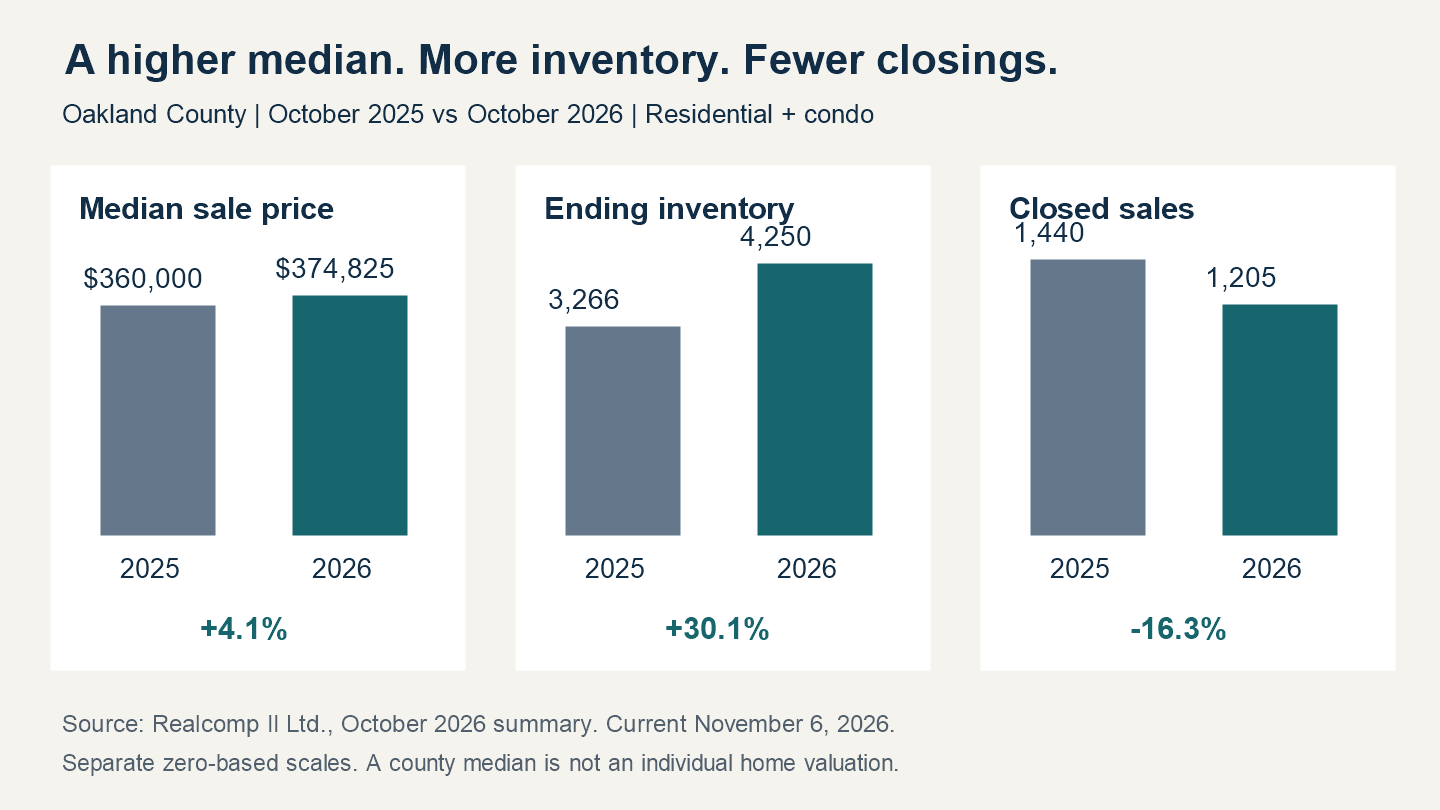
Put together, those measures describe a market where buyers had more listed properties to consider and fewer transactions closed than a year earlier. The median among the homes that closed was still higher. These county figures do not establish the price direction for an individual subdivision, price bracket or property.
They also don’t count how many Oakland County sellers reduced their asking prices. We should not treat a closed-sale report as a price-cut report. Your listing’s price history and the changes among its actual competitors deserve a separate review.
First, separate the three prices people tend to mix together
1. The original asking price
This is the price a seller chooses when the listing goes live. It reflects a strategy and an expectation. It isn’t a completed transaction, an appraisal or proof that a buyer will pay that amount.
A home listed above the range supported by relevant comparisons can need an adjustment even when the broader market has appreciated over time. The starting point may simply have been too ambitious.
2. The current asking price
This is what the seller is asking now. A reduction narrows the gap between the earlier expectation and the seller’s current position. It may follow showing feedback, a change in competition, a revised timeline or new information. The price change alone does not tell you which explanation applies.
3. The final sale price
This is the recorded price when a transaction closes. Even then, the number isn’t the seller’s net proceeds. Payoffs, transaction expenses and any agreed concessions matter to the seller’s actual outcome.
For a buyer, the purchase price is only part of the decision, too. Financing, taxes, insurance, association charges where applicable and the condition of the home affect the full ownership budget.
A price cut and a higher sale price can happen on the same home
Here’s a deliberately simple illustration. It is not a client transaction, a CMA or a prediction.
Suppose relevant comparable homes sold for about $400,000 a year ago. An owner now starts at $450,000, reduces the asking price to $425,000 and eventually closes at $415,000.
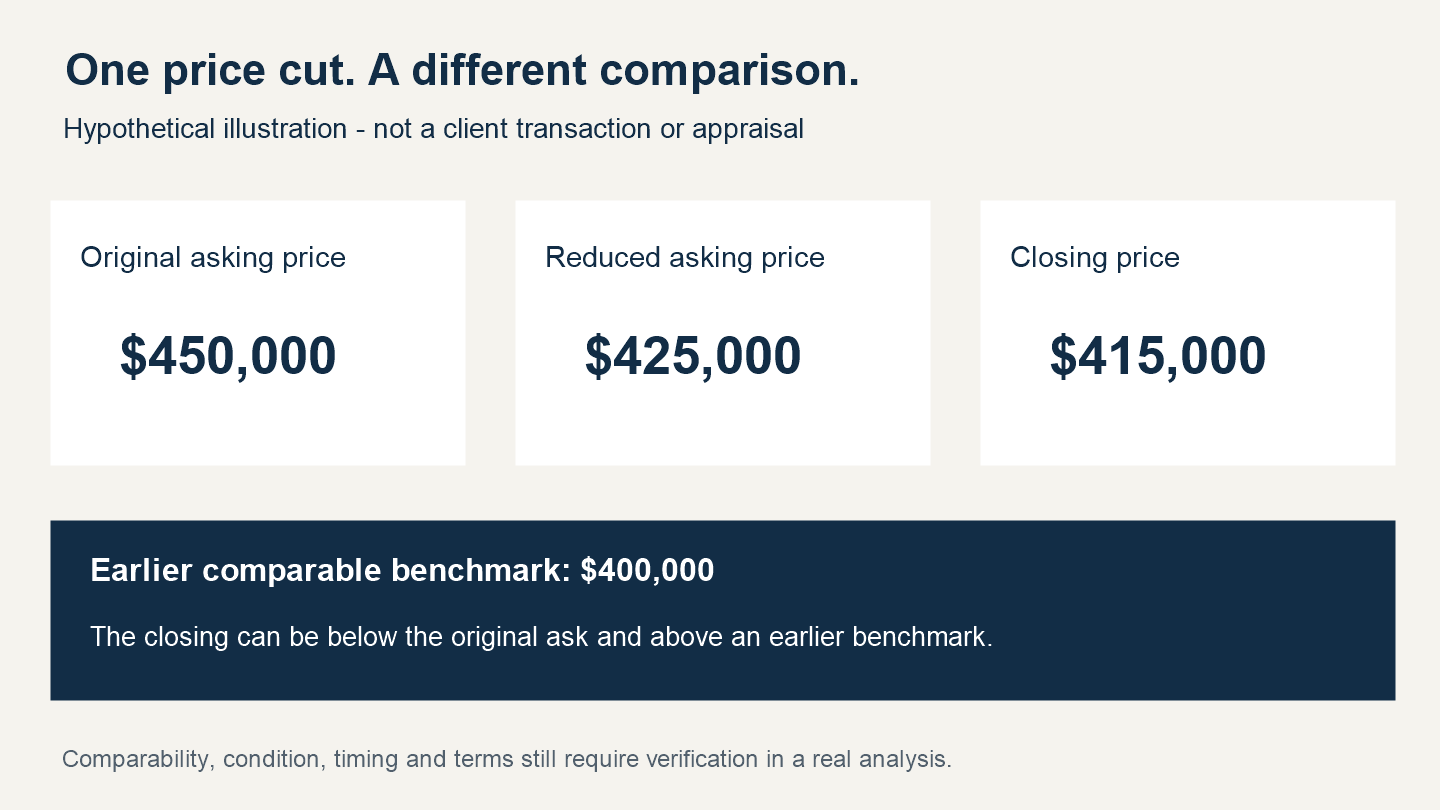
The seller reduced the asking price. The final price was also above the earlier $400,000 comparison. There is no mathematical contradiction. What we still need to know is whether those earlier homes were truly comparable and how condition, location, size, timing and terms differed.
Now change the original asking price to $420,000. A $415,000 closing would look very different in a price-history notification, even though the final sale price is identical. That’s why I wouldn’t use the presence or absence of a reduction as the entire verdict on a pricing strategy.
A higher median does not mean your home appreciated by the same percentage
The median is the middle sale price when completed sales are arranged from lowest to highest. It is useful context, but it does not track the same individual houses being sold twice.
Consider another small hypothetical example. Five homes sell for $250,000, $300,000, $350,000, $500,000 and $650,000. The median is $350,000. In another period, a different group sells for $275,000, $325,000, $400,000, $550,000 and $700,000. The median becomes $400,000.
That change doesn’t show that every house in the neighborhood gained $50,000. The groups may contain different sizes, locations, conditions or property types. The mix of transactions matters.
The same caution applies to countywide reports. Oakland County includes many distinct markets. A Farmington Hills colonial, a Novi condo and a West Bloomfield lakefront property do not become direct substitutes because they appear in the same county total.
Why a market can feel softer even when the annual median is higher
A homeowner can be right that the market feels more competitive without being right that every property is worth less. Buyers choose among the homes available to them now. They don’t negotiate against the county’s median in the abstract.
Imagine your listing was the only suitable option in its price range. A buyer had limited alternatives. Now imagine several similar homes are available, with different layouts, updates and terms. The buyer can compare more carefully. That does not automatically set a lower value for yours, but it makes the explanation behind your price more important.
It also makes presentation useful in a practical way. Buyers need to understand the layout, the condition, what is included and which spaces are above or below grade. Good marketing should help them evaluate the property accurately. It cannot guarantee that they will accept the asking price.
Longer average selling time deserves the same restraint. Thirty-one days is an average among the report’s observations, not a deadline after which every home is overpriced. A particular listing may need attention sooner; another may have a reasonable explanation for a longer marketing period.
What I would check before recommending a price adjustment
I’d start with the home’s actual alternatives. A county report helps set the conversation. A property-specific comparison helps us decide what to do.
Which closed sales are genuinely comparable?
We would compare relevant location, property type, above-grade area, layout, lot characteristics, condition and timing. Finished basement space belongs in the discussion, but it should be identified separately. A larger total finished-area figure can hide an important difference between homes.
When the information is available, I also want to understand concessions and unusual transaction circumstances. Two equal sale prices do not necessarily represent equal terms.
What can a buyer choose instead today?
Active listings reveal the current competition, not the prices buyers have already agreed to pay. We should still examine them carefully. A newly listed, similarly priced home with a different condition or feature set can change the choices facing your buyer.
Pending listings can provide additional context, but the eventual closing price and terms may not yet be available. We shouldn’t fill those gaps with assumptions.
What does the showing feedback actually say?
Few showings, showings without offers and offers that repeatedly fall below the asking price are different patterns. I’d review price, photos, access, condition and the competitive set together before choosing a response.
Online views alone are incomplete feedback. People may save a home for many reasons. A high view count does not establish qualified demand, and a quiet week does not prove a permanent lack of interest.
What outcome matters most to this seller?
Timing, carrying costs, preparation work and the next move affect the decision. A price adjustment may be one option. Improving information, changing access, completing a sensible repair or offering appropriate terms may also deserve consideration.
I would explain the trade-offs rather than promise that one change will produce an offer. For a broader planning conversation, see selling now versus waiting until spring.
A price reduction and a buyer credit are different tools
A lower purchase price and a seller-paid credit should not be presented as interchangeable. A credit’s permitted use and amount depend on the financing program, lender and transaction. A buyer may have a cash-to-close concern that a small price reduction doesn’t address in the same way.
Before advertising or accepting a proposed credit, the buyer should confirm it with the lender and the parties should document the actual agreement. On the seller’s side, compare estimated net proceeds under each option rather than judging only the headline price.
The useful question is: what problem are we trying to solve? A strategy works better when it addresses the buyer’s real obstacle and the seller’s priorities, within the transaction’s rules.
What buyers should take from a price-reduced listing
A reduction is a reason to look again, not proof of a bargain or a defect. Review the home, its history, the current alternatives and any information explaining the change. Ask questions without assigning a motive to the seller.
More choice can make comparison easier, but it doesn’t eliminate competition for a particular property. Write an offer around your budget, the home’s condition and relevant evidence. Keep the protections and deadlines in your actual agreement clear.
If inspections identify an issue, specialist advice and the contract matter more than a price-change label. Our after-inspection guide explains the next questions to work through.
Five questions to bring to your next pricing conversation
- Which recent closed sales are the closest comparisons, and where do they differ?
- Which active listings compete with our home at the current asking price?
- What has changed since we set the price?
- What do the showing feedback and actual offers tell us?
- What are the estimated proceeds and practical trade-offs under each option?
Those questions are useful whether you’re preparing to list or reviewing a home already on the market. They keep the conversation grounded in your property rather than a headline.
Questions about Oakland County prices and price reductions
Are Oakland County home prices up or down?
Realcomp’s combined residential-and-condo median sale price was higher in October 2026 than in October 2025. That is a countywide monthly comparison, not proof that every home appreciated. The answer for a specific home requires comparable sales and current competition.
How can asking prices fall while the median sale price rises?
An asking-price reduction changes what a seller requests. The median summarizes completed sales. A home can sell below its original asking price while still selling above an earlier comparable benchmark. A different mix of homes selling can also change the median.
Does a price reduction mean the home has a problem?
No. A reduction alone does not establish a defect, a seller’s motivation or a bargain. Review the property, price history, disclosures, inspections and comparable options before deciding what it means.
Should I reduce my price if other sellers are reducing theirs?
Not automatically. Compare your home with relevant closed sales and active competition, review showing feedback and consider your timeline and estimated proceeds. A recommendation should explain why an adjustment—or holding the price—fits the evidence.
Is Oakland County now a buyer’s market?
The October figures show more listed inventory, fewer closings and longer average selling time than a year earlier. They do not establish identical negotiating conditions across every property type, neighborhood and price range. Assess the specific homes a buyer can choose among.
Should I use the county median to price my Farmington Hills home?
Use it as context, not a valuation. A Farmington Hills pricing analysis should compare relevant properties, condition, location, layout, above-grade and basement area, timing and available terms. County figures cannot substitute for that work.
Want to see where your home fits?
If you’re considering selling in Farmington Hills or a nearby Oakland County community, we can review your competition, preparation priorities and estimated proceeds before choosing a price.
Request a personal selling plan
Tom Gilliam · RE/MAX Classic
248-790-5594 · Contact Tom
Sources and data notes
Realcomp II Ltd., October 2026 Housing Market Report and Listing and Sales Summary, current as of November 6, 2026. Oakland County statistics here combine residential and condo categories. They are not a Residential-only series, a Detroit-metro series or a forecast. Inventory is an ending count; sales are closings during the month. The example prices and five-sale median illustration are hypothetical.
The price-cut frequency for Oakland County is not established by this report. No individual property appreciation rate, promised discount or guaranteed sale time is implied.
This statistical information has been obtained from Realcomp II Ltd., the REALTOR’S® MLS. Although not guaranteed, these statistics are derived from data believed to be reliable. This information is not to be reproduced, redistributed, or combined with data from other sources without expressed permission from Realcomp. See Realcomp’s statistical-use terms.